 Society

HIIVE by fusion brings business and golf closer in Bình Dương
1.
|
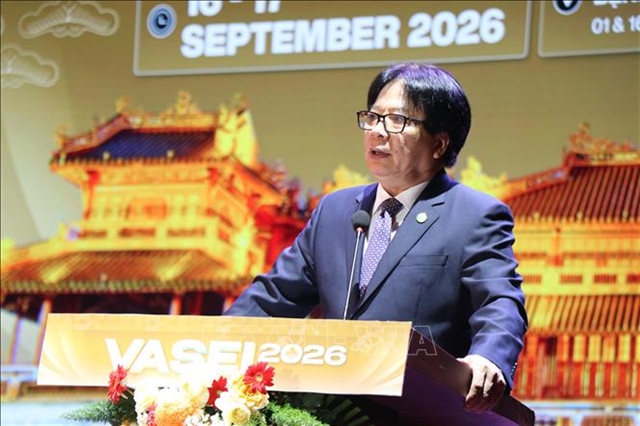
| Professor Trần Bình Giang, chairman of the Việt Nam Association for Surgery and Endolaparosurgery, gives a speech at the conference. — VNA/VNS Photo Mai Trang |
HUẾ — Delegates discussed both traditional surgical fields and advanced new techniques such as robotic surgery, 3D image-guided endolaparosurgery and minimally invasive interventions during a medical technology workshop on Thursday.
The event was organised by the Huế Central Hospital, in cooperation with the Việt Nam Association for Surgery and Endolaparosurgery (VASEL).
With the theme 'Technological Innovation: Integrating AI to Advance Endolaparosurgery', the 2026 National Scientific Conference on Surgery and Endolaparosurgery brought together more than 700 delegates from Việt Nam and abroad.
VASEL Chairman and Professor Trần Bình Giang said topics presented at the conference provided a comprehensive overview of the current key areas of surgery.
This demonstrates the strong development of surgery in Việt Nam while confirming the ability of the country’s surgical teams to master advanced techniques, he said.
Giang expressed his hope that the conference would help further promote scientific research, training, technology transfer and international cooperation, helping to improve the quality of surgical treatment in Việt Nam.
At the same time, he said Vietnamese surgeons should strengthen their contributions to the development of surgery in the Asia-Pacific region and worldwide.
Surgery and endoscopic surgery are among the fields that have always received significant investment and continuous innovation in Vietnamese medicine.
From basic endoscopic techniques, endolaparosurgery has developed rapidly, now encompassing minimally invasive procedures, advanced laparoscopic surgery, robotic surgery, image-guided surgery and many other modern technologies.
As artificial intelligence (AI) is increasingly applied in medicine, it must be noted that AI does not replace surgeons, according to Giang.
Technology only delivers real value when it is appropriately integrated with clinical knowledge and experience, technical expertise and medical ethics.
The conference served as a forum for experts and healthcare professionals to exchange experience and update their knowledge of the latest advances in modern surgery.
It also promoted the clinical application of advanced techniques, AI, robotics and digital technologies. In doing so, the conference was expected to help meet the urgent need for access to advanced techniques in surgery and endolaparosurgery, while improving the quality of treatment for patients.
The event featured numerous presentations from specialists at hospitals focusing on surgery, obstetrics and gynaecology, oncology and paediatrics, public and private general hospitals, and surgical residents, postgraduate trainees and specialist nurses, as well as experts from countries and territories with advanced medical systems, including Japan, China, India and Taiwan (China).
More than 260 presentations covering a wide range of topics were selected for delivery in person across nine conference halls and one video session.
Notable presentations included the application of robotic surgery in gastrointestinal, urological, obstetric and gynaecological and thoracic diseases; the application of AI to support clinical decision-making, medical literature analysis and surgical navigation; and 3D modelling and printing techniques to plan surgery for complex abdominal tumours and orthopaedic trauma conditions.
Professor Phạm Như Hiệp, director of the Huế Central Hospital and VASEL deputy chairman, said that after more than 130 years of development, the hospital has upheld its position as one of the country’s largest surgical centres and has introduced many leading treatment techniques.
Endolaparosurgery and interventional endoscopy are among the hospital’s prominent areas of expertise. The hospital achieved a milestone by becoming the first in Việt Nam, as well as one of the first in the world, to perform single-incision laparoscopic surgery and natural orifice transluminal endoscopic surgery. Since the early 2010s, Huế Central Hospital’s endolaparosurgery techniques have also been transferred to surgeons in Malaysia, Indonesia, the Philippines, Singapore and Thailand.
During the conference, several cooperation agreements were signed between VASEL, Huế Central Hospital, Việt Đức University Hospital, the Indian Association of Gastrointestinal Endoscopic Surgeons and the Asian Centre for Endoscopic and Robotic Surgery Training.
These agreements are expected to open up breakthrough development opportunities in surgery, laparoscopic surgery and robotic surgery in Việt Nam. — VNS
Society
 Society
 Society
 Society
 Society
 Society
 Society
 Society
 Society
 Society
 Society
 Society
 Society
 Society
 Society