 Society
Data centre market faces energy challenges
1.
|
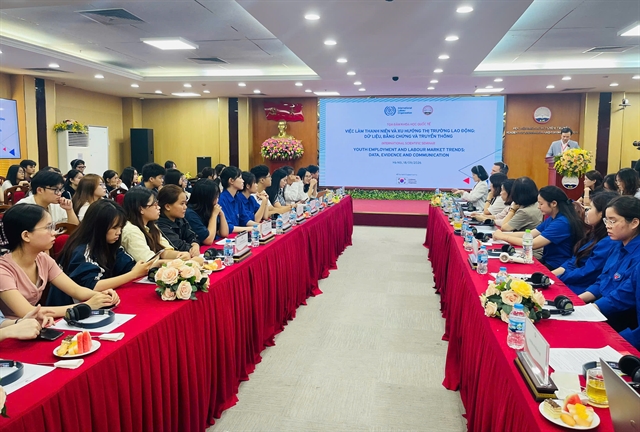
| The event brings together labour market experts, journalists, communication professionals, lecturers and students.— VNS Photo Thu Trang |
HÀ NỘI — Young people are entering the labour market at a time of profound transformation. Digitalisation and artificial intelligence, the green transition, demographic shifts and the reconfiguration of global supply chains are reshaping labour demand, skills requirements and employment opportunities.
This was the central discussion of a knowledge-sharing event on “Youth employment and labour market trends: Data, evidence and communication”, organised in Hà Nội on Friday by the International Labour Organisation (ILO) Country Office for Việt Nam, with the support of the ILO–Korea Partnership Programme, and the Academy of Journalism and Communication.
It brought together labour market experts from the Ministry of Home Affairs (MoHA), the National Statistics Office (NSO), ILO specialists, journalists, communication professionals, lecturers and students.
Delegates at the workshop showed that the challenge was no longer only whether young people can find jobs, but whether they can access productive and decent work and navigate increasingly complex labour market transitions.
Inclusive labour market
Discussions established a shared evidence base extending well beyond the unemployment rate.
According to the NSO, the unemployment rate among young people aged 15–24 in Việt Nam reached 8.67 per cent in the second quarter this year, almost four times the unemployment rate for the working-age population.
Among employed youth, however, informal employment accounted for 57.5 per cent of total youth employment in 2024, while only 41.4 per cent participated in social insurance schemes.
These figures highlight persistent decent work deficits and suggest that many young workers continue to enter jobs characterised by limited protection, weaker prospects for skills development and career progression, and greater vulnerability to economic shocks.
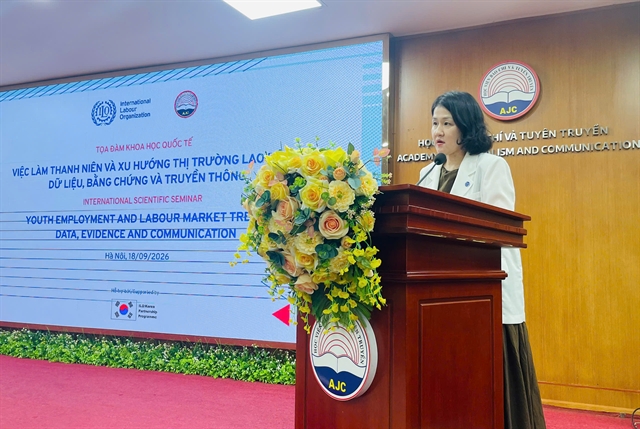
Sinwon Park, ILO Country Director for Việt Nam, said, “At the ILO, we believe that investing in young people is investing in the future. When young people have access to decent work, opportunities to develop their skills and equal and fair chance to realise their potential, the benefits extend well beyond individuals. They contribute to stronger enterprises, more inclusive labour markets and more sustainable development.”
Young women and men are often among the first to be affected by labour market change, which is why youth employment remains a priority for the ILO and their partners.
“At its core, youth employment is about supporting successful transitions from school to work,” she said.
|
| Sinwon Park, ILO Country Director for Việt Nam, speaks at the workshop. — VNS Photo Thu Trang |
Evidence shows that early labour market experiences matter. “Access to education and training, career guidance and work experience can improve young people’s long-term prospects, while prolonged unemployment or unstable work can have lasting consequences,” said Sinwon.
“Experience from around the world also tells us that there is no single solution to youth employment challenges,” she said.
Effective responses require a combination of skills development, employment services, labour market information, social protection and job-rich economic growth. They also require strong collaboration and coordination among governments, employers, workers, education institutions and other stakeholders.
“Good policies and programmes depend on good evidence. Understanding labour market trends, identifying emerging opportunities and assessing what works all require reliable data and careful analysis,” said Sinwon.
Participants also examined the concept of young people not in employment, education or training (NEET), which captures a broader group than unemployment statistics alone.
According to the NSO, an estimated 1.4 million young people in Việt Nam were NEET in the second quarter this year.
Globally, the figure stands at some 257 million, or 20 per cent of the world's youth population, more than two-thirds of them young women, according to the ILO’s Global Employment Trends for Youth 2026 report.
The green transition illustrates what is at stake. Research by the ILO and the Institute of State Organisational and Labour Sciences under the MoHA, titled “Assessment on green jobs and career development support for youth in Việt Nam” shows that only around 3 per cent of young people in Việt Nam are currently employed in green jobs, while more than 30 per cent of youth employment has the potential to become green.
There is no single measure to address youth employment challenges.
Skills development is essential but not sufficient; economic growth is necessary but does not automatically generate decent work for young people, according to the ILO.
The ILO's integrated approach combines employment-centred economic policies, career guidance, skills development, work-based learning, employment services, labour market information systems, enterprise support, social protection, gender equality and social dialogue.
Important role
The event also underlined the role of journalists, communication professionals and educators in enhancing public understanding and contributing to more balanced narratives about the opportunities and challenges facing young people.
|
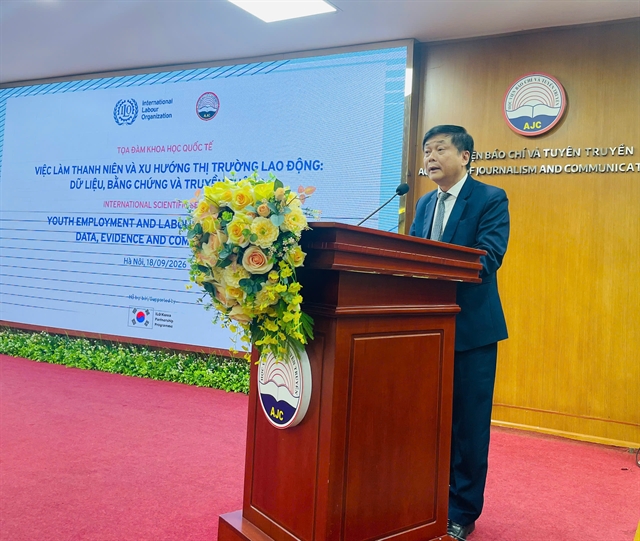
| Assoc. Prof. Phạm Minh Sơn, director of the Academy of Journalism and Communication, gives a speech at the event. — VNS Photo Thu Trang |
Assoc. Prof. Phạm Minh Sơn, director of the Academy of Journalism and Communication, said, "Journalism on the labour market shapes how society understands the opportunities and risks facing young people. Equipping our students and our media partners to work confidently with labour market data is part of the academy's responsibility to the profession."
Sinwon Park, ILO Country Director for Việt Nam affirmed journalists, communication professionals and educators played an important role.
“By communicating labour market information accurately and responsibly, they help improve public understanding, inform policy discussions and support better decision-making,” she said. — VNS
Society
 Society
 Society
 Society
 Society
 Society
 Society
 Society
 Society
 Society
 Society
 Society
 Society
 Society
 Society