 Society

Drive to Great: BAIC FOTON Africa Partners Conference Set to Open
1.
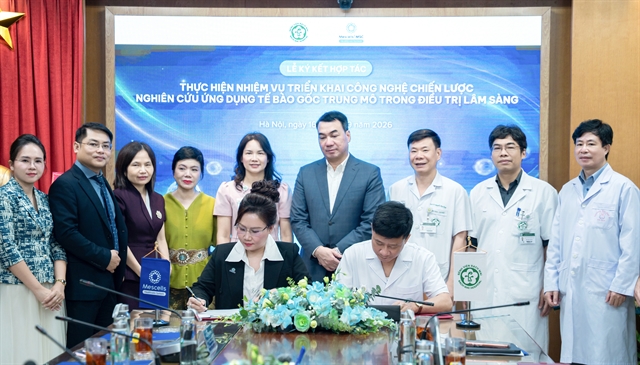 |
| Associate Professor Dr Nguyễn Tuấn Tùng, deputy director of Bạch Mai Hospital, and Mescells Chairwoman Nguyễn Thị Thu Hiền sign the cooperation agreement. — Photos courtesy of the organiser |
HÀ NỘI — Bạch Mai General Hospital and Mescells Healthcare System signed a comprehensive cooperation agreement to research the application of mesenchymal stem cells in clinical treatment on September 16.
This cooperation aims to research the clinical application of mesenchymal stem cells, in line with the Prime Minister's Decision 1131/QĐ-TTg regarding national key technology groups.
By combining exceptional clinical expertise with an advanced cell technology platform, the initiative aims to establish a deep public-private partnership model in regenerative medicine and cell therapy in Việt Nam.
At the signing ceremony, Dr Nguyễn Ngô Quang, director of the Ministry of Health's Department of Science, Technology and Training, said that cell technology is currently one of three strategic technologies outlined by Prime Minister Lê Minh Hưng for implementation and aimed at developing safe and effective products and techniques for treating patients.
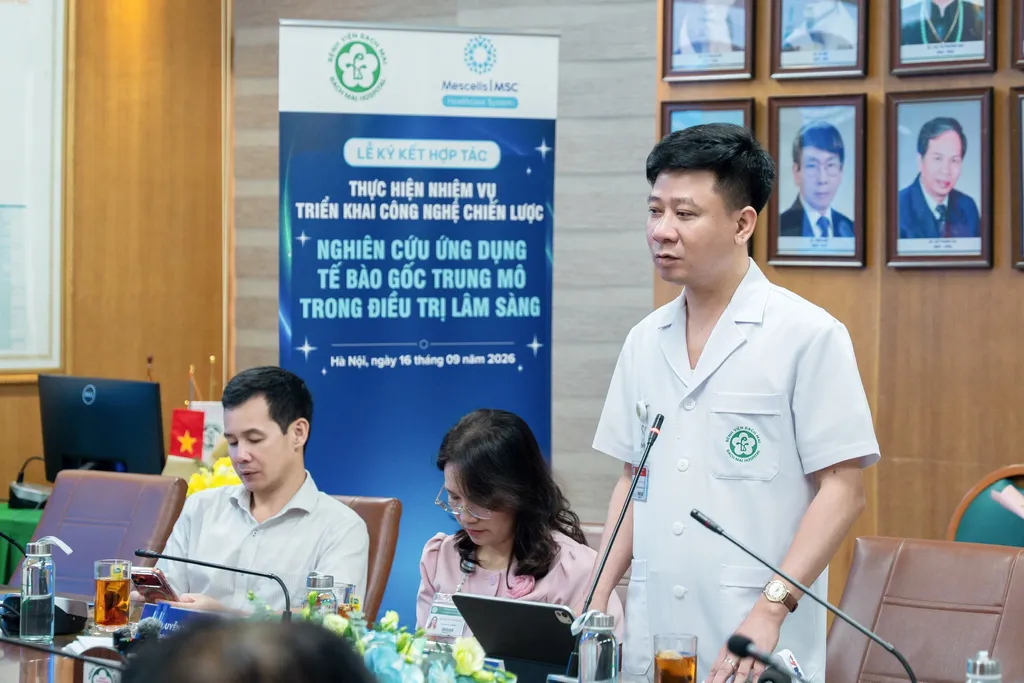 |
| Associate Professor Dr Nguyễn Tuấn Tùng, deputy director of Bạch Mai Hospital, speaks at the event. — Photos courtesy of the organiser |
Under the framework of the agreement, the two organisations aim to achieve key objectives, including collaboration on scientific research and development of cell-based products. The two parties will support each other in the development and commercialisation of biomedical products resulting from joint research, in accordance with legal regulations.
They will also collaborate in organising continuing education programmes and specialised scientific conferences to update knowledge and enhance professional expertise in the fields of regenerative medicine and modern medicine.
Both parties will also work together on the application and development of technical expertise, coordinate the implementation of professional activities and high-tech medical services, and share resources to support research and treatment efforts.
“Alongside its mission of providing top-level medical care to the public, the advancement of science and technology, training and scientific research constitute three pillars that Bạch Mai Hospital consistently pursues and develops in tandem. This integrated approach aims ultimately to enable patients to access cell-based services and technologies during their treatment,” said Associate Professor Dr Nguyễn Tuấn Tùng, deputy director of Bạch Mai Hospital.
 |
| Mescells Chairwoman Nguyễn Thị Thu Hiền speaks at the event. — Photos courtesy of the organiser |
“One of the areas we are particularly interested in is the research and application of cell technology in liver diseases, especially cirrhosis. This is a field where cell therapy is opening up new approach directions in regenerative medicine,” Mescells Chairwoman Nguyễn Thị Thu Hiền said.
Hiền said she hopes that the cooperation with Bạch Mai Hospital will not stop at research or clinical trials, but will move towards technology transfer and capacity building, integrating cell technology techniques and products into routine clinical practice once all scientific, safety and legal requirements have been fully met.
The collaboration between the Mescells Healthcare System and Bạch Mai Hospital on the application of mesenchymal stem cells for treating liver cirrhosis is highly significant. The successful implementation of this research project will provide a new therapeutic method for the treatment of liver cirrhosis, according to Hiền.
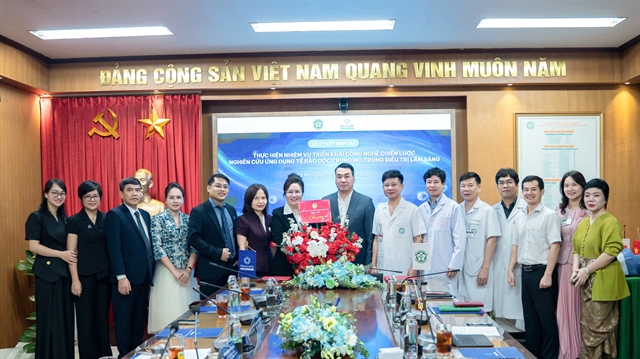 |
| Delegates attend the agreement signing ceremony. — Photos courtesy of the organiser |
Liver cirrhosis and musculoskeletal disorders are chronic conditions that require new medical treatment solutions. Recent global research has yielded promising results regarding the use of stem cell therapy to treat these conditions.
According to statistics from the World Health Organization, the prevalence of cirrhosis in Việt Nam is approximately 5 per cent of the population. This is a relatively high rate, closely linked to the prevalence of hepatitis B (affecting 10–20 per cent of the population) and hepatitis C (approximately 3.6 per cent), as well as alcohol-related causes.
Mescells is a medical system specialising in regenerative medicine and cell therapy in Việt Nam, featuring a closed-loop ecosystem that encompasses research, training, manufacturing and clinical application.
Mescells’ ecosystem includes the Mescells Institute for Applied Cell Technology; the Mescells Tissue Bank; the MSC Clinic System; and the Mescells Training Centre. — VNS
Society
 Society
.jpg) Society
Society
 Society
 Society
 Society
 Society
 Society
 Society
 Society
 Society
 Society
 Society
 Society
 Society