 Society

Drive to Great: BAIC FOTON Africa Partners Conference Set to Open
1.
|
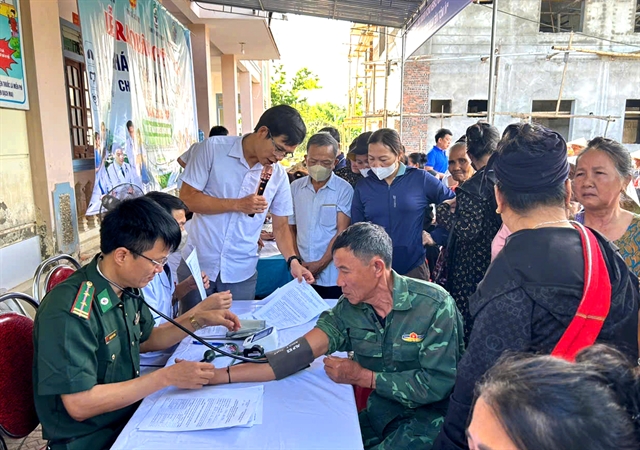
| Residents in remote areas receive free medical examinations and medicines through the 'Border Medicine Cabinet' model implemented by the Nghệ An Border Guard. VNA/VNS Photo Văn Tý |
NGHỆ AN — To improve access to primary healthcare in remote border areas where difficult terrain and economic hardship limit residents’ access to medical services, the Nghệ An Border Guard Command has established medicine cabinets and basic healthcare points in areas with high poverty rates and poor transport links.
Military medical officers at border guard posts provide basic examinations and medicines while also raising public awareness of disease prevention, environmental hygiene, reproductive health and family planning.
In Anh Sơn Commune, residents of border villages previously had to travel more than 20km along forest roads to reach the commune health station. The difficult journey often discouraged them from seeking medical attention, particularly for common illnesses.
Since the ‘Border Medicine Cabinet’ model was introduced closer to residential areas, local people have had access to basic healthcare in their communities. When health problems arise, they can seek examinations, advice and free medicines from medical officers of the Phúc Sơn Border Guard Station.
Vi Thị Thân, a resident of Vều 2 Village in Anh Sơn Commune, said: “Previously, we had to travel a long way to see a doctor, so sometimes people just put up with being ill. Having the medicine cabinet and soldiers to guide us makes us feel more reassured.”
La Thị Mai, a resident of Khe Bu Village in Châu Khe Commune, said that in the past, local residents often bought medicines themselves or relied on traditional herbal remedies when they fell ill. The long distance to medical facilities also discouraged many from seeking treatment.
“Now that military medical officers from the Border Guard regularly provide guidance, examinations and medicines. The soldiers also remind us to take medicines properly and seek hospital treatment if the illness is serious rather than trying to treat ourselves at home,” she said.
To make the model more effective, the Châu Khe Border Guard Station does not wait for residents to seek help, but proactively sends medical officers into the villages. During community outreach visits, officers and soldiers combine efforts to assess local living conditions with health education. Elderly people, those living alone and residents with limited mobility receive home visits and assistance.
|
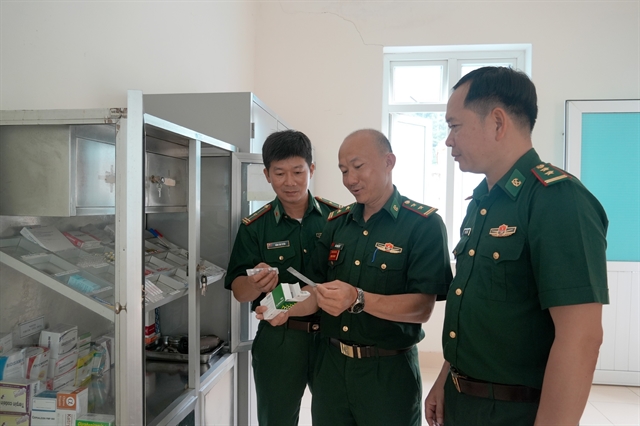
| Military medical officers stand beside a 'Border Medicine Cabinet'. VNA/VNS Photo Văn Tý |
Military medical officer at the Châu Khê Border Guard Station Major Đặng Văn Tuyến said the unit covers a large area, with villages located far from one another, making it necessary for medical officers to take healthcare services directly to residents.
Through examinations, medical officers identify common illnesses, advise residents on prevention and provide guidance on the safe use of medicines. Patients whose conditions are beyond the unit’s capacity are advised to seek treatment at higher-level medical facilities.
According to military medical personnel, common health problems among border residents include respiratory and digestive diseases, musculoskeletal conditions, high blood pressure and some seasonal illnesses.
Lieutenant Colonel Hà Ngọc Duy, deputy commander of the Châu Khê Border Guard Station, said military-civilian medical stations and ‘Border Medicine Cabinets’ in the unit’s area not only provide basic examinations and medicines, but also serve as a channel for border guards to monitor local health conditions and population movements. This information helps them work with local authorities to carry out appropriate disease prevention measures.
According to the Nghệ An Border Guard Command, the ‘Border Medicine Cabinet’ model has been introduced in several disadvantaged border areas. At one point, eight cabinets were maintained across the province, including six at military-civilian medical stations and two at working teams of the Phúc Sơn Border Guard Station and Nậm Cắn International Border Gate Border Guard Station.
Political commissar of the Nghệ An Border Guard Command Colonel Trần Quang Trung said the unit would continue reviewing areas facing difficulties and mobilising organisations, individuals and benefactors to provide medicines and other supplies, with a view to expanding the model to areas where there is demand.
Local authorities, however, say the model needs to be more closely linked with the local healthcare system in the long term. While it provides valuable support in areas facing difficult conditions, it cannot replace commune-level health stations or specialised medical facilities.
Chairman of the Anh Sơn Commune People's Committee Nguyễn Công Thắng said the ‘Border Medicine Cabinet’ has helped meet residents’ immediate need for basic medical care. In the longer term, however, appropriate mechanisms are needed to develop military-civilian medical stations, enabling people to access healthcare closer to home while fully benefiting from health insurance coverage.
Across Nghệ An’s border areas, the model demonstrates a practical approach to improving healthcare in remote communities by bringing basic services closer to residents, rather than requiring them to overcome long distances and difficult terrain to reach medical facilities.
It also reflects how border guards build public trust through practical, everyday support. Alongside border patrols, days spent in villages and efforts to safeguard border markers, they are closely involved in addressing the essential needs of local communities.
When people’s health and livelihoods receive greater attention, trust in authorities and border forces is strengthened. Residents are better able to remain in their villages and work with authorities and relevant forces to maintain security and order and safeguard national sovereignty in the country’s border areas. — VNS
Society
 Society
.jpg) Society
Society
 Society
 Society
 Society
 Society
 Society
 Society
 Society
 Society
 Society
 Society
 Society
 Society