 Society
Việt Nam promotes hot spring tourism at Algerian forum
1.
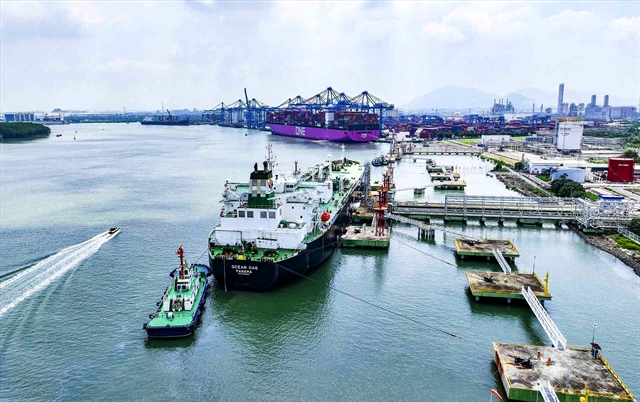 |
| A mega container vessel docks at the Gemalink terminal at the Cái Mép-Thị Vải deep-water port complex in HCM City, a key gateway for direct international shipping routes connecting southern Việt Nam with global markets. — VNA/VNS Photo |
Nguyễn Diệp
HCM CITY — HCM City is making a strategic pivot from river-oriented to sea-facing development, aligning with national ambitions set out under Resolution No. 20-NQ/TW to transform Việt Nam into a strong maritime nation and the city’s own 100-year master plan.
The shift is expected to reshape the economic landscape of the southern key economic region, turning coastal areas into a gateway to global shipping routes, anchored by deep-water ports, a free trade zone (FTZ), and eco-friendly urban hubs.
Cần Giờ, long isolated by its complex waterway network, is poised for a major transformation. The Cần Giờ International Transshipment Port project, to cost over VNĐ128 trillion (US$4.86 billion), has received in-principle approval, with investors making preparations.
By 2047, the facility is projected to handle up to 16.9 million TEUs annually.
For the project to realise its full potential, development of a hinterland connection linking Cần Giờ with the Cái Mép-Thị Vải port complex, Long Thành International Airport, and major industrial hubs across the southeastern region will be critical.
Under the new planning model, Cần Giờ and Cái Mép-Thị Vải will function as complementary components of an integrated maritime complex.
Cần Giờ will specialise in international container transshipment, while Cái Mép-Thị Vải will focus on direct import-export cargo alongside regional transshipment services.
The Cần Giờ Bridge will replace the Bình Khánh Ferry to establish a direct connection between urban HCM City, and Nhà Bè and Cần Giờ communes
Meanwhile, the proposed 14-kilometre, six-lane Cần Giờ-Vũng Tàu sea-crossing route, budgeted at VNĐ93 trillion ($3.5 billion), will bypass National Highway No 51 to connect the two port areas directly.
At the regional scale, Phước An Bridge, the Bến Lức-Long Thành Expressway, and Biên Hòa–Vũng Tàu Expressway will create an interconnected freight network spanning from the Mekong Delta through HCM City to Đồng Nai City.
In addition, natural river arteries such as the Lòng Tàu, Soài Rạp, Gò Gia, and Thị Vải rivers will serve as a waterborne distribution network to collect and transfer containers between terminals.
Over the longer term, the proposed Biên Hòa-Vũng Tàu railway will add high-capacity rail freight connections directly into the port ecosystem.
Bùi Hòa An, deputy director of the city Department of Construction, said the integrated network would fundamentally transform both port areas.
"Neither Cần Giờ nor Cái Mép-Thị Vải should be viewed as standalone assets. Once road, rail, and waterway links are fully integrated, the two areas will operate as synchronised nodes within a unified regional logistics supply chain."
Trần Quang Thắng, director of the city Institute for Economics and Management, said closer operational coordination between Cần Giờ and Cái Mép-Thị Vải would create the country’s largest deep-water port, driving down logistics costs that currently hover at 16–18 per cent of GDP.
Direct mainline container vessels calling on the port would eliminate third-country transshipment delays, shortening transit times and improving cash flows for exporters, he said.
"A strong port ecosystem must extend beyond berth capacity to encompass high-value services such as maritime finance, insurance, cold-chain logistics, and bonded warehousing."
Connecting the port complex with Long Thành International Airport and regional expressways will strengthen Việt Nam’s appeal to global corporations seeking resilient manufacturing and distribution bases, he added.
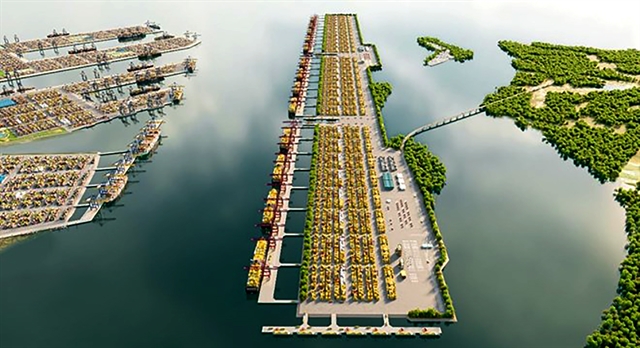 |
| A perspective of the proposed location for the construction of the Cần Giờ International Transshipment Port. — Photo Courtesy of the HCM City Department of Transport |
Pioneering institutional framework, sustainable marine economy
A vital component of the strategy is the creation of a free trade zone associated with the Cái Mép Hạ port area under a recent decision by the city government.
Thắng proposed developing the FTZ as a specialised institutional zone operating under a free port customs framework.
Under this model, goods entering the FTZ would be exempt from immediate import duties, allowing them to be stored, packaged, processed, and re-exported.
To establish a competitive free trade zone, key administrative recommendations focus on streamlining governance and modernisation.
The framework proposes establishing a single management authority with streamlined "single declaration, single inspection" customs procedures alongside a digital customs platform featuring cross-border electronic bills of lading and automated AEO Plus clearance.
It also highlights the need to set up a maritime financial centre offering documentary credit, factoring, and international reinsurance, while permitting flexible foreign-exchange transactions supported by advance tax rulings.
Furthermore, it recommends setting up an international maritime arbitration centre within the zone to effectively address commercial disputes.
Urban planning expert and architect Ngô Viết Nam Sơn described the transition to sea-oriented growth as a turning point that will alleviate congestion in central HCM City while establishing distinct regional economic roles.
"Under the expanded development space, industrial and high-tech sectors will cluster inland, maritime and energy industries will centre around port corridors, and central HCM City will concentrate on financial and high-end services."
But coastal and port development must strictly respect natural ecosystems, particularly as climate risks intensify, he said.
"Ecological governance must be the top priority in Cần Giờ.
"Port and logistics operations must be strictly zoned away from the Cần Giờ Mangrove Biosphere Reserve. Buffer zones must be safeguarded, and the core forest kept intact."
The Cần Giờ International Transshipment Port must adopt strict green-port standards, including emissions reduction targets, renewable energy usage, and closed-loop wastewater management, ensuring sustainable growth for the region, he added. — VNS
Society
 Society
 Society
 Society
 Society
 Society
 Society
 Society
 Society
 Society
 Society
 Society
 Society
 Society
 Society