 Society
Seven Vietnamese export product groups at risk of trade remedy investigations
1.
|
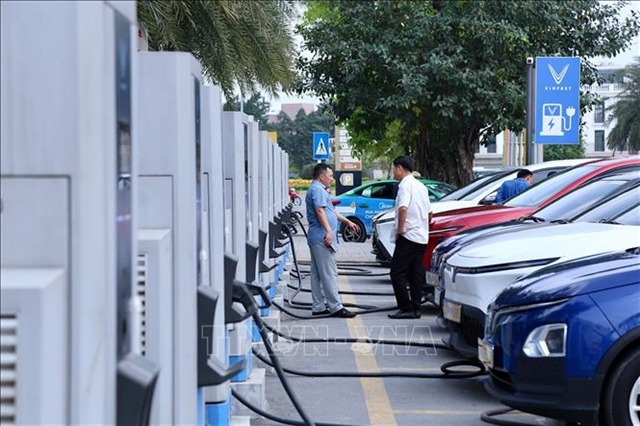
| Residents use charging stations to recharge their vehicles in a western Hà Nội urban area. — VNA/VNS Photo Hà Anh |
HÀ NỘI — The development of electric vehicle (EV) charging networks should be integrated into urban planning, linking transport, land use and urban space while ensuring adequate power supply, Assoc. Prof. Dr. Vũ Anh Tuấn from the Vietnamese-German University (VGU) has said.
The rapid growth of EVs is creating new infrastructure challenges for cities, requiring charging networks to be planned according to travel demand, power supply capacity and available urban space.
In Hà Nội, as part of a survey of infrastructure serving the transition to EVs in the Ring Road No. 1 area, Hà Nội Parking Co Ltd reviewed 150 parking sites and initially identified around 40 locations suitable for charging stations. The approach links charging infrastructure with parking facilities, traffic organisation and vehicle conversion needs.
Under its Plan No. 215/KH-UBND, the municipal People’s Committee identified 180 locations suitable for battery-swapping cabinets across the Ring Road No. 1 area. Of these, 77 are in the two core wards of Hoàn Kiếm and Cửa Nam, with two cabinets planned at each location.
Trần Minh Dũng, a resident of Hà Nội's Đại Kim area, said battery-swapping cabinets near residential areas could make EVs more convenient, especially for apartment dwellers who cannot charge at home.
Dr. Phạm Duy Hoàng, a transport expert from the United Nations Development Programme (UNDP), said public charging networks should be located according to actual demand, particularly in apartment complexes, urban areas and public facilities.
Preparing power systems, parking spaces, and cabling from the design stage would support future expansion as the number of EVs grows, while avoiding higher costs and problems related to power capacity, space, and technical safety, he noted.
In HCM City, forecasts indicate a need for about 17,000-23,000 public charging points for electric cars by 2030. More than 80 per cent are expected to be Level 2 chargers, with over 60 per cent located in residential areas. These chargers are suitable for parking lots, shopping centres and residential areas, where vehicles tend to remain parked for longer periods, while DC fast chargers are more appropriate for major transport corridors, expressways and locations requiring rapid charging.
Meanwhile, electric motorbikes pose an even larger infrastructure challenge. By 2030, HCM City is forecast to need about 13,000-15,000 battery-swapping cabinets and 18,300-27,400 Level 1 charging points, with 59-64 per cent of public charging points for electric motorbikes expected to be located at public sites. The figures highlight the need not only to increase the number of facilities but also to secure land, power supply and an integrated network suited to urban space.
A survey by the HCM City People's Committee identified about 90 potential sites meeting criteria including accessibility, traffic volume, land availability and grid capacity. Of these, 58 per cent are on public land and 42 per cent on private land. If developed, the sites could add about 1,094 charging points, including 125 slow, 541 fast and 428 ultra-fast chargers. The additional network could serve more than 34,000 EVs per day.
Tuấn said infrastructure for EVs should be planned alongside housing, workplaces, schools, hospitals, parking facilities, transport hubs and public transport. New urban areas, apartment complexes, shopping centres and public facilities should reserve space and prepare power capacity, with built-in technical infrastructure being more efficient than retrofitting.
Experts also called for databases covering vehicles, charging demand, potential station locations and grid capacity. They said that electricity providers should be involved from the planning stage to assess power supply capacity, identify areas with available capacity and recommend locations compatible with the existing grid. — VNA/VNS
Society
 Society
 Society
 Society
 Society
 Society
 Society
 Society
 Society
 Society
 Society
 Society
 Society
 Society
 Society