 Society
Hà Nội to host international exhibition on food, beverage and packaging technology
1.
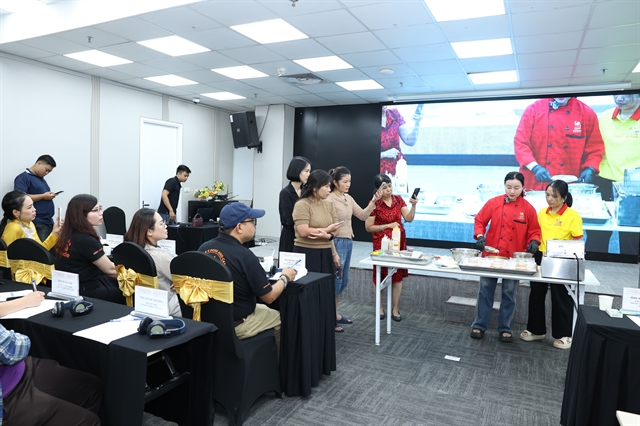 |
| Participants experience hands-on food preparation. — Photos courtesy of the organiser |
HÀ NỘI — A livelihood transition project for dog and cat traders and slaughterers in Hà Nội has achieved positive results after 14 months of implementation, with 28 households ceasing operations and another 25 registering to switch their business models.
Participants heard that at a sustainable livelihood transition training for dog and cat meat traders and slaughterhouse owners in 14 wards of Hà Nội on September 16.
Approved by the Hanoi People's Committee on 24 July 2025, the project aims to achieve the National Target Programme goal of zero human rabies deaths by 2030, while strengthening management capacity, improving disease control and gradually aligning animal welfare standards with international practices.
The project is being implemented by Hà Nội's Department of Livestock, Fisheries and Veterinary Medicine in partnership with Soi Dog Foundation and Vietnamese social enterprise SBCC Vietnam (Social and Behaviour Change Communication for Sustainable Development).
Speaking at the event, Ngô Đình Loát, Deputy Head of the Hà Nội Sub-Department of Animal Husbandry, Aquaculture and Veterinary Medicine, said review results show that more and more business households are proactively ceasing operations and registering for the transition.
“We encourage the remaining households to confidently join the programme and make full use of the training sessions and support packages currently underway."
 |
| Participants are taught how to prepare popular, best-selling dishes and beverages that are currently in high market demand. — Photos courtesy of the organiser |
Building on the success of previous rounds of livelihood training and online sales skills courses, the event was a live trade demonstration and hands-on practice session held right in the conference hall.
Under the direct guidance of culinary and mixology experts, participating households were taught how to prepare popular, best-selling dishes and beverages that are currently in high market demand. This hands-on experience helped participants clearly grasp the feasibility of the new business models before deciding to register for the transition programme.
At the event, they were also provided with legal regulations on food safety, disease prevention and control, traceability, and slaughter control. A representative of the Soi Dog Foundation shared practical operational experience from successful transition models implemented around the world, while SBCC Vietnam directly guided participants through the registration process for the livelihood program and upcoming vocational courses.
The organising committee also officially announced the first start-up support package for five business households that had actively participated in the training, while also accelerating the review process for the next five households so that support can be delivered in time during October and November this year. All costs for experts, training, and practice materials are fully funded by the project.
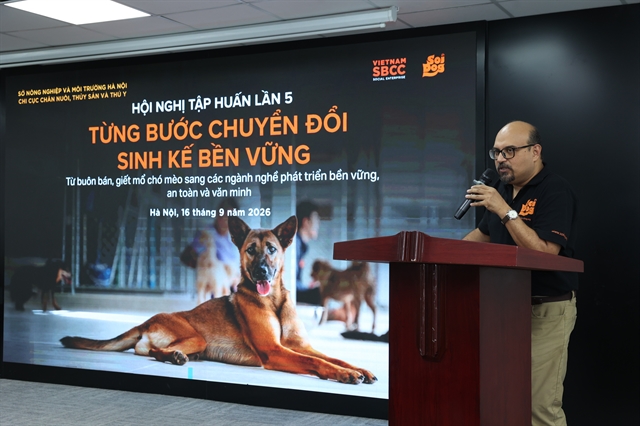 |
| Faizan Jalil, Senior Manager at the Soi Dog Foundation, speaks at the event. — Photos courtesy of the organiser |
Faizan Jalil, Senior Manager at the Soi Dog Foundation, shared: "Experience from other South Asian Countries and around the world shows that when people see a safe new career opportunity with stable income, they will proactively come forward to participate in the transition. These real-world results are not only changing the lives of individual families, but are also laying the foundation for a regional model program on rabies prevention and control linked to sustainable economic development by phasing out the dog and cat meat trade."
Nguyễn Văn Hùng, a former owner of a dog and cat meat shop in Tây Mỗ Ward who has since switched to selling beer and beverages, said that he faced considerable difficulties during the initial transition period because his business location was not in a central area.
“Fortunately, with the project’s support, I was able to take part in the full range of courses, from online sales to preparation of foods and beverages. This practical knowledge has helped me learn how to apply technology to grow my business and attract new customers without depending too heavily on my physical location."— VNS
Society
 Society
 Society
 Society
 Society
 Society
 Society
 Society
 Society
 Society
 Society
 Society
 Society
 Society
 Society