 Society

Divo Tùng Dương reunites with hit songwriter for 25th-anniversary concert
1.
|
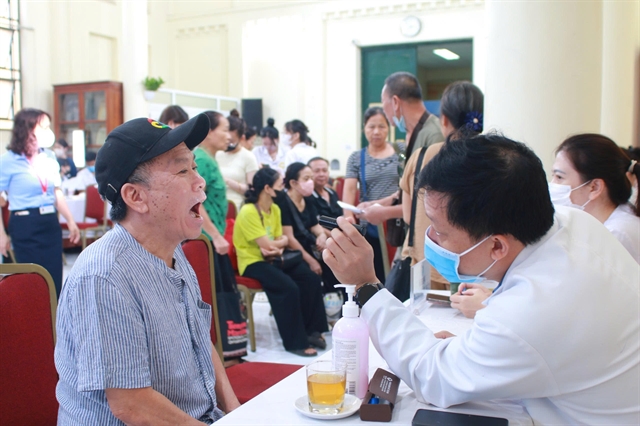
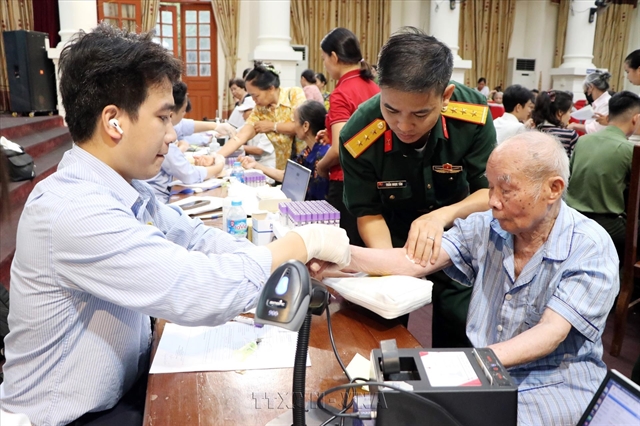
| An elderly resident of Hà Nội's Kim Liên Ward gets a free health checkup at Đống Đa General Hospital. — Photo suckhoedoisong.vn |
By Thái Bình
HÀ NỘI — The queue outside Đống Đa General Hospital had already formed before the sun had fully risen. Residents of Hà Nội's Kim Liên Ward filed in one by one as staff checked their names off a list and waved them down a corridor of stations: internal medicine, surgery, eye exams, ear-nose-and-throat, dental, blood work, a chest X-ray.
No one seemed to be waiting long. Staff moved between the lines, answering questions, nudging people toward the next open desk.
The wait, according to several people who showed up that morning, was a pleasant surprise. Some admitted they'd come braced for the usual grind of a public hospital – crowded halls and murky procedures. Instead, they found something closer to a well-run assembly line, and left saying so: the process was clear, the staff were patient, and for once, a checkup hadn't felt like an ordeal.
That morning in Kim Liên was not a one-off. It was the opening session of a citywide campaign that Đống Đa General Hospital is running throughout 2026, and a small piece of something much larger: a national effort, now a year old, to give every person in Việt Nam a free health checkup or screening at least once annually, and, in the process, to build the country's first comprehensive electronic health record system.
"This year, we aim to examine more than 13,000 residents aged 18 and over across the areas we've been assigned," said Dr Nguyễn Đình Phúc, the hospital's director, whose team is responsible for four wards – Kim Liên, Láng, Văn Miếu–Quốc Tử Giám, and Đống Đa.
The work, he said, is part of Hà Nội's broader push to ensure every resident gets checked annually, catch problems early, and end up with a digital health file that follows them through life.
|
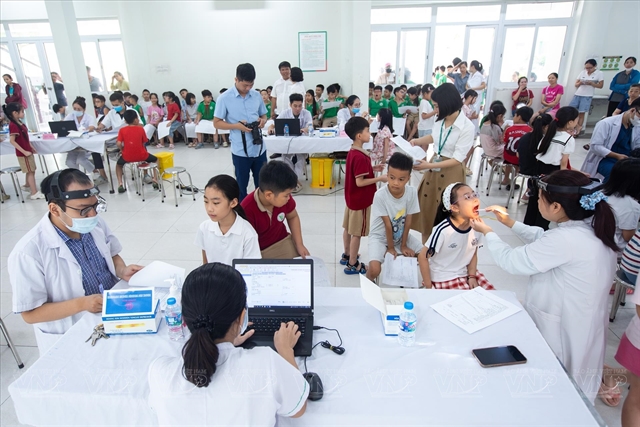
| Students at a primary school in Hà Nội get free checkups as the new school year begins. — VNA/VNS Photo |
That ambition traces back to Resolution 72, the policy directive that set this whole effort in motion a year ago.
Minister of Health Đào Hồng Lan says the ministry moved quickly once the resolution passed: it pushed through a new Law on Disease Prevention, drafted Decree 165 to spell out how checkups should actually work, and secured a prime ministerial directive, issued in May, ordering localities to organise them.
Behind the legal scaffolding sits a simple idea: a healthcare system built to catch disease early is cheaper and kinder than one that waits for people to get sick before stepping in.
Rolling that out to a population of roughly 100 million required sorting people into categories.
Schoolchildren are checked under existing school health rules. Workers are examined and paid for by their employers, under occupational safety law. Military and police personnel go through their own ministries.
The harder cases – the elderly, people with disabilities, poor and near-poor households, those with recognised service to the revolution, and people managing chronic illness – fall to provincial governments, funded through state budgets.
Everyone else gets folded in gradually, as local budgets allow.
As of mid-August, close to 40.2 million people, nearly 40 per cent of the country, had received a free checkup or screening. Some provinces and cities are well ahead: Đồng Tháp had reached 77 per cent of its population, Lai Châu 71 per cent, Phú Thọ 69 per cent, and Thái Nguyên and Điện Biên both around 68 per cent. Others, including Hà Tĩnh and Nghệ An, sat closer to half.
Health officials attribute the gap less to any single failure than to the ordinary friction of rolling out something this large – differences in local resources, organisational capacity, and how quickly each province or city managed to get its plans off the ground. It is, after all, still the opening phase of a policy meant eventually to reach everyone.
The checkups themselves, though, are really the visible half of a quieter and arguably more consequential project: building a digital record that turns each visit into something permanent.
Health authorities, working with the Ministry of Public Security and Vietnam Social Security, piloted an electronic health-record system in nine provinces and cities before expanding it nationwide.
|
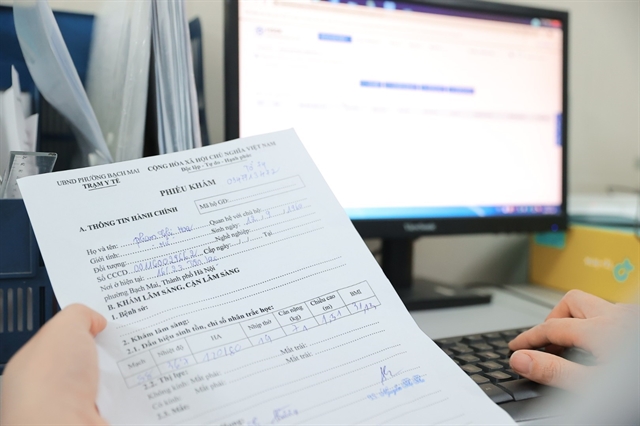
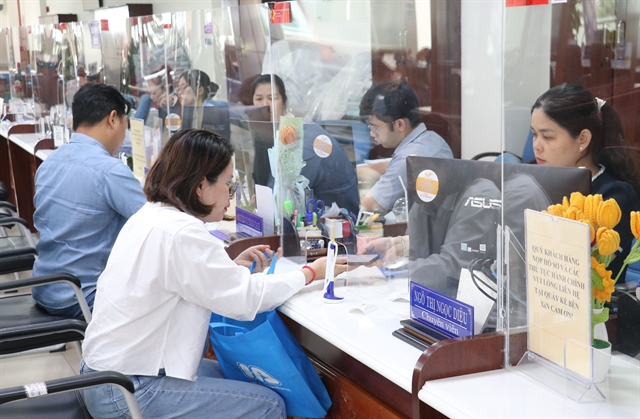
| A health worker inputs a patient's records onto the Hà Nội's Electronic Health Record System. — VNA/VNS Photo |
Since July 8, the country has been in the middle of what officials are calling a '100-day campaign', running through mid-October, to populate these records on the VNeID app, the national digital-identity platform, by linking data from checkups, screenings, and hospital visits.
By August 10, more than 41 million people, about 41 per cent of the population, had an activated electronic health record on the app, according to the Ministry of Public Security's population data centre.
On the health-insurance side, the finance ministry has retooled the portal that Vietnam Social Security uses to ingest medical data, so that checkup and screening results can flow directly into the insurance verification system.
The volumes moving through it so far are modest – in its first month, only 25 medical facilities had submitted data, totalling 226 uploads – but the pipeline now exists, which it didn't a year ago.
What officials describe as the real point of all this isn't the checkup itself, but what happens after it. A single visit to a doctor, however thorough, is still just a snapshot. The goal is to string those snapshots together – checkup results, screening data, occupational exams, insurance claims, chronic-disease monitoring – into one continuous file that follows a person for life, rather than sitting scattered across a dozen clinics and hospitals that never talk to each other.
For patients, that means not having to repeat their history every time they see a new doctor. For the health system, it means something more valuable still: the ability to spot patterns, flag risk early, and direct resources toward the people who need them most, rather than reacting one emergency at a time.
The Ministry of Health says it now intends to knit periodic checkups together with student health screenings, occupational exams, and insurance-covered treatment into a single connected system – the long-term aim being free healthcare access for the entire population, and a completed digital health record for every citizen in the country.
For the people who walked out of Đống Đa General Hospital that morning, chest X-rays and blood test results in hand, that promise is still mostly abstract. But somewhere in a government server, the first page of a record that could follow them for the rest of their lives had just been inputted. — VNS
Society
 Society
 Society
 Society
 Society
 Society
 Society
 Society
 Society
 Society
 Society
 Society
 Society
 Society
 Society