 Society
National conference maps out comprehensive diplomacy at new height
1.
|
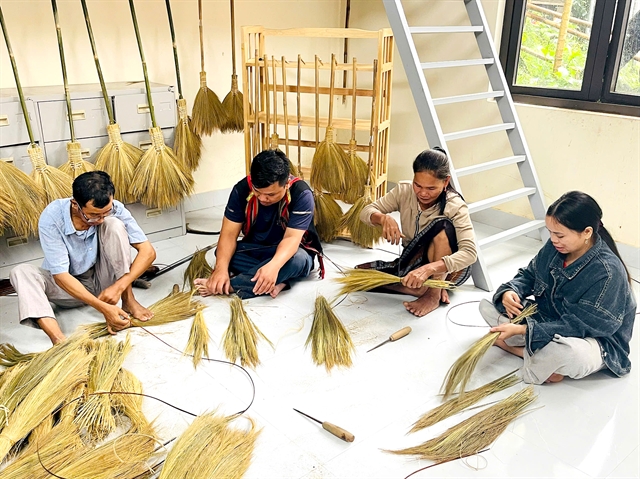
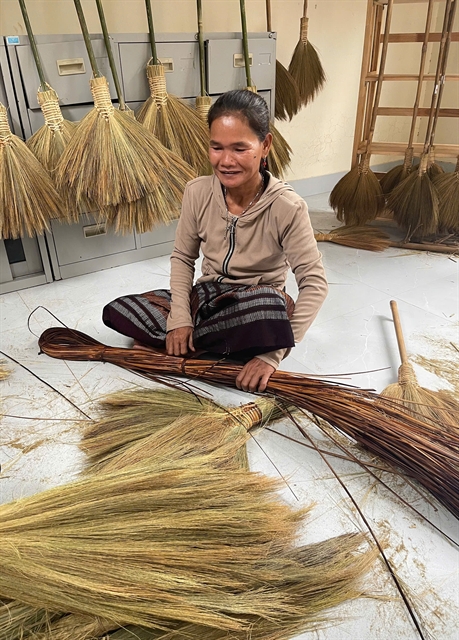
| The Vùng Kho Disabled People’s Broom Cooperative in Đakrông Commune, Quảng Trị Province helps local residents secure suitable livelihoods. — VNS Photo Thu Trang |
Thu Trang
QUẢNG TRỊ — For generations, the lives of the Vân Kiều and Pa Kô ethnic groups in the mountainous areas of Quảng Trị Province have depended mainly on slash-and-burn farming. For people with disabilities, finding stable employment is even more difficult.
The Vùng Kho Disabled People’s Broom Cooperative, was established on May 19, 2023 in Đakrông Commune, has helped them secure livelihoods.
Currently operating with 22 participating households, the cooperative generates incomes of approximately VNĐ50,000-150,000 (US$1.90-$5.70) per day.
Hồ Thị Lâng, 51, has worked at the cooperative from its earliest days. At first, she could make only one or two brooms a day. She now produces 20 brooms daily.
“I prefer this work to farming. Working in the fields is very hard in the rain and sun, while making brooms is gentler and better suited to my health,” she said.
Her husband and children strongly support her in this work.
|
| Hồ Thị Lâng finds making brooms well suited for her health. — VNS Photo Thu Trang |
Hồ Ê Nót, head of the cooperative, said it is highly meaningful work.
“In the past, people with disabilities had no jobs, so they felt sad and inferior. Now, with broom-making, they are happier, striving in life and integrating into society. Although the income is not large, it is enough for them to cover living costs and contribute to their families,” Nót said.
The broom-making cooperative and another nearby solar energy system project are both part of the Resilience First Programme, funded by the Government of Ireland and carried out by Plan International Việt Nam, Care International in Việt Nam and the Research Centre for Community Development Initiatives.
More confident
Hoàng Vân Trinh, a cultural and social affairs officer in Đakrông Commune, said the model has helped local people gain employment, raise their incomes, reduce family burdens and integrate better into the community.
“When they join the group, members learn from one another, share experiences and gradually overcome feelings of shame and inferiority. In the past, people rarely went out. But after participating in group activities, everyone has become more open and cheerful, helping each other to overcome work difficulties and bringing income to their families,” Trinh said.
The group’s brooms are now available in many provinces and cities, including HCM City, Ninh Bình, Hà Nội, Bắc Giang, Huế, Quảng Trị, Quảng Bình and Nha Trang. Schools have been particularly supportive. In Hà Nội alone, there was once an order for up to 400 brooms.
“In the near future, local authorities will continue to promote the group’s products more widely, both inside and outside the province. The aim is for more people to learn about the group’s products, expanding outlets and increasing sales,” Trinh said.
Plan International project officer Đặng Bá Lộc said the model initially faced countless difficulties.
“Group members have different types of disabilities: some have leg impairments, others have weak hands. To complete a single broom, there are certain stages that some people find very challenging. Group members have come together to support one another,” Lộc said.
Most members have now become skilled, and with additional support from their families, they are fully able to work independently.
"Participating in the group also creates opportunities to connect and share about both work and daily life. As a result, their spirits are happier and more positive, life feels more meaningful and household economies also improve," Lộc said.
Solar energy
|
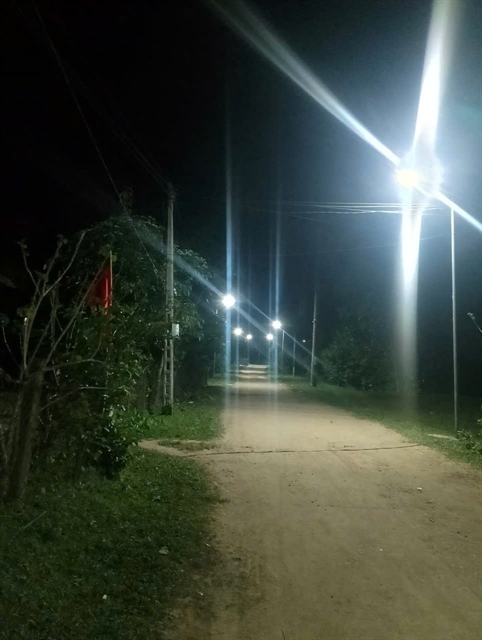
| The solar power lighting system illuminates local roads in Ly Tôn Village, Đakrông Commune, Quảng Trị Province. — VNS Photo Thu Trang |
A new solar power lighting system illuminating village roads is another initiative improving the quality of life for residents of Ly Tôn Village, Đakrông Commune.
The system aims to provide clean, sustainable electricity, reduce greenhouse gas emissions and enhance climate change adaptation.
The project benefits 83 households, with 50 solar-powered light poles along a 1,500-metre stretch.
Head of Ly Tôn Village Hồ Văn Phái said each household contributes VNĐ20,000 ($0.70) per year for maintenance and upkeep of the system.
The village has set up a five-person management team to regularly inspect and maintain the infrastructure.
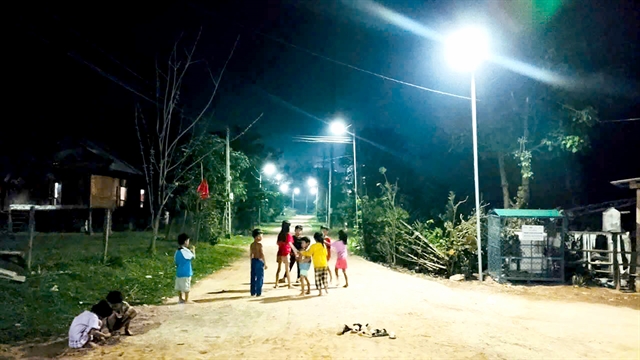
“On the first day the lights came on along the road, in early March this year, villagers and children were very happy. They stayed out playing and chatting until midnight,” Phái said.
Hồ Thị Nhàn, a local resident, said women in the village have encouraged one another to help monitor the power system.
“We are very happy to have street lights. Before, when there were no street lights, getting around at night was difficult. Since the lights were installed, it has been more convenient for people to travel. Security, order and traffic safety are now assured,” Nhàn said.
|
| With the light, children can play outdoors in the evenings. — VNS Photo Thu Trang |
Trinh said local people have enthusiastically supported the solar lighting system and are very pleased.
“With lighting in place, local security and order have improved, enabling residents to focus on production and economic development,” she said.
After the solar lights were installed in Ly Tôn Village, other villages also contacted the management board, expressing their hope that the model would be replicated in all other villages in the commune, bringing light to residents and joy to children after school.
“People can take part in cultural, artistic and sporting activities outdoors in the evenings, as well as enjoy recreation with their children after tiring days of work,” Trinh said.
The Resilience First Programme covers Quảng Trị, Phú Thọ and Tuyên Quang provinces, with a budget of around 1.4 million euros (US$1.6 million) per year. — VNS
Society
 Society
 Society
 Society
 Society
 Society
 Society
 Society
 Society
 Society
 Society
 Society
 Society
 Society
 Society