 Opinion

HKSTP Showcases 24 Greentech Companies at Eco Expo Asia 2026
1.
 |
| Professor Dr Đào Xuân Học, chairman of the Việt Nam Water Resources Association. — VNA/VNS Photo Thanh Hương |
Professor Dr Đào Xuân Học, former Deputy Minister of Agriculture and Rural Development and chairman of the Việt Nam Water Resources Association, spoke to Chính Phủ (Government) Portal about technical solutions, prerequisites and basin-level governance mechanisms needed to restore rivers sustainably.
Many people are now deeply concerned about efforts to restore polluted rivers. From the perspective of water resources and hydraulic engineering, what does it take for a river to be considered sustainably restored?
Under the Law on Water Resources, the fundamental principle for restoring a river is to ensure an environmental flow. In other words, the river must maintain a minimum flow, which in many cases is equivalent to more than 30 per cent of the long-term average dry-season flow.
The environmental flow is essential for sustaining life and restoring and maintaining biodiversity and ecosystems along the river corridor. In addition to flow volume, water quality must be significantly improved to meet the needs of agricultural irrigation, domestic use and production without posing health risks or causing harm to the community.
For river systems such as the Nhuệ and Bắc Hưng Hải, which currently operate in much the same way as major irrigation canals, restoration must also comply with technical requirements for minimum flow rates and flow velocities.
This is necessary to prevent excessively slow currents that could lead to sediment accumulation and obstruction of the river channel. A river can therefore only truly be considered 'alive' again when two core issues are addressed simultaneously: maintaining a minimum flow and restoring water quality to required standards.
The Ministry of Agriculture and Environment has proposed a pilot scheme to provide gravity-fed water replenishment of up to 120cu.m per second for the Bắc Hưng Hải system, 200cu.m per second for the Nhuệ-Đáy river system and 28cu.m per second for the Ngũ Huyện Khê River. How feasible do you consider this proposal to be?
I consider the technical solution proposed by the ministry to be both appropriate and scientifically sound. After years of excessive sand mining, the dry-season water level of the Hồng (Red) River has fallen by about 3.5m, while the Đuống River has dropped by nearly 5m compared with the period before the 1990s.
As a result, all the gravity-fed water intakes at Xuân Quan and Liên Mạc, as well as those serving the Đáy River and various pumping stations, are now effectively stranded, making it impossible to draw or pump water into the systems by gravity.
To provide around 350cu.m per second of replenishment water for the entire area, there are essentially two engineering options of building pumping stations or constructing weirs to raise water levels.
The optimal solution would be to build a weir downstream of the Xuân Quan sluice gate on the Red River and another downstream of the Long Tửu sluice gate on the Đuống River. Raising the water level with weirs would allow water to flow by gravity into the Bắc Hưng Hải system, the Nhuệ and Đáy rivers and the Ngũ Huyện Khê River, without the huge electricity costs associated with operating pumping stations.
The weirs on the Đuống and Red rivers would also have strategic significance from a hydrological perspective. Because the Đuống riverbed has been deeply eroded, the proportion of floodwater diverted from the Red River into the Đuống has increased abnormally, raising risks to the safety of the entire Hồng-Thái Bình river dike system.
Constructing weirs would enable more proactive regulation of water flows and help maintain the appropriate flood-season diversion ratio, thus improving safety in downstream areas.
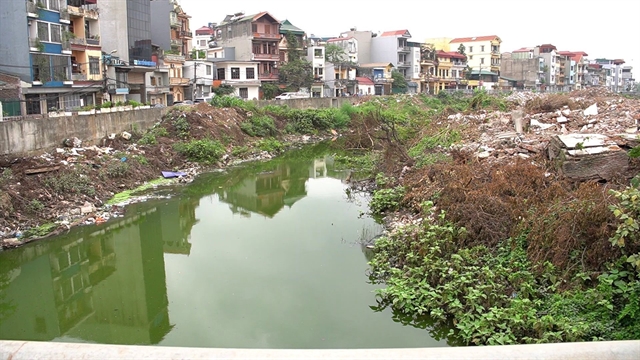 |
| A section of the Nhuệ River in Hà Nội. — VNA/VNS Photo Kim Anh |
For rivers suffering both from depleted flows and large volumes of domestic and industrial wastewater, what is the most critical prerequisite for sustainable restoration?
The current situation is deeply concerning. The Nhuệ-Đáy river system is severely polluted because it receives a large proportion of untreated wastewater from Hà Nội, leaving people in downstream areas such as Hà Nam unable to use the river water for irrigation or domestic purposes.
Sustainable restoration requires two measures to be carried out simultaneously: bringing clean water into the river system to dilute pollutants and restore flows, while tackling wastewater discharges at their source.
The most important bottleneck is the need for a clear and decisive roadmap for controlling wastewater discharge. National plans and strategies set a target of treating 100 per cent of wastewater from industrial parks, industrial clusters, new urban areas and craft villages to required standards before it is discharged into the environment by 2030. This is a mandatory requirement.
For domestic wastewater from residential areas, meanwhile, collection and treatment systems need to be developed progressively. If water is replenished without stopping polluted discharge, the river will remain polluted. Conversely, if wastewater is treated but the riverbed is left depleted without an environmental flow, the river ecosystem cannot recover either.
One major problem is that rivers pass through several localities, while flow management remains divided along administrative boundaries. What mechanism is needed to ensure unified management across an entire river basin?
This is precisely the biggest bottleneck in water resource management and disaster prevention at present. Natural flows do not stop at the administrative boundaries of any province or city. Fragmented management can result in situations where the upstream section discharges wastewater while the downstream section bears the consequences, or where infrastructure is operated without adequate coordination.
River basin management boards in the past were largely part-time bodies, with limited legal authority and financial instruments. Their coordinating effectiveness was therefore very limited. Recently, the Việt Nam Water Resources Association, in coordination with the Japan International Cooperation Agency and Thuy Loi University (Water Resources University), held a scientific workshop and formally submitted recommendations to the Government.
We have proposed that the Government assign the Ministry of Agriculture and Environment to take the lead in reviewing and improving river basin governance mechanisms, with a view to strengthening unified coordination from upstream to downstream.
The authority and responsibilities of river basin coordinating bodies must be clearly defined in relation to provincial and municipal People's Committees. A single basin can contain dozens of hydropower reservoirs and interconnected irrigation works. Without a unified governance mechanism and real-time management tools, the risks to water security and cascading disasters are very significant.
It is estimated that tens of trillions of Vietnamese đồng will be required for projects to revive these rivers. How can such investment generate long-term value in terms of water security, flood prevention and the creation of new development spaces?
Investment in river restoration can generate substantial economic, social and environmental benefits. First, in terms of water security and energy savings, weirs would raise the water level of the Red River, allowing water to be drawn by gravity throughout the year.
This would reduce the need for the power sector to release billions of cubic metres of water from major hydropower reservoirs such as Sơn La, Hòa Bình and Thác Bà during agricultural irrigation periods, conserving valuable water resources for peak-load power generation and supporting the wider economy.
Next, modern engineering technology can be used, drawing on international experience such as France's construction of 23 weirs on the Rhine River. Modern weirs can be equipped with automated gates to ensure they do not impede flood drainage, while incorporating navigation locks to support inland waterway transport and fish passages to protect aquatic ecosystems.
Finally, as directed by the Government, water restoration must go hand in hand with the effective management and use of approximately 2,100ha of land that could become available following the rehabilitation projects.
Integrated planning for green corridors, public spaces and riverside eco-urban areas could transform degraded rivers into green landscape axes, creating new drivers of socio-economic development for Hà Nội and provinces across the Red River Delta. — VNS
Opinion
 Opinion
 Opinion
 Opinion
 Opinion
 Opinion
 Opinion
 Opinion
 Opinion
 Opinion
 Opinion
 Opinion
 Opinion
 Opinion