 Opinion
Vietnamese engineers develop mini underwater robot for offshore inspections
1.
|
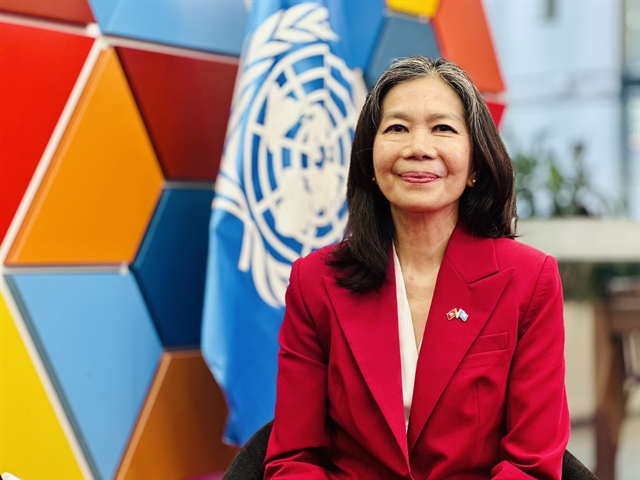
| Pauline Tamesis, United Nations Resident Coordinator in Việt Nam. — VNA/VNS Photo |
On United Nations Day, and as fifty years of partnership approach, a new era calls for a new measure of success. On this occasion, United Nations Resident Coordinator in Việt Nam Pauline Tamesis wrote an article for Việt Nam News.
Every year on 24 October, the world marks the day the United Nations Charter entered into force. In Việt Nam, this year's UN Day carries special meaning. Next September will mark fifty years since Việt Nam joined the United Nations, and this week the UN family met Prime Minister Lê Minh Hưng to discuss how our partnership can best serve the country's next stage of development.
When Việt Nam took its seat in 1977, it was a country still healing from war. The United Nations stood with it in the difficult years that followed, bringing food, clean water and health care, and later served as a bridge to global expertise during Đổi Mới. Since then, multidimensional poverty has fallen to around 1.3 per cent, generations of children have been protected through immunisation, and during COVID-19 the UN helped deliver more than 61 million vaccine doses. These achievements belong first and foremost to the Vietnamese people. The United Nations is proud to have been part of them.
Today, the relationship has changed. As General Secretary and State President Tô Lâm told the General Assembly in New York last month, Việt Nam has moved from recipient of assistance to active contributor. Vietnamese peacekeepers, women among them, serve in demanding missions. Hà Nội hosted the signing of the UN Convention against Cybercrime. Việt Nam sits on the Human Rights Council and shares its experience in poverty reduction and agriculture with partners in Africa and beyond. The Government's decision to extend the rent-free arrangement for the Green One UN House for another ten years is a tangible expression of its confidence in multilateralism.
Việt Nam now stands at a turning point. Having reached upper middle-income status, it aims to become a high-income country by 2045 and to reach net-zero emissions by 2050. The model that brought it this far, built on abundant labour, capital and assembly for global markets, will not carry it the rest of the way. The next stage depends on science, technology, innovation and, above all, people. One conviction should guide it: how Việt Nam grows matters as much as how fast it grows.
Take the green transition. Extreme weather already costs Việt Nam an estimated 1 to 1.5 per cent of GDP every year. An ambitious new climate plan, NDC 3.0, adopted in time for COP31 next month, can be far more than a pledge. It can be a plan for investment, competitiveness and jobs, at a time when export markets increasingly reward low-carbon products. The UN system stands ready to help turn that ambition into action, alongside development banks and other partners.
Or take digital transformation. With one of the world's first comprehensive national laws on artificial intelligence, Việt Nam is well placed to help shape how this technology is governed, so that it benefits all of humanity while its risks are managed. The first report of the UN's Independent International Scientific Panel on AI shows that the opportunities are immense, but so is the risk of new divides. Digital progress will count only if it reaches small businesses, rural communities, women and older people, and if it protects from online violence and fraud while widening access to information.
Growth of this kind cannot be judged by GDP alone. GDP tells us how much an economy produces. It does not tell us whether growth reaches the most vulnerable, whether it depletes the natural resources on which future prosperity depends, or whether it leaves the next generation better off.
The Secretary-General's High-Level Expert Group on Beyond GDP, which includes a Vietnamese economist, has proposed a dashboard of indicators on well-being, equity and sustainability. As the expert group puts it, what we measure shapes what we value. For Việt Nam, that could mean tracking, alongside GDP, the share of renewable energy, the availability of decent jobs and real wages, social protection for a fast-ageing population, and the gap in digital access between cities and villages.
A new era also calls for a new kind of partnership with the United Nations. Our new Cooperation Framework for 2027 to 2031 is built around Việt Nam's own priorities and draws on the full UN system, resident and non-resident alike. Its value should not be measured by the funds we bring. International financial institutions and bilateral partners provide finance at scale, and their role is essential. Ours lies in impartial advice, global expertise, international norms and standards, including on human rights, and the trust and convening power to bring partners together behind national goals.
Nearly fifty years ago, the flag of a country still healing from war was raised for the first time at the United Nations. Today, Vietnamese peacekeepers serve under the blue flag on another continent. The true measure of the next fifty years will not be the number of agreements we sign, but the child in a mountain village who grows up healthy and goes to school, the young woman who finds a decent job in a new industry, and the farmer in the Mekong Delta whose land is protected from a changing climate. If they can say that this partnership made their lives better, we will have honoured the promise of 1977. VNS
Opinion
 Opinion
 Opinion
 Opinion
 Opinion
 Opinion
 Opinion
 Opinion
.jpg) Opinion
 Opinion
 Opinion
 Opinion
 Opinion
 Opinion