 Opinion

Chinese medicine maker addresses global TCM gathering, bringing flagship heart pill to trial in Singapore
1.
|
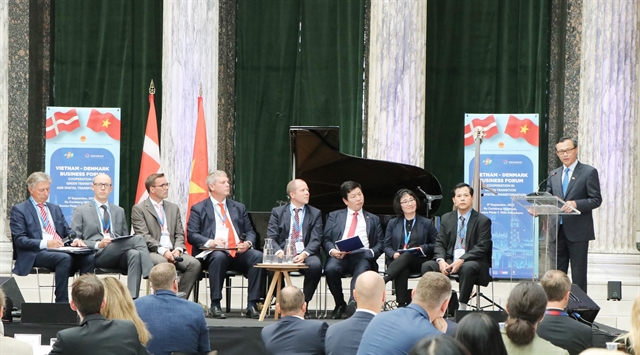
| Ambassador Lương Thanh Nghị speaks at the Việt Nam–Denmark Business Forum on cooperation in green and digital transformation, held at the Ny Carlsberg Glyptotek museum in Copenhagen on September 5, 2022. VNA/VNS Photo |
By Lương Thanh Nghị*
I am delighted to hear that Party General Secretary and State President Tô Lâm and his spouse Ngô Phương Ly will pay a state visit to Denmark from October 19 to 21, 2026, at the invitation of the King and Queen of Denmark. I am confident that this important visit will give fresh momentum to Việt Nam–Denmark relations and open up new opportunities to make cooperation deeper and more substantive.
Looking back on 55 years of diplomatic ties, I am more convinced than ever that the relationship rests not just on government agreements but on the friendship, trust and goodwill between our peoples. Building on this, the two countries now have a chance to open a new chapter focused on the green transition, innovation and sustainable development.
Ties that endure
For many Vietnamese, Denmark brings to mind Hans Christian Andersen’s fairy tales, such as The Little Mermaid, The Steadfast Tin Soldier and The Little Match Girl. Far fewer know a true story: Prince Henrik, the late husband of Queen Margrethe II, had a lifelong attachment to Hà Nội and Việt Nam.
Prince Henrik spent part of his childhood in Hà Nội, where he also went to school. His memoirs devote an entire chapter to the house at 80 Phan Đình Phùng Street. Ahead of his visit to Việt Nam in 2009, he said that coming back to the country felt like revisiting his childhood, words I have never forgotten.
Nor were these memories his alone. When I presented my credentials to Queen Margrethe II at Fredensborg Palace on May 6, 2022, I was touched to hear her speak about the Prince’s years in Việt Nam. She recalled a cyclo ride through Hà Nội’s Old Quarter and told me that Việt Nam had always been part of the royal family’s stories.
I was also surprised to discover that the greenhouse at Fredensborg Palace grows herbs and spices any Vietnamese cook would recognise: basil, dill, spring onions and chillies. It is a small detail, but a telling one. Friendship between nations is sometimes nourished by the simplest things: shared memories, everyday habits and genuine warmth.
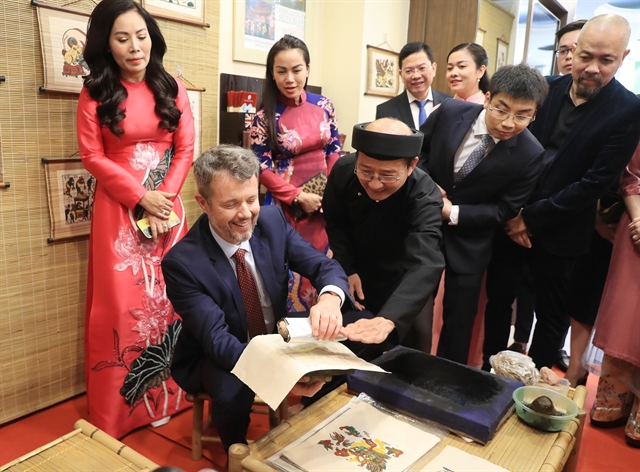
Before succeeding to the throne, Crown Prince Frederik visited Việt Nam several times. On his November 2022 trip with Crown Princess Mary, the couple met business leaders, discussed cooperation on the green transition and made time to experience Vietnamese culture. I still fondly remember seeing the Crown Prince stroll around Hoàn Kiếm Lake, visit Ngọc Sơn Temple, watch a water puppet show and try his hand at Đông Hồ woodblock printing.
|
| Then Danish Crown Prince Frederik (now King Frederik X) tries his hand at Đông Hồ folk woodblock printing during his visit to Việt Nam in November 2022. VNA/VNS File Photo Lâm Khánh |
Moments like these show that the relationship has been shaped as much by real experiences and a sincere respect for each other’s culture and history as by diplomatic documents.
I saw this again in the Danish friends who have spent years building ties with Việt Nam. Trine Doan, former chairwoman of the Danish-Vietnamese Association, told me about the association’s work since its founding in 1976 to foster understanding and cooperation between the two peoples. Some of its members once marched against the war in Việt Nam, and they are still championing the friendship today.
Another friend, Thomas Pedersen, who spent many years in Việt Nam running a Danish company, gave me valuable insights into how Denmark developed, particularly in renewable energy, education, science and technology, and innovation.
What Việt Nam can learn from Denmark
In May 2023, I joined a “green journey” organised by the Danish Ministry of Foreign Affairs. With fellow ASEAN diplomats, I visited research centres working on high-tech farming, wind turbine manufacturing, quantum technology, drones and robotics.
The trip brought home what Thomas Pedersen had told me: Denmark’s success comes not only from cutting-edge technology but from the way it organises and runs its development model.
For decades, Denmark has stuck with long-term policies on energy, the environment and sustainability. With few natural resources of its own, it has built its competitive edge on knowledge, technology, a highly skilled workforce and a strong culture of collaboration across society.
What stands out most to me about the Danes is their creativity. From LEGO bricks to energy technology, they excel at turning ideas into products, services and economic value. But creativity does not depend on individual talent alone. It thrives in an environment that encourages experimentation, welcomes new ways of doing things and puts knowledge to practical use.
Danes often talk about samskabelse, or “co-creation”. In this approach, government, businesses, universities, research institutes and citizens work together to identify problems, find solutions and create shared value.
Việt Nam can learn from this. As the country enters a new stage of development, raising productivity, the quality of growth and competitiveness has become more pressing than ever. That means forging closer ties between the State, businesses and research institutions, bringing more research to market, and making it easier for companies to invest in innovation.
Education offers another lesson. Danes places great value on lifelong learning and keep updating their knowledge and skills throughout their careers. Children are taught to think independently, work in teams and solve problems. It is entirely normal for adults, even retirees, to go back to learn new skills.
Of course, no country can simply copy another’s development model. Rather than looking for a ready-made formula, Việt Nam should draw on principles that can be adapted to its own conditions: a long-term vision, effective governance, investment in knowledge, stronger public-private partnerships and a people-centred approach.
Building a green future together
Bilateral cooperation has deepened in stages. In 2011, Việt Nam and Denmark set up a Strategic Partnership on climate change, energy, environment and green growth. In 2013, this became a Comprehensive Partnership, broadening cooperation to the economy, trade, education, health, agriculture and food.
The Green Strategic Partnership, established in November 2023, was a major milestone. It reflected both countries’ determination to align their cooperation with sustainable development goals.
In my view, what matters most about this framework is not just the priorities it sets out but whether it can turn commitments into real results. The green transition requires finance, technology, skilled workers and effective coordination. These are all areas where Việt Nam and Denmark can complement each other.
Việt Nam needs clean energy, modern infrastructure, energy-efficient technology and effective ways to cut emissions. Denmark brings experience and expertise in renewable energy, green technology, shipping, environmental management and sustainable business models. If these strengths are matched well, both sides stand to gain.
The LEGO Group’s investment in Việt Nam is a case in point. The group’s factory in the former Bình Dương Province (now part of HCM City) represents a total announced investment of more than US$1 billion. It is designed to run sustainably, using renewable energy and minimising its environmental footprint. Beyond the investment and jobs it brings, the project shows that green manufacturing standards can take root in Vietnamese industry.
Beyond attracting investment, I believe the two countries should step up cooperation in research, training, technology development and business matchmaking. Joint programmes should aim for measurable results, such as stronger technological capacity, lower emissions, more efficient use of resources or more high-quality jobs.
I hope the visit will give fresh impetus to cooperation in shipping, logistics, renewable energy, green technology, innovation, education and human resource development. I also hope it will encourage businesses on both sides to invest more, build stronger supply chain links and pursue long-term projects. Alongside government-level ties, closer exchanges between people, localities, universities and social organisations will put the relationship on an even firmer footing.
After 55 years, Việt Nam and Denmark have every reason to look ahead with optimism. The two countries differ in size, level of development and specific priorities, but they share the same goals: a prosperous economy, a high quality of life and a more sustainable future for generations to come.
Andersen’s fairy tales once brought Denmark closer to generations of Vietnamese readers. Today, Denmark’s experience in innovation, education and the green transition can open up new avenues for cooperation.
With the friendship and trust built up over decades, I am confident that Việt Nam and Denmark can write an even brighter chapter together, one in which they learn from each other, innovate together and build a green, prosperous and sustainable future for both their peoples. VNS
*The author was Việt Nam’s Ambassador to Denmark from 2022 to 2025.
Opinion
 Opinion
 Opinion
 Opinion
 Opinion
 Opinion
 Opinion
 Opinion
 Opinion
 Opinion
 Opinion
 Opinion
 Opinion
 Opinion
 Opinion