 Opinion
Go Global Programme seeks to move firms beyond exports to global brands
1.
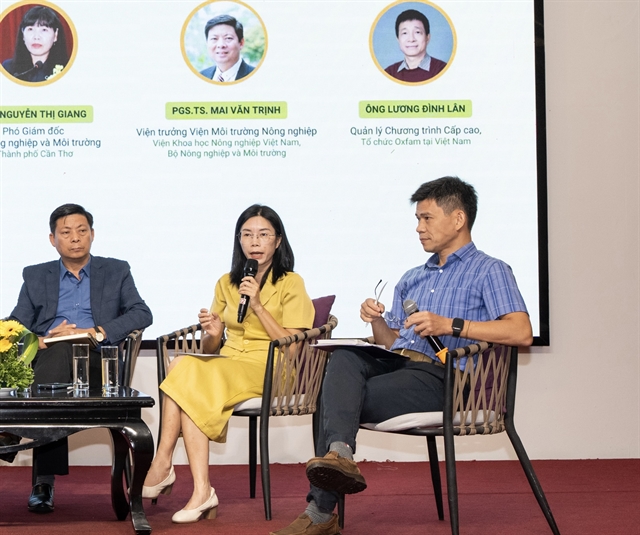 |
| Nguyễn Thị Thu Hương (centre), deputy director of the Plant Production and Protection Department under the Ministry of Agriculture and Environment. — Photo courtesy of Oxfam |
Nguyễn Thị Thu Hương, deputy director of the Plant Production and Protection Department under the Ministry of Agriculture and Environment, speaks to Việt Nam News reporter Khánh Dương about progress and challenges in carrying out the one million-hectare high-quality, low-emissions rice project in the Mekong Delta.
What initial results and challenges have emerged from implementing the one million hectare project for high-quality, low-emissions rice cultivation after nearly three years?
After nearly three years of implementation, we have seen some relatively positive results.
At the macro level, the project has received attention and broad support from relevant agencies, ministries, sectors and local authorities, particularly from farmers and businesses involved in high-quality, low-emissions rice production. This support is important for building a brand, increasing farmers’ incomes and adding value to the rice sector.
In terms of cultivated area, approximately 420,000 hectares of rice fields have so far adopted all or part of the sustainable rice farming practices promoted under the project.
Some of these areas have also undergone emissions measurement. Results from pilot models show that emissions have been reduced by around two to four tonnes of carbon per hectare, depending on the crop season and other farming conditions.
We have also taken initial steps towards establishing production links among cooperatives, rice growers and businesses involved in input supply and purchasing. Several pilot models have brought together businesses across the value chain in high-quality, low-emissions rice-growing areas, from agricultural input suppliers and farmers to cooperatives and companies that purchase, process and export the rice. We hope to expand these integrated models further.
Regarding the Vietnamese Green Low-Emissions Rice brand, the Vietnam Rice Industry Association has begun developing the brand and registering it for intellectual property protection. It has also started issuing certification to several exporters supplying key markets.
We hope these initial achievements will help accelerate implementation of the project and provide an important driving force for its progress in the coming years.
What difficulties have emerged over these three years?
We believe the biggest challenge lies in awareness among farmers, participating businesses and consumers of sustainable products and low-emissions production processes.
Their understanding is not yet comprehensive, and this is a new approach for many of them. The farming practices involved may be unfamiliar and somewhat more complicated than traditional methods, making farmers hesitant to adopt the recommended technical measures.
For example, farmers in the Mekong Delta currently typically use around 130kg, and in some cases up to 160kg, of rice seed per hectare. Under the one million hectare project, however, we aim to reduce this to approximately 75kg per hectare. Given their traditional farming practices, farmers may worry that using such a small quantity of seed will not ensure sufficient yields or output, potentially affecting their incomes.
Another challenge concerns alternate wetting and drying, a water management technique in which fields are periodically drained and re-flooded. The process of controlling water levels to maintain dry conditions in the fields and reduce emissions is still relatively new to many farmers.
Low-emissions agriculture practices also require farmers to remove rice straw from the fields and treat it with composting products to reduce emissions. These measures are all challenging for producers.
For businesses, there is not yet a dedicated market for green, low-emissions Vietnamese rice. As a result, selling prices and access to consumers have not generated sufficiently positive signals to motivate them to invest in and participate in this market or establish production links.
In addition, existing on-farm infrastructure is relatively basic and will need to be upgraded to support sustainable farming. This includes irrigation systems, internal farm roads for transport and infrastructure that allows agricultural machinery to access fields and carry out necessary operations.
Could you elaborate on the difficulties in establishing links among the three key stakeholders – farmers, cooperatives and businesses – in high-quality, low-emissions rice production?
Production links are a long-standing issue discussed at many forums, not only in the rice sector but also in other agricultural industries.
Previously, such connections were often understood simply as purchasing and offtake agreements between businesses and cooperatives. In reality, a production link should encompass a much broader value chain and ecosystem.
As I mentioned, it should bring together suppliers of agricultural inputs, providers of farming services such as pesticide spraying, ploughing, harvesting and sowing, farmers as direct producers, cooperatives and companies responsible for purchasing, processing and exporting the rice. The network can even extend to relevant industry associations, such as the Vietnam Food Association and the Vietnam Rice Industry Association.
This is a long-standing issue, and we need to focus on two key aspects.
First, we must ensure that farmers and businesses participating in the value chain gain tangible benefits. What do they stand to gain? If the profits are sufficiently attractive, this will give them an incentive to remain in the chain and strengthen production links.
Next, we need to encourage a sense of community responsibility among participants. Even when financial returns are not particularly high, a sense of responsibility towards the community and the environment can serve as an additional motivation for them to participate and help make the links more sustainable.
When this ecosystem expands and stakeholders across the value chain become closely connected, their relationship will go beyond simple buying and selling. They will be able to support one another, from the supply of production inputs all the way through to exports and access to end markets.
I believe this is a more sustainable way to develop production links than simply trying to make offtake contracts more effective or requiring businesses to purchase farmers’ entire output.
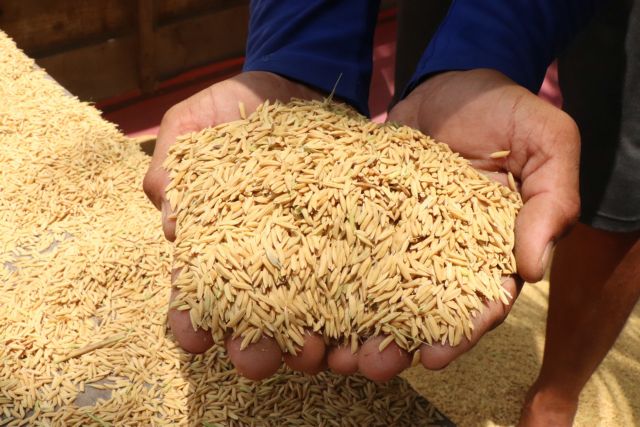 |
| About 420,000 hectares of rice fields in the Mekong Delta region have so far adopted all or part of the sustainable rice farming practices. — VNA/VNS Photo |
What solutions do you envisage to address these key challenges, particularly through digital transformation and the development of high-tech agriculture to improve productivity and reduce emissions?
On the part of the Ministry of Agriculture and Environment, with strong direction from the Government, we are submitting for approval an amended decision revising Decision 1490/QD-TTg. This decision approved the project on sustainable development of one million hectares of high-quality, low-emissions rice cultivation associated with green growth in the Mekong Delta by 2030.
The revised project will expand its scope to cover the entire specialised rice-growing area in the Mekong Delta. It will also aim to build a transparent and accountable Vietnamese rice brand while removing barriers to participation, enabling all relevant stakeholders to participate in and contribute to the project and to the development of Việt Nam’s rice sector as a whole, particularly in the Mekong Delta.
The existing project and its proposed revision have identified numerous tasks and key solutions. However, I believe we will focus on several major groups of measures in the near future.
We first need to refine the technical package for sustainable, low-emissions rice production. By improving these farming techniques, we expect to expand the area adopting the recommended practices, ensure that emissions reductions are measured in a substantive and evidence-based manner, and strengthen monitoring against the project’s performance indicators.
Second, we will step up the application of science and technology, digital and green transformation, as well as strategic technologies. The Ministry of Agriculture and Environment is currently directing the Plant Production and Protection Department to carry out these efforts.
Another priority is to ensure coordinated investment in on-farm infrastructure, storage, processing and mechanisation. This will help align production infrastructure with the advanced techniques and scientific and technological solutions that we plan to apply under the project.
We will also work with relevant ministries and sectors to strengthen the management capacity of cooperatives and raise awareness among farmers, businesses and consumers of low-emissions products.
Ultimately, we hope to build a distinctive and high-quality rice value chain and establish a unique brand for Vietnamese rice – a green, low-emissions product with transparent information and market data. — VNS
Opinion
 Opinion
 Opinion
 Opinion
 Opinion
 Opinion
 Opinion
 Opinion
 Opinion
 Opinion
 Opinion
 Opinion
 Opinion
 Opinion
 Opinion