 Economy

A Vietnamese voice in a South African home
1.
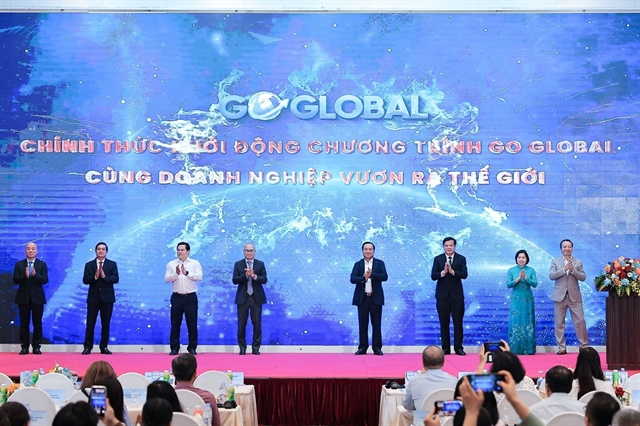 |
| Go Global Programme is officially launched in Hà Nội on November 4 support business expansion abroad. — VNA/VNS Photo Lê Đông |
HÀ NỘI — The Ministry of Industry and Trade has launched the Go Global Programme to help enhance the competitiveness of domestic businesses and enable them to move beyond exporting goods to building internationally recognised brands and take a bigger role in global value chains.
The programme was launched on November 4 at the Vietnam Export Promotion Forum 2026, themed 'Go Global – From National Strength to Global Success', held in Hà Nội by the Vietnam Trade Promotion Agency under the Ministry of Industry and Trade.
Deputy Minister of Industry and Trade Lương Hoàng Thái said Việt Nam’s approach to international economic integration is entering a new phase, with businesses expected to move from adapting to international markets to proactively expanding their global presence.
The Go Global Programme, approved under Prime Ministerial Decision No. 626/QĐ-TTg dated April 6, 2026, aims to strengthen the international competitiveness of Vietnamese private businesses and support their expansion into overseas markets through exports, cross-border trade, participation in global value chains and overseas investment.
Thái called for coordinated implementation of the programme, highlighting the importance of local authorities in identifying their competitive advantages and developing support measures suited to businesses in their areas.
So far, 18 provinces and cities have issued action plans under the programme’s Local Go Global initiative, he said.
There was no one-size-fits-all formula for businesses seeking to expand globally, nor could the journey be completed overnight. However, it could begin with concrete actions.
“The Government creates an enabling environment and connects resources, local authorities take the initiative in implementation, partners provide support, and businesses remain at the centre as the creators of value,” Thái said.
He urged businesses to prepare comprehensively in terms of products, human resources, finance and corporate governance, while investing in research and development, intellectual property protection, brand development and overseas distribution networks.
From exporters to global players
At the forum, Director of the ministry’s Vietnam Trade Promotion Agency Vũ Bá Phú said Go Global was not simply about increasing exports but helping Vietnamese companies develop the capabilities needed to compete internationally and establish a lasting presence in foreign markets.
Citing the development of China's Haier, Japan's Toyota and the Republic of Korea's Samsung, he said successful global businesses had followed a long-term path built on product quality, production capacity, technology and management.
He outlined a development path for Vietnamese businesses that begins with building quality, production and management capabilities, followed by entering international markets to gain customers and understand standards and consumer behaviour.
Companies should then move beyond contract manufacturing, assembly and straightforward exports towards controlling technology, developing their own brands and establishing distribution networks, before building a long-term overseas presence through investment and business operations, he said.
Vietnamese businesses are increasingly well placed to pursue that transition, following nearly four decades of economic reforms, the establishment of a network of 18 free trade agreements and expanding trade relations. By October 2026, the country's total trade turnover had exceeded US$1 trillion, Phú cited
The Politburo’s Resolution 68 on the development of the private economic sector set the target that at least 20 large companies participate in the global value chain by 2030.
 |
| Bitel telecoms services invested by military-run Viettel in Peru. Some Vietnamese companies have also established substantial operations in international markets. — Photo baochinhphu.vn |
Some Vietnamese companies have also established substantial international operations. Viettel operates in 10 overseas markets and leads market share in seven of them, with international revenue of about US$3.3 billion in 2025.
FPT reported more than VNĐ35 trillion (about US$1.4 billion) in overseas information technology services revenue last year, with newly signed contracts worth around US$1.5 billion, particularly in Japan and the United States.
However, Phú said the next stage of international integration should focus not only on expanding trade volumes but also on increasing the value captured by Vietnamese businesses.
The Go Global programme therefore identifies four routes for international expansion: goods exports, cross-border trade, participation in global value chains, and overseas business presence and investment.
The programme aims to provide training for 10,000 business participants, help 1,000 companies develop international expansion plans and offer specialised support to 100 businesses investing overseas, with mergers and acquisitions accounting for 30 per cent of those cases.
Phú said the ministry is focusing on developing data, tools, mechanisms and resources, with the aim of launching the Go Global Index in 2027 and ensuring the Go Global Platform is fully operational from the second quarter of 2027, together with the development of training programmes and support to strengthen businesses' capacity for international expansion.
Marco Foerster, managing partner at Stratburg, said Việt Nam's domestic market was expanding rapidly, providing businesses with a stronger foundation in terms of capital and scale for overseas expansion.
He also pointed out that Vietnamese investment abroad tripled from $421 million in 2023 to $1.36 billion in 2025 but is still modest compared to Thai, Malaysian and Philippine firms.
Foerster proposed a three-stage approach to international expansion, beginning with low-cost market testing in the first year, followed by establishing a foothold between the first and third years and scaling up through investment and joint ventures from the third year onwards.
At the event, the ministry also introduced a Go Global partner network to bring together business associations, financial institutions, consultancy firms, research and training organisations, trade promotion agencies and international partners. — VNS
Economy
 Economy
 Economy
 Economy
 Economy
 Economy
 Economy
 Economy
 Economy
 Economy
 Economy
 Economy
 Economy
 Economy
 Economy