 Opinion

Việt Nam views 6.5 mln overseas Vietnamese as strategic resource, cultural ambassadors
1.
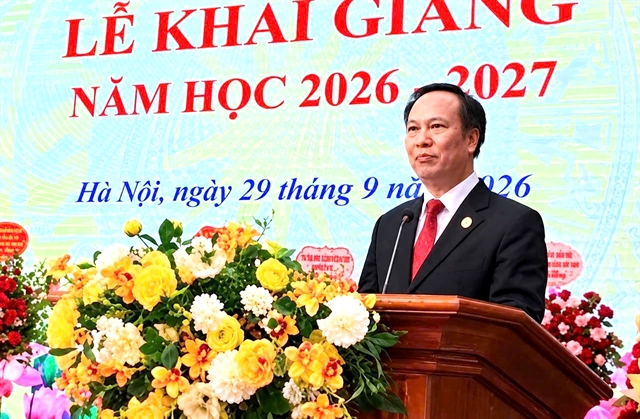 |
| Associate Professor Dr Nguyễn Đức Hạnh gives a speech at the opening ceremony for the 2026-2027 school year at the Việt Nam Court Academy. — Photo courtesy of the Việt Nam Court Academy |
Associate Professor Dr Nguyễn Đức Hạnh, director of the Việt Nam Court Academy, speaks to Việt Nam News reporter Thu Trang about the significance of living and working in accordance with the Constitution and the law, on the occasion of the Việt Nam Law Day on November 9.
As an institution responsible for training human resources for the court sector, how does the Việt Nam Court Academy (VCA) view the significance of this day in promoting a culture of living and working in accordance with the Constitution and the law, particularly among the future generation of officials and judges?
The VCA is a training institution under the Supreme People’s Court. We provide training and professional development for officials within the court sector. At the same time, we also carry out academic training for undergraduate and postgraduate students, awarding Bachelor of Laws and Master of Laws degrees. With these two training mandates, the Việt Nam Law Day is one of the most important and meaningful occasions for us.
We recognise that living and working in accordance with the law is one of the fundamental and core elements in building a socialist rule-of-law state of the people, by the people and for the people.
Whether students of the VCA can perform their adjudication duties well and resolve cases effectively is inseparable from strict compliance with the provisions of the law. Where the law has not yet provided specific regulations, they must also act in the interests of justice, the nation and the people, issuing decisions that help remove obstacles to resource flows and promote social development.
People must not only work in accordance with the law, but also live in accordance with it. This is a fundamental and core element in shaping the qualities and ethics of court officials, who should truly be 'close to the people, helping the people, understanding the people and learning from the people', and who should 'serve the public interest and uphold the law with impartiality and objectivity'.
These are also the qualities that we seek to instil in students studying in this environment, so that they can become high-quality human resources for judicial institutions in the future.
The theme of Việt Nam Law Day 2026 emphasises renewing thinking on law-making and law enforcement, promoting digital transformation and building a culture of compliance with the law. What are the measures that the VCA has adopted, and will adopt, to incorporate this spirit into its training programmes, scientific research and students’ practical activities?
The essence of the socialist rule-of-law State of Việt Nam is that it is a State of the people, by the people and for the people. To achieve this, the supreme requirement is compliance with the Constitution and the law. If a training institution fails to help learners understand and apply the supreme authority of the law, it has not fully fulfilled its responsibility as an institution specialising in legal education.
This is particularly important for an institution belonging to the court sector, a sector entrusted with adjudication and the exercise of judicial power. As the only institution entrusted with exercising judicial power, the court sector has an even greater responsibility to uphold the Constitution and the law.
The Constitution and the law are not to be upheld and implemented in a purely legalistic manner; they must always be linked with politics and must ensure both political and legal elements. Only then can we build a socialist rule-of-law state of Việt Nam that is truly of the people, by the people and for the people.
We are entering a digital era. Scientific research, work and study can no longer rely solely on traditional methods. We must apply information technology and use knowledge in the digital environment and cyberspace. In particular, the use of artificial intelligence and big data can support scientific research, legal research and legal education. This is both a task and a requirement. If institutions fail to apply these technologies and keep pace with developments, they will certainly be unable to develop, while learners’ capabilities and the knowledge imparted to them will lag behind those of other law schools.
As the head of a training institution, I therefore hope that, in line with the national digital transformation movement, the VCA will become one of the institutions that strongly applies and develops digital transformation in scientific research and teaching. Furthermore, we aim to connect with and share experience with reputable domestic and international law schools in the application of technology and digital transformation in legal education.
What capabilities should court officials be equipped with to ensure fair and professional adjudication, while also helping people access the law conveniently and promptly in the digital environment?
In the current context of digital transformation, as the early stage of the digital era is being prioritised and developed across all sectors and fields, the court sector cannot remain outside this process. It must also take responsibility for keeping pace with this trend. Online trials are one manifestation of this alignment.
Online trials will make it more convenient for people, help reduce litigation costs and effort, shorten trial times and make justice more accessible. In addition, in certain cases, online trials can remove obstacles at national borders when carrying out judicial cooperation or obtaining support from witnesses who are not present in Việt Nam or are unable to attend court hearings that have already been arranged.
At the same time, we believe that real-time, technology-enabled case management throughout the entire proceedings will make the compilation of statistics and the evaluation of adjudication more comprehensive, accurate and rapid. This will enable court leaders, as well as judges themselves, to review their results conveniently and quickly, learn from the experience of fellow judges, and identify common standards for performing their duties.
But, this also presents challenges. In today’s era, judges must observe appropriate standards of conduct in the digital environment and cyberspace. They must also know how to make use of artificial intelligence applications, and how to analyse, assess and use electronic evidence when handling the cases assigned to them. This will help people access justice more easily and ensure that justice is served.
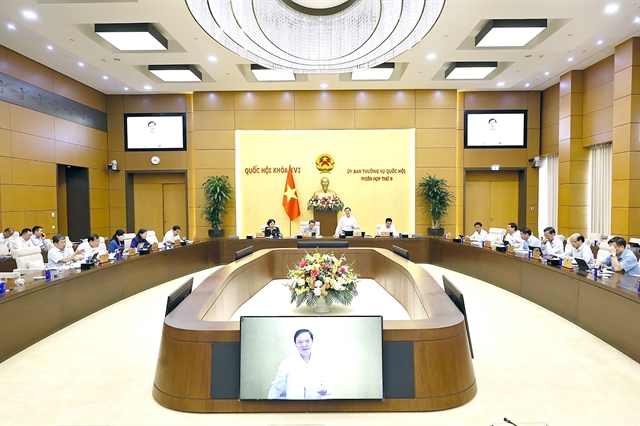 |
| National Assembly (NA) Vice Chairman Nguyễn Khắc Định speaks as the NA Standing Committee discussing opinions on the draft Resolution regulating protection regime for judges, on September 24, 2026. — VNA/VNS Photo Doãn Tấn |
Looking towards the 80th anniversary of the first National Assembly’s adoption of the first Constitution of the Democratic Republic of Việt Nam, what message would you like to send to students, trainees at the VCA as well as the community about their responsibility to respect, comply with and protect the Constitution and the law?
The essence of the socialist rule-of-law State of Việt Nam is that it is a State of the people, by the people and for the people. To achieve this, the supreme requirement is compliance with the Constitution and the law. If a training institution fails to help learners understand and apply the supreme authority of the law, it has not fully fulfilled its responsibility as an institution specialising in legal education.
This is particularly important for an institution belonging to the court sector, a sector entrusted with adjudication and the exercise of judicial power. As the only institution entrusted with exercising judicial power, the court sector has an even greater responsibility to uphold the Constitution and the law.
The Constitution and the law are not to be upheld and implemented in a purely legalistic manner; they must always be linked with politics and must ensure both political and legal elements. Only then can we build a socialist rule-of-law State of Việt Nam that is truly of the people, by the people and for the people. — VNS
Opinion
 Opinion
 Opinion
 Opinion
 Opinion
 Opinion
 Opinion
 Opinion
 Opinion
 Opinion
 Opinion
 Opinion
 Opinion
 Opinion
 Opinion