 Opinion
Garment, textile industry looks to AI, robots to boost competitiveness
1.
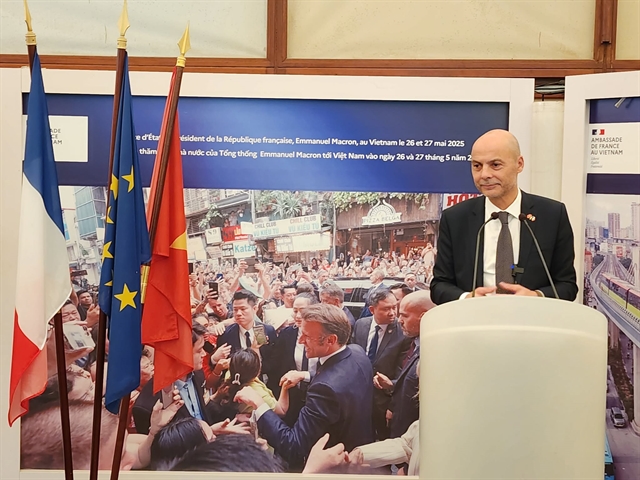 |
| French Ambassador to Việt Nam Didier Le Bret during his interview on September 30. — VNS Photo Lê Việt Dũng |
Didier Le Bret, France's new ambassador to Việt Nam, spoke to Việt Nam News about his priorities for bilateral ties, from education and high-speed rail to critical minerals, and the Francophonie and APEC summits ahead.
After the recent high-level visits and the new 2026–28 bilateral action plan, which concrete results are you prioritising?
I'm lucky to have a fairly precise roadmap. When I presented my credentials to General Secretary and President Tô Lâm, he reiterated what he sees as essential.
First, there's an exceptionally strong foundation to build on: the ties between our people. On his official visit to France, he visited Paris-Saclay University and our Atomic Energy Commission, and we signed several agreements on science, technology and training.
We're not starting from scratch. Nearly 7,000 Vietnamese students are in France, and another 1,500 go every year. Here we also have something unique: Franco-Vietnamese institutions in exactly the fields Việt Nam is prioritising – engineering, management and digital technology.
The PFIEV elite engineering programme, the University of Science and Technology of Hà Nội and the French-Vietnamese Centre for Management Education have more than 17,000 alumni. Add our two French high schools, some 40 accredited schools teaching French and research bodies such as CNRS, CIRAD, IRD and the Institut Pasteur, whose work is designed jointly around Việt Nam's development priorities and benefits France and the world too.
We also want to be present in Việt Nam's priority sectors – infrastructure, transport, energy – where France and Europe have world-class companies. Airbus has supplied most of Việt Nam's fleet over the past 20 years, and the General Secretary and President has asked us to speed up deliveries. Alstom has just signed a major contract with Vingroup for 200 trainsets.
So alongside our traditional strengths, such as pharmaceuticals, luxury goods and agrifood, we're moving into the sectors now vital to Việt Nam's economy.
How can France and Việt Nam step up cooperation in new technologies and innovation?
I'd single out three areas where there's strong demand on both sides.
The first is space, since so much of climate change is observed from above. More than 20 years ago, France supplied an Earth observation satellite that is now reaching the end of its life, and we're in advanced talks to replace it. The project also brings scientists together and builds skills.
The second is quantum, where top leader Lâm has asked us to get involved. France's Quandela recently signed an agreement with Vietnamese tech group FPT to work together on quantum computers. It goes both ways: FPT supplies software used in France by manufacturers such as Airbus.
The third is an old field that is also cutting-edge: critical raw materials and rare earths. The green and digital transitions both depend on them, from wind turbines and batteries to the chips in our phones and data centres. Việt Nam has very significant resources, and its authorities have asked France and Europe, most recently in Brussels, during the General Secretary and President's visit, to help map these resources, process them locally and develop them.
It's a genuine win-win: Việt Nam becomes a major player in a crucial field, and France and Europe secure agreements, not necessarily exclusive, that diversify our supply.
How can France support Việt Nam's ambitions in transport and energy?
On transport, let me focus on rail. The ambitions are enormous: one of the world's longest high-speed lines, between Hà Nội and HCM City, plus rail links to the big ports – Hải Phòng and HCM City's deep-water port.
France pioneered high-speed rail, and we want to support Việt Nam along the whole chain, from design and manufacturing to operation, maintenance and management. That's why major French engineering consultancies such as Artelia and Systra have been here for more than 20 years.
When France built its first high-speed lines in the early 1980s, they redrew the map of a very centralised country, and regions around Marseille, Bordeaux and Lille took off. The same will probably happen here if the line serves some 20 cities between Hà Nội and HCM City.
On energy, we'll keep supporting major renewables projects. At France's initiative, Europe set up the Just Energy Transition Partnership, worth 15 billion euros (US$16.8 billion), and more than 500 million euros has already been earmarked for renewables.
France and other European countries already have financing facilities for projects such as expanding capacity at Hòa Bình and upgrading the grid. That’s a regional concern too, and it sits broadly within the EU’s Global Gateway.
Where does Việt Nam fit into France's Indo-Pacific strategy, and where would you like to strengthen cooperation?
Why does France care about the Indo-Pacific? You might say we're a long way off, and you wouldn't be wrong. But France is a maritime power, with the world's second-largest maritime area, from waters off Canada to the Indian Ocean and the Pacific, where we have New Caledonia, French Polynesia and Wallis and Futuna. Ninety per cent of our exclusive economic zone is in the Pacific, and a quarter of our trade and foreign direct investment comes from there.
That makes the region a top priority, and it's why we have 7,000 military personnel permanently stationed there. With the agreement and support of the Vietnamese authorities, I'll be welcoming the frigate Vendémiaire on November 12 for a port call and joint exercises at sea. It shows we can be an active partner for Việt Nam in upholding freedom of navigation and safe sea lanes – things we can't necessarily take for granted these days.
What do you expect from the Francophonie Summit in Cambodia, and how can France and Việt Nam strengthen La Francophonie in Asia?
The Phnom Penh summit in mid-November will let our heads of state meet again and take stock of our Comprehensive Strategic Partnership. Choosing the OIF's next Secretary-General will also be high on the agenda.
Việt Nam, which hosted the first Francophonie Summit in Asia in 1997, has big ambitions and ideas of its own, including in sport, where it wants a strong presence at upcoming competitions.
La Francophonie can be a valuable platform for a country like Việt Nam. Like many members, it will bring a delegation of businesses and young entrepreneurs, especially in tech. Every summit has a dedicated exhibition area, the 'Francophonie Village', where members from north and south share good practices and showcase their innovations.
Việt Nam will host APEC in Phú Quốc in November 2027. What do you expect from the summit, and what role can Việt Nam play?
It's a major event, bringing together big economies driving global growth, from Canada and the US to Asia.
Although it's above all an economic forum, expectations are high because Việt Nam can act as a facilitator. Few countries have negotiated as many free trade and investment agreements with almost every major partner. Far from favouring tariffs, Việt Nam wants people, goods, services, ideas and investment to flow freely. That's an important voice to have at the summit.
Việt Nam is also one of the five or six countries most exposed to climate change, with its long coastline and the great farming regions of the Red River and Mekong deltas. So I think it may well put crisis preparedness high on the agenda, along with our shared duty to honour the Paris Agreement: countries that emitted little 30 years ago are paying the price today. It's in Việt Nam's interest to keep up the momentum with us on cutting emissions.
France isn’t an APEC member, but it belongs to a think tank that works on the economic and scientific issues APEC deals with. Its programme on 29 and 30 October, for which CIRAD handled the research side, focused on preparing Southeast Asia, and Việt Nam in particular, for climate shocks. Its national committee is chaired by former WTO Director-General Pascal Lamy. — VNS
Opinion
 Opinion
 Opinion
 Opinion
 Opinion
 Opinion
 Opinion
 Opinion
 Opinion
 Opinion
 Opinion
 Opinion
 Opinion
 Opinion
 Opinion