 Opinion
IRONMAN 70.3 triathlon heads to spectacular Ha Long Bay
1.
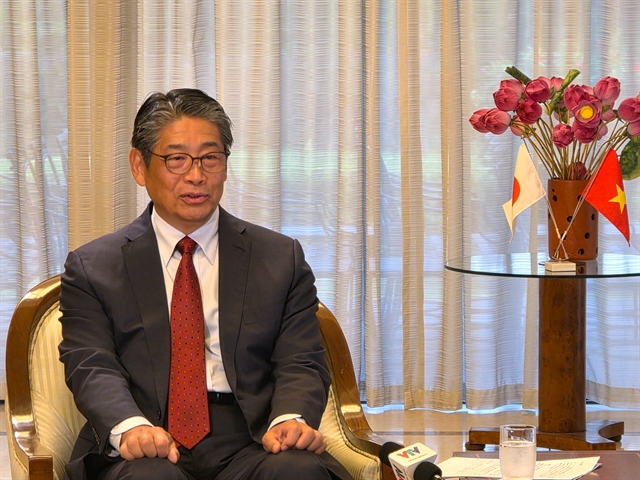 |
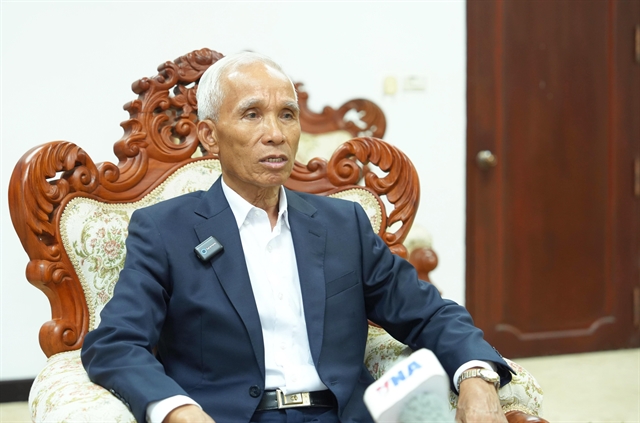
| Japanese Ambassador to Việt Nam Ito Naoki spoke to the local media ahead of General Secretary of the Communist Party of Việt Nam Central Committee and State President Tô Lâm's official visit to Japan. — VNS Photo Trọng Kiên |
HÀ NỘI — Japan and Việt Nam are looking to give fresh momentum to their Comprehensive Strategic Partnership, with cooperation in regional security, advanced technologies, and economic resilience expected to feature prominently during General Secretary of the Communist Party of Việt Nam (CPV) Central Committee and State President Tô Lâm's official visit to Japan from November 8 to 11.
Speaking with the local media ahead of the visit, Japanese Ambassador to Việt Nam Ito Naoki said the visit would be particularly significant as it marks the first trip to Japan by a CPV chief since the late leader Nguyễn Phú Trọng's visit in 2015.
It will also be the fifth visit to Japan by a CPV General Secretary.
Ambassador Ito said Japan attached great importance to the occasion, which takes place in the first year of Tô Lâm's new five-year term as Party General Secretary, reflecting Việt Nam's strong commitment to its relationship with Japan.
The visit follows Japanese Prime Minister Takaichi Sanae's trip to Việt Nam in May this year, providing an opportunity for leaders of both countries to build on recent exchanges and elevate bilateral ties to a new level.
Ito identified three major areas of cooperation that Japan particularly hopes to advance during the visit: contributing to regional peace and stability, strengthening economic cooperation, and promoting people-to-people and cultural exchanges.
Against a backdrop of increasingly complex international developments and challenges to the international order, the two countries share an interest in maintaining peace and stability in the region, he said.
He noted that both sides had repeatedly underscored the importance of upholding an international order based on international law and rules.
Technology and economic security
Economic security, supply chain resilience and innovation are expected to be among the key priorities of the visit, building on agreements reached during PM Takaichi's visit.
The two countries have identified artificial intelligence (AI), semiconductors, digital transformation, green transformation, critical minerals, food security and agriculture as priority areas for cooperation.
Japan is particularly interested in supporting Việt Nam in developing high-quality human resources for the semiconductor and AI industries.
The two countries are currently implementing joint semiconductor research and training programmes involving five pairs of universities, including doctoral training for Vietnamese researchers in Japan.
During the top leader's visit, the two sides are expected to announce six additional joint research projects in the semiconductor field.
Japan aims to train a total of 250 Vietnamese personnel in semiconductors through doctoral programmes at Japanese universities.
Ambassador Ito also said Japan was considering expanding its NEXUS human resource development programme, initially focused on semiconductors, to include AI training, following Việt Nam's request for greater cooperation in doctoral-level AI education.
Through the Japan International Cooperation Agency (JICA), Japan also plans to provide a programme loan to help Việt Nam improve its AI-related policies and institutional framework.
The Việt Nam–Japan University is another important component of bilateral educational cooperation. Japan aims to develop the institution into a research-oriented university promoting innovation and practical human resource training.
The construction of its campus using Japanese official development assistance (ODA) loans is expected to be implemented, while around 200 students are currently enrolled in semiconductor-related programmes at the university.
In the energy sector, Japan hopes to expand cooperation between governments and private businesses to ensure sufficient energy supplies for Việt Nam's growing economy.
Under the Asia Zero Emission Community (AZEC) initiative, Japanese companies are considering developing liquefied natural gas (LNG)-fired power plants in Việt Nam.
Ambassador Ito welcomed Việt Nam's ongoing revision of its Electricity Law, expressing hope that financial feasibility issues, particularly mechanisms to ensure the recovery of investment costs, would gradually be addressed.
He also emphasised the importance of closer coordination among governments, businesses and academic institutions to facilitate cooperation in energy, semiconductors, AI and green and digital transformation.
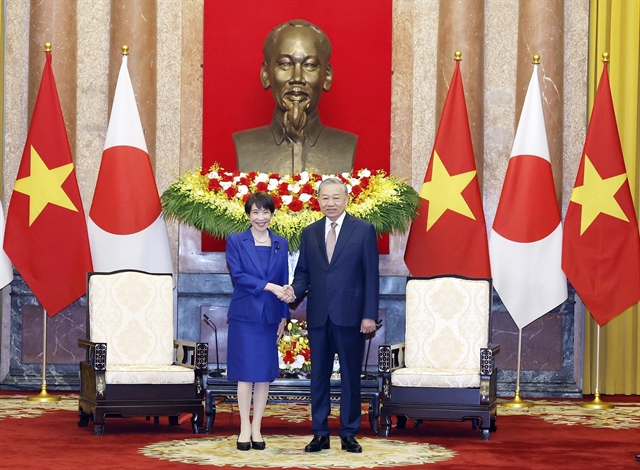 |
| Party General Secretary and State President Tô Lâm with Japanese Prime Minister Takaichi Sanae in Hà Nội on May 2. — VNA/VNS Photo Thống Nhất |
Trade and investment ties expand
Bilateral economic ties continue to demonstrate strong growth.
Trade between Japan and Việt Nam reached US$43.7 billion in the first nine months of 2026, up 15 per cent year-on-year. With the current growth momentum, the figure is expected to reach approximately $58 billion for the full year.
Bilateral trade has expanded 1.8-fold over the past decade and could reach $75 billion by 2030, according to the ambassador.
Electrical equipment, electronic components and automobile parts are expected to remain promising product groups as trade continues to expand.
Agricultural products also offer significant potential. The two countries are expected to open their respective markets to Japanese grapes and Vietnamese pomelos, which Ito said could be among the outcomes of the upcoming high-level talks.
Japan also expects exports of products such as sake and Wagyu beef to Việt Nam to increase alongside rising incomes and the expansion of the country's middle class.
Japanese investment in Việt Nam is also maintaining positive momentum.
Investment from Japan reached $2.45 billion in the January-September period, up 15.5 per cent year-on-year. Japan's accumulated investment in Việt Nam now stands at $81.2 billion, making it the country's third-largest foreign investor.
The Japanese diplomat welcomed Politburo's Resolution No. 10 on attracting high-quality foreign direct investment, particularly its emphasis on human resource development, technology transfer, research and development.
He said translating the resolution into appropriate incentives and concrete policies would help attract more high-quality Japanese investment, strengthen workforce training and deepen linkages between businesses in the two countries.
Japanese companies have actively encouraged Vietnamese suppliers to participate in their supply chains. Honda, for example, has achieved a localisation rate of 90 per cent in its motorcycle production in Việt Nam.
However, Vietnamese companies need to continue improving their technological capabilities, workforce quality and product standards to strengthen their ability to work with Japanese partners, he said.
Japan hopes to see more Vietnamese businesses become integrated into global supply and value chains, alongside increased investment by Japanese technology start-ups in Việt Nam.
Strengthening defence and security cooperation
Regional peace and stability will also be an important focus of bilateral cooperation, particularly amid growing strategic uncertainties in the Indo-Pacific.
Ito said Japan and Việt Nam shared strategic interests in maintaining an international order based on the rule of law and were committed to working together to contribute to regional peace and stability.
Defence cooperation has gained further momentum.
On October 28, Japanese Defence Minister Koizumi Shinjiro held talks with Vietnamese Deputy PM and Minister of National Defence Phan Văn Giang in Cebu, the Philippines. The two sides discussed cooperation for regional peace and development and agreed to strengthen collaboration in the development and production of high-speed landing craft.
Japan's Government and businesses will also participate in the Việt Nam International Defence Expo in December.
On November 2, Japanese shipbuilder Tsuneishi signed a contract with the Việt Nam Coast Guard to build six patrol vessels, under a project backed by a Japanese ODA loan worth 36.6 billion yen.
The two countries are also promoting cooperation through Japan's Official Security Assistance (OSA) framework.
Given Việt Nam's active participation in United Nations peacekeeping operations overseas, including in African countries, Japan is working to provide necessary equipment and support through the OSA mechanism, Ito said.
He added that Japan welcomed Việt Nam's growing international standing and its increasingly active contribution to regional peace and stability.
People-to-people exchanges and tourism
People-to-people exchanges remain another important pillar of bilateral relations.
The number of Vietnamese visitors to Japan is expected to exceed 700,000 this year, while Japanese arrivals in Việt Nam are forecast to approach 900,000, according to Ito.
The two countries aim to reach a combined two million visits in both directions annually before 2030.
Increasing direct and charter flights will be important to achieving this goal, the ambassador added.
Beyond major Japanese destinations such as Tokyo, Nagoya, Osaka and Fukuoka, Hiroshima and Shizuoka also have direct air connections with Việt Nam, while a direct route between Việt Nam and Hokkaido is being planned.
Ambassador Ito said Japan hoped more Vietnamese tourists would explore destinations beyond the traditional Golden Route of Tokyo, Osaka, Kyoto, and Mount Fuji.
The year 2028 will mark the 55th anniversary of diplomatic relations between the two countries. The visit is expected to provide an opportunity to establish further orientations for promoting bilateral tourism and exchanges between localities.
The two countries have already held two local cooperation forums, in Quảng Ninh last year and Huế this year. A third edition is expected to take place in Việt Nam in 2027.
Cultural cooperation, particularly in creative industries, is another area with considerable potential. While Việt Nam is focusing on developing its cultural industries, Japan is seeking to expand its content industry, including manga, anime and J-pop.
Ito said greater cultural exchanges could help strengthen understanding between the two peoples, particularly younger generations.
Improving conditions for Vietnamese workers in Japan
Japan is also seeking to improve working conditions and career development opportunities for foreign workers, including Vietnamese nationals.
A new Employment for Skill Development programme is scheduled to be introduced in April 2027, with the governments of Japan and Việt Nam currently discussing a memorandum of cooperation on the scheme.
Under the new programme, recruitment fees charged by sending organisations will be capped at the equivalent of two months' salary. Workers will also be allowed to change employers under certain conditions, while the transition to Japan's Specified Skilled Worker programme, which targets workers with higher levels of professional skills, will be made easier.
The initiative aims to provide foreign workers with more opportunities to improve their professional qualifications, extend their working careers in Japan and develop their skills, Ito said.
Japan is also working to strengthen Japanese-language support for foreign workers from their arrival and throughout their employment.
The ambassador noted that around 690,000 Vietnamese nationals were currently living in Japan.
Japan hopes the two countries will reach agreement on international consular arrangements, including provisions requiring consular notification in all applicable cases.
Ito said stronger cooperation in this area would help reduce legal violations among Vietnamese nationals, improve their working and living environment, and create more favourable conditions for people-to-people exchanges.
Looking ahead, he said Japan hoped to continue supporting Việt Nam's growing role in regional and international affairs.
He particularly welcomed Việt Nam's role as CPTPP chair this year and its preparations to host APEC in 2027, expressing Japan's readiness to work closely with Việt Nam to ensure the success of the event.
Japan also attaches importance to advancing its vision of a Free and Open Indo-Pacific (FOIP), which Ambassador Ito described as an important framework for building a peaceful and prosperous region.
He said Việt Nam's support for Japan's regional initiatives, including FOIP, expressed during PM Takaichi's Hà Nội visit, was a meaningful message that opened up further prospects for bilateral cooperation. — VNS
Opinion
 Opinion
 Opinion
 Opinion
 Opinion
 Opinion
 Opinion
 Opinion
 Opinion
 Opinion
 Opinion
 Opinion
 Opinion
 Opinion
 Opinion