 Opinion
Aligning education with in-demand skills key to UK-Việt Nam partnership: ambassador
1.
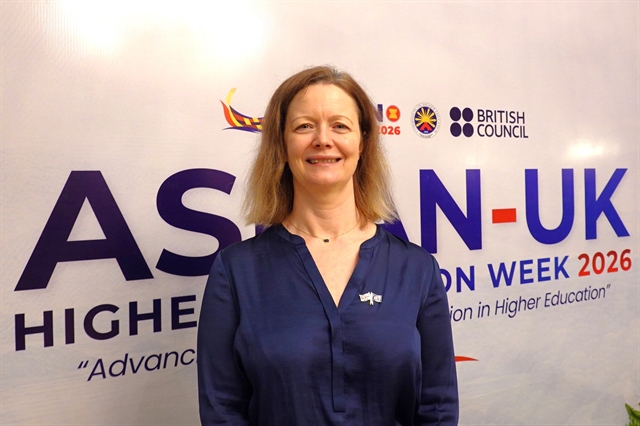
Nearly 160 education experts gathered at the ASEAN-UK Higher Education Week, held from November 3 to 5 in the Philippines, to discuss ways to strengthen higher education cooperation between the bloc and the UK. Helen Fazey, UK Ambassador to ASEAN, spoke to Việt Nam News reporter Bảo Hoa about the potential for further regional cooperation and for transnational education partnership between the UK and Việt Nam.
|
| UK Ambassador to ASEAN Helen Fazey. — VNS Photo Bảo Hoa |
How do you evaluate the potential for cooperation between the UK and ASEAN, especially in higher education?
I think there is enormous potential for cooperation between ASEAN and the UK and higher education is a really important part of our partnership. We have already got strong foundations in higher education research and skills, but there's a lot more that we can achieve together. ASEAN is one of the most dynamic regions in the world with growing demand for advanced skills, research capability, and international partnerships in higher education, while on the UK side, we bring globally recognised strengths in science, innovation, research and quality assurance.
I think it's really exciting where our priorities align across ASEAN. We see governments investing in areas like AI, digital technologies, advanced manufacturing, green energy, healthcare and lifelong learning. We were discussing this with officials from ASEAN earlier, and these are all areas where UK universities and researchers and businesses have considerable expertise and experience.
As we look ahead, I think there's a huge opportunity to move beyond just talking about student mobility and to focus on creating solutions to shared challenges together, whether that's about developing future skills, accelerating innovation, supporting the green transition, or helping people reskill throughout their working lives. There's a real potential for ASEAN and the UK to achieve things together.
What are the specific actions that the UK will take to turn this potential into results?
We are going to continue using forums like the ASEAN-UK Higher Education Week that we did in Manila to exchange ideas, share best practice, and develop practical partnerships that support skills development, higher education, research, and innovation across the region.
If I look particularly at Việt Nam, there's a framework for us working together on shared education, skills and challenges, and new areas for collaboration through a memorandum of understanding that our Minister for Skills, Baroness Smith, signed when she visited Việt Nam last month.
We have already got common interests in sectors like maritime, pharmaceuticals and green energy, and we're really keen to deepen that cooperation and keep exploring new opportunities for partnerships between our universities, researchers and skills providers.
Việt Nam ranked fifth in the East Asian region in the number of students enrolled in UK transnational education programmes in 2024-25, above countries with higher economic development levels such as Japan and South Korea. Why does a British education have such a strong appeal to Vietnamese students?
I think there are three reasons why the UK is popular for Vietnamese students. Firstly, we have got a globally recognised reputation for the quality of education and research and professional qualifications that are available in the UK. Secondly, we have spent many years building a strong education ecosystem with Việt Nam, and that runs from English language teaching, K-12 education, transnational education, professional qualifications and university partnerships. We have worked really closely with Vietnamese partners to support the development of the education sector at every level, from schools and technical and vocational qualifications to colleges and universities.
And the third reason is, I think what the UK has to offer aligns very well with Việt Nam's priorities. Not every student wants or is able to study overseas. So the transnational education offer from the UK means that students have an opportunity to gain internationally recognised qualifications while studying closer to home, and with the lower costs that being closer to home brings. So that's one reason why the UK is now Việt Nam's largest transnational education partner, with around 70 programmes and more than 13,000 students enrolled in those programmes.
Do you think this potential can be elevated further in the future?
Absolutely. I think there is a huge potential to keep building on this. There is a lot of demand from Vietnamese students, which is really exciting for us to see, and a long track record of collaboration between the UK and Việt Nam, and confidence on the Vietnamese side about the quality of the education that is provided by UK institutions. So the next step is to deepen and strengthen that collaboration.
We need to make sure that our partnerships are aligned with the future skills that are going to be needed in both countries, in areas like advanced manufacturing, green energy and pharmaceuticals. So we can work together on shared priorities, and it's a really core part of the UK approach on this is that we aren't coming to Việt Nam or any other country and saying 'this is how you do it'. It is about having ASEAN-led priorities, adapting to those, understanding those, and bringing what is useful to you from the UK's expertise and experience. — VNS
Opinion
 Opinion
 Opinion
 Opinion
 Opinion
 Opinion
 Opinion
 Opinion
 Opinion
 Opinion
 Opinion
 Opinion
 Opinion
 Opinion
 Opinion