.jpg) Opinion

Private conglomerates expand economic contributions through jobs, taxes and investments
1.
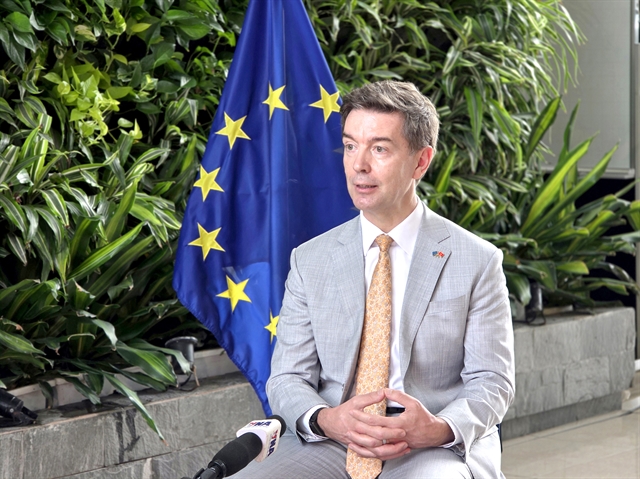 |
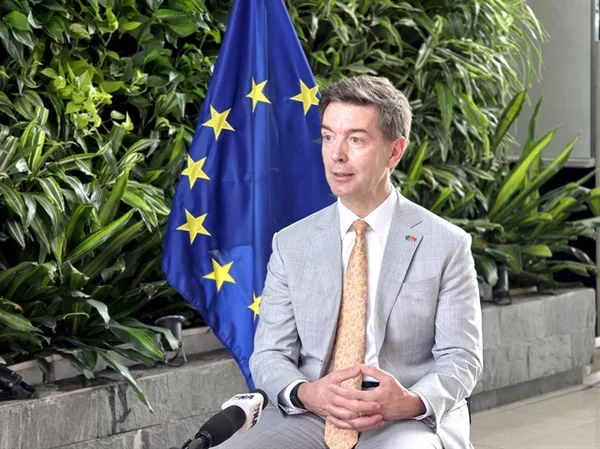
| EU Ambassador to Việt Nam Julien Guerrier at the press briefing with Vietnamese media in Hà Nội. — VNS Photo Trọng Kiên |
HÀ NỘI — General Secretary of the Communist Party of Việt Nam and President Tô Lâm's European Union visit on October 22 seeks to translate their Comprehensive Strategic Partnership into concrete outcomes in trade, investment, energy, technology and security, EU Ambassador to Việt Nam Julien Guerrier said.
Speaking to media ahead of the visit, Guerrier said Việt Nam's top leader would hold meetings with European Commission President Ursula von der Leyen and European Council President António Costa in Brussels. Costa will also host an official luncheon for the Vietnamese leader at the EC's premises.
A business roundtable with General Secretary and President Tô Lâm along with chief executives of major European companies will also take place, while ministers, Politburo members, provincial leaders and business representatives accompanying the leader are expected to hold parallel meetings with their European counterparts, offering an opportunity to advance cooperation across a broad range of sectors, Guerrier said.
The visit comes as Việt Nam and the EU want to build on the Comprehensive Strategic Partnership established in January during Costa's visit to Hà Nội, following 35 years of diplomatic relations.
“For us, it's a very important moment in the relationship between the EU and Việt Nam,” Guerrier said, adding that the visit would allow the two sides to review implementation of the partnership and 'translate our shared ambitions into practical and concrete results'.
The agenda will cover trade and investment, energy, education, science and technology, security, and critical raw materials, alongside discussions on international law and multilateral cooperation.
Trade and investment at the centre of the agenda
Trade and investment will be among the main priorities, as the EU ambassador highlighted the scope for further expansion of economic ties eight years after the entry into force of the EU–Việt Nam Free Trade Agreement (EVFTA) in 2020.
Bilateral trade exceeded €76 billion (US$85.3 billion) last year, he said, but further growth would depend on fully implementing the agreement, addressing remaining trade barriers and creating a more predictable and transparent regulatory environment in Việt Nam.
The EU wants to encourage more small and medium-sized European companies to invest in the country and develop industrial ecosystems, bringing not only capital but also advanced technologies, he said.
“We want to invest in quality industries here in Việt Nam,” Guerrier said, adding that European investment and technology could support Việt Nam's strategic autonomy in areas including transport, secure digital infrastructure and energy infrastructure.
The EU's Global Gateway initiative is expected to play an important role in advancing these ambitions.
The EU will continue supporting Việt Nam's ambition to become a developed country by 2045 and achieve climate neutrality by 2050, he added.
Energy security and critical raw materials
Energy security and critical raw materials are expected to feature prominently as both sides seek to diversify supply chains and reduce exposure to external disruptions.
Guerrier remarked that the crisis in the Strait of Hormuz has underlined the importance of secure energy supplies and domestic energy production, pointing to the common interest in expanding clean energy.
The EU intends to accelerate funding and cooperation through its Just Energy Transition Partnership (JETP) with Việt Nam and the infrastructure initiative Global Gateway, supporting renewable energy development, including hydropower, wind and solar power.
The bloc is also supporting the development of Việt Nam's nuclear industry, particularly in nuclear safety, he said.
Expanding clean energy generation will be important not only to meet Việt Nam's rapidly growing demand for electricity but also to reduce industrial emissions and improve energy security.
Guerrier said the regulatory environment would need to develop in ways that attract private investment, including investment to improve the quality of the electricity grid and strengthen interconnections with other ASEAN countries.
The EU is also strongly supporting the ASEAN Power Grid, which aims to improve regional electricity connectivity.
On critical raw materials, Guerrier said the EU and Việt Nam had complementary interests and capabilities that could support the development of more diversified global supply chains.
Europe could contribute capital and technologies for mapping, exploration, extraction, processing and recycling, while Việt Nam has important reserves of rare earths and tungsten that could contribute to global supplies.
“At this stage, what's important for us is to assess precisely what we can bring here,” he said, referring to the technologies Europe could offer and the ways Việt Nam could develop its role in international supply chains.
The high-level discussions in Brussels are expected to explore how European expertise could support the development of Việt Nam's domestic capabilities while providing more secure sources of raw materials for European industry.
Railway infrastructure, education and technology
Transport infrastructure is another priority, with the EU seeking to support the development of sustainable urban transport and railway networks in Việt Nam.
Guerrier said the bloc had launched a dedicated transport facility for Việt Nam this year, providing €40 million ($44.8 million) in grants and technical assistance to help transfer advanced standards and expertise in high-speed railways and urban transport.
The facility is expected to help leverage €1 billion in concessional loans from European financial institutions, including the European Investment Bank and national development banks, he said.
European support will also include technical assistance for infrastructure projects and training facilities to prepare workers to operate new railway lines and metro systems planned for the coming years.
The EU has also invested in a terminal project at Đà Nẵng Port worth €2 billion, which Guerrier described as an effort to develop Việt Nam's first climate-neutral port terminal. The facility is intended to serve central Việt Nam and neighbouring Laos.
Education, science and technology will form another important strand of the visit.
A letter of intent on education and training is expected to be signed between Việt Nam's Ministry of Education and Training and European Commission, paving the way for initiatives to strengthen exchanges between students and researchers, as well as encourage more Vietnamese researchers and research institutions to participate in Horizon Europe, the EU's research and innovation funding programme.
Guerrier said stronger educational links would support Việt Nam's development needs and help European companies operating in the country, while building lasting connections between people and institutions.
He also outlined plans for two major projects to support the development of the circular economy in Việt Nam, covering industry and agriculture, alongside more specific infrastructure renovation projects in Hà Nội and railway training centres.
IUU fishing yellow card remains unresolved
Responding to the media's queries over the outstanding issue of EU's yellow card against Việt Nam over illegal, unreported and unregulated (IUU) fishing, Guerrier said the two sides had cooperated on the issue for almost a decade, with significant progress made in developing Việt Nam's legal framework and improving vessel monitoring.
He said he had met the Minister of Agriculture and Environment the previous day and praised the coordination between the two sides in establishing legislation and regulations intended to bring Việt Nam's fisheries management in line with international standards.
However, implementation at provincial level remained more difficult, while the latest inspection had identified further work needed on the traceability of processed fisheries products.
The EU has supported Việt Nam's efforts, including by funding experts through the Food and Agriculture Organization of the United Nations, he said.
The Ministry of Agriculture and Environment was preparing an updated report on progress, which the EU would need to assess before determining the next steps.
“We hope that we can soon lift the IUU yellow card,” Guerrier said, but cautioned that the warning would not be lifted during the coming visit.
“We still will need to receive the report, to analyse it, to have a new inspection coming in,” he said, adding that he hoped the assessment would show continued progress towards lifting the measure.
Maritime security, international law
Beyond economic cooperation, the visit will provide an opportunity for Việt Nam and the EU to strengthen coordination on international law, maritime security and shared concerns over regional and global stability.
Guerrier said the two sides shared an interest in multilateralism, international law and free and open trade at a time when geopolitical tensions were mounting and international rules were being challenged.
The EU considers Việt Nam a key partner in the Indo-Pacific and the first ASEAN member with which it has established a Comprehensive Strategic Partnership.
The bloc is also seeking to strengthen ties with other partners in the region, having concluded trade agreements with the Philippines and Indonesia and pursued negotiations with Malaysia and Thailand, he said.
On maritime security, Guerrier highlighted the strategic importance of the South China Sea (known in Việt Nam as the East Sea) to Europe, despite its geographical distance.
“It's far away from Europe, but we have 40 per cent of our imports and 25 per cent of our exports that sail through the South China Sea,” he said.
The two sides therefore shared an interest in ensuring freedom of navigation and peace and security in the region.
Guerrier said the EU wanted to reinforce bilateral cooperation with Việt Nam on maritime security, the security of undersea cables and counterterrorism, while continuing to work through ASEAN-led mechanisms where possible.
The two sides also share a commitment to the United Nations Convention on the Law of the Sea (UNCLOS), he said, adding that discussions would cover the importance of international law, territorial integrity and the autonomy of nations.
The EU hopes to upgrade its relations with ASEAN to a Comprehensive Strategic Partnership next year, coinciding with the 50th anniversary of EU–ASEAN relations. It also hopes to contribute to a more secure and stable region through work on the South China Sea Code of Conduct, Guerrier said.
He noted that Việt Nam was the only ASEAN partner with which the EU had a Framework Participation Agreement enabling Vietnamese personnel to participate in EU missions. The arrangement also supports the training of Vietnamese peacekeeping officers for participation in EU and United Nations missions.
Việt Nam's role in regional and international organisations was also an important area of cooperation, he said, citing the country's participation in ASEAN, its chairmanship of the Comprehensive and Progressive Agreement for Trans-Pacific Partnership (CPTPP) this year, and its preparations to host APEC next year.
The EU was particularly interested in working with like-minded partners to develop international rules and standards in areas where multilateral institutions faced difficulties delivering results, including digital trade.
Guerrier said he had been encouraged by the alignment between remarks delivered by President Costa and Việt Nam’s top leader Tô Lâm at the United Nations General Assembly in New York recently, particularly their support for multilateral institutions and an international order based on law.
He said the breadth of the agenda reflected the growing depth of the relationship, which now covered nearly all areas of public policy.
The objective, he added, was to build on the Comprehensive Strategic Partnership through practical cooperation that would benefit both sides over the coming years.
“We have a stable, steadily increasing, and strong relationship between the two sides,” the EU diplomat said.
“And we want to continue on that trajectory for the years to come for our mutual benefits.” — VNS
Opinion
 Opinion
 Opinion
 Opinion
 Opinion
 Opinion
 Opinion
 Opinion
 Opinion
 Opinion
 Opinion
 Opinion
 Opinion
 Opinion
 Opinion