 Society

Vietnamese leaders extend congratulations to Kazakhstan on Republic Day
1.
|
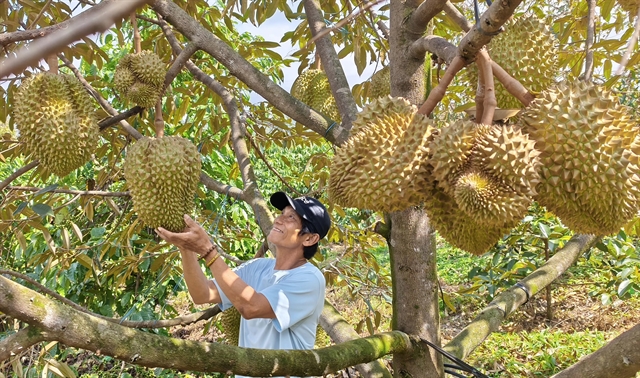
| A farmer in Nhân Cơ Commune, Lâm Đồng Province, tends his durian orchard using high-tech farming methods, organic fertiliser and a water-saving irrigation system. — VNA/VNS Photo Nguyễn Huy Thành |
LÂM ĐỒNG — Lâm Đồng Province is shifting from conventional agricultural production towards a knowledge-based agricultural economy, combining high technology, green transformation, digital commerce and farm-based tourism.
The efforts are in line with the implementation of the Politburo’s Resolution No 57 on breakthroughs in science, technology, innovation and national digital transformation issued in December 2024.
The province, spanning the Tây Nguyên (Central Highlands) and south-central coastal regions, is applying science, technology, innovation and digital transformation to develop high-tech agriculture, expand digital trade and promote green production.
It has nearly 109,500ha of high-tech farmland, accounting for more than 38.5 per cent of the province’s GRDP.
In key farming areas, including Đà Lạt, Đơn Dương, Đức Trọng and Lạc Dương, Internet of Things (IoT) sensors are being used to monitor soil moisture and micronutrients and automate irrigation.
Precision farming has supported high-value models such as premium flowers, hydroponic vegetables and medicinal plants, generating annual revenue ranging from billions to tens of billions of đồng per hectare.
The province Department of Industry and Trade has focused on digitalising commercial infrastructure and strengthening agricultural value chains.
It has worked to standardise 961 growing-area codes using GIS and apply blockchain identification to 100 per cent of the province’s products recognised under the country’s “One Commune – One Product” programme.
It has also promoted multi-channel trade and expanded the presence of processed agricultural products on modern retail systems and e-commerce platforms.
Direct farm-to-consumer sales are being encouraged to reduce intermediaries and improve farmers’ profits.
The province is also supporting deeper processing, lower emissions and eco-friendly packaging.
Agricultural tourism is another part of the strategy, with 33 quality agricultural tourism sites standardised.
These models not only diversify local tourism products but also serve as “on-site distribution channels”, directly connecting high-tech agricultural products with consumers.
Digital tools such as QR codes are used to connect farm experiences, local produce and on-site purchases. — VNS
Society
 Society
 Society
 Society
 Society
 Society
 Society
 Society
 Society
 Society
 Society
 Society
 Society
 Society
 Society