 Society

Việt Nam, Laos firms sign deals on property, smart farming projects
1.
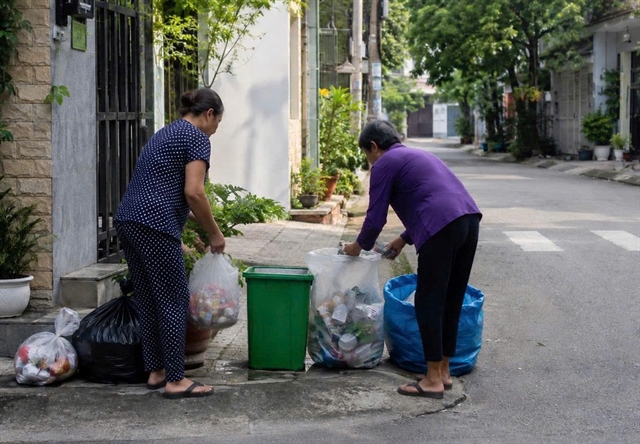 |
| Residents in HCM City collect and sort domestic waste in a residential area, helping reduce the total volume sent for treatment and fostering green living habits. — VNA/VNS Photo |
HCM CITY — HCM City has begun charging household waste fees based on volume or weight, a key reform designed to motivate waste reduction and sorting at source.
The new framework, which took effect on September 1 under Decision No 65/2026/QĐ-UBND and Law No 146/2025/QH15, applies until June 30, 2027.
It fundamentally shifts the city’s waste management strategy from fixed flat rates to a system based on actual generation and household size, encouraging residents to move from "paying to dispose" to "controlling waste to curb costs."
Under the new policy, unsorted residential waste is billed according to demographic tiers.
In central urban wards and communes, small households with two or fewer residents pay a combined monthly collection and transport fee of VNĐ42,000 ($1.7), a reduction of nearly 50 per cent for many small families.
Households with three or more residents pay VNĐ84,000 ($3.3) per month.
Pricing varies across non-central zones and suburban areas, with Special Zone Côn Đảo recording the lowest base rate.
Conversely, households that properly sort their waste pay a collection fee of VNĐ666 ($0.03) per kilogramme.
For small businesses producing up to 300kg per day, fees are structured into volume brackets; those generating between 250kg and nine tonnes per month pay per-kilogramme rates ranging from VNĐ453 to VNĐ486 ($0.018-$0.019) for collection and VNĐ147 to VNĐ180 ($0.006-$0.007) for transport.
Following administrative consolidations, the city generates nearly 14,000 tonnes of municipal solid waste daily, most of which remains unsorted.
Officials project that effective sorting could cut daily collected volumes by up to 30 per cent, significantly easing pressure on transport networks, landfill space, and treatment facilities.
While residents and business owners welcome the fairer pricing, many emphasise the need for end-to-end synchronisation across the supply chain to ensure sorted waste is not re-mixed during transport.
Effective implementation relies on several core requirements.
Standardised collection aligns private and public collectors to ensure sorted waste streams remain separate during transport.
Scheduled logistics establish clear, neighbourhood-specific timetables alongside specialised vehicles designed for narrow alleys.
Digital monitoring utilises centralised management software, automated weighbridges, and real-time GPS tracking to oversee service quality and track waste origins.
Finally, organic waste reuse encourages the local composting of food waste, allowing households to reduce their total output and further lower their monthly bills.
Nguyễn Hồng Nguyên, deputy director of the city Department of Agriculture and Environment, said the city is currently drafting and advising the city People's Committee to issue unified regulations on domestic solid waste and medical waste management, alongside a comprehensive plan for waste separation at source.
“The aim is to promulgate these legal documents by the fourth quarter of 2026 to ensure full execution starting in 2027.”
Alongside policy building, the department is perfecting shared waste management software from municipal to ward levels to monitor waste source data, identify source owners, and apply corresponding service rates transparently. — VNS
Society
 Society
 Society
 Society
 Society
 Society
 Society
 Society
 Society
 Society
 Society
 Society
 Society
 Society
 Society