 Society

Coca-Cola Hong Kong Launches "Coca-Cola Recycling Academy"
1.

|
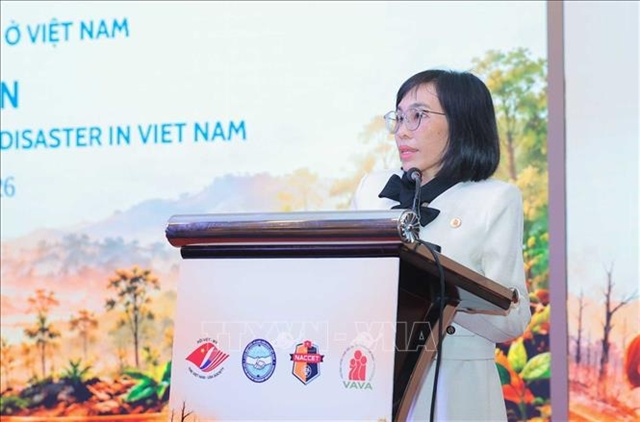
| Deputy Minister of Health Lê Đức Luận speaks at the ceremony to launch a national programme on child protection and the prevention and reduction of child labour on September 11. — VNA/VNS Photo |
HÀ NỘI — The Ministry of Health on Friday launched a national programme on child protection and the prevention and reduction of child labour, targeting a reduction in the proportion of children aged 5-17 engaged in child labour to below 1.1 per cent by 2030.
The launch aims to promote and carry out the Prime Minister's Decision 1415/QĐ-TTg issued on July 28, with the event in Hà Nội connected to the health departments of all 34 provinces and cities nationwide.
Under the national programme, children affected by violence, sexual abuse or child labour, those at risk of exploitation or abandonment, and those in other special circumstances will gain access to support and intervention services to help them reintegrate into society and achieve comprehensive development.
The programme sets several key targets for 2030, including reducing the rate of children affected by violence and sexual abuse by at least 5 per cent annually and bringing the rate of child labour among those aged 5-17 to below 1.1 per cent.
All provinces and cities are expected to carry out integrated child protection service models, while 95 per cent of commune-level administrations are to implement inter-sectoral service models and 100 per cent are to establish child-friendly investigation rooms.
All requests for legal aid for children will be addressed in accordance with the law. To improve management, 100 per cent of children requiring protection or at risk will be registered and managed through a database that is connected with other relevant databases.
At the launch, Deputy Minister of Health Lê Đức Luận pointed out a number of difficulties and challenges facing child protection efforts.
Violence against children is on the rise globally amid economic downturns, inflation and natural and social shocks, increasing the risk that vulnerable children will drop out of school and enter the labour force prematurely, he said.
Child labour also persists in the agriculture, forestry and fisheries sectors, households and small-scale production and business establishments, where inspection and supervision are particularly difficult.

|
| Delegates at the launch of the national programme on child protection and the prevention and reduction of child labour for the 2026–30 period. — VNA/VNS Photo |
In some areas, the network of child protection service providers remains limited, while service coordination, interconnection and referral mechanisms are not yet consistent. The application of information technology and the management of child-related data at the local level also vary considerably among regions.
A representative of UNICEF in Việt Nam said children in the country continue to face multiple risks, including violence, exploitation and sexual abuse, including abuse and exploitation online, as well as hazardous and arduous work.
Addressing these challenges requires more than laws and policies, the representative said. What is needed is a strong, integrated and adequately funded child protection system, supported by social workers, reliable data, effective coordination mechanisms and accessible services reaching every community.
At the event, Luận emphasised that the national programme for 2026–30 sets out six groups of tasks and solutions, ensuring clear responsibilities, duties, authority, timelines and expected results.
As 2026 marks the first year of implementation of the five-year socio-economic development plan, effective implementation of the programme from the outset will be crucial to achieving the country's sustainable development goals and fulfilling its international commitments on children's rights, he noted.
According to the Department of Mother and Child Health, as of 2025, Việt Nam had nearly 25 million children, including 13,092,705 boys, accounting for 52.5 per cent, and 11,857,711 girls, or 47.5 per cent.
Children from ethnic groups accounted for 18.3 per cent of the total, while those living in multidimensional poverty accounted for 8.4 per cent.
There were 790,514 children in special circumstances, representing 3.2 per cent of all children nationwide. About 15,000 children in special circumstances were receiving monthly social assistance benefits. — VNS
Society
 Society
 Society
 Society
 Society
 Society
 Society
 Society
 Society
 Society
 Society
 Society
 Society
 Society
 Society