 Society
Project lays foundation for digital greenhouse gas emissions data management
1.

|
| Local authorities and residents attend the conference to sum up the campaign. — VNS Photo Thu Trang |
QUẢNG TRỊ — Nine inspiring stories were developed and subsequently shared on the media platforms of Lìa Commune Women’s Union and community groups, recording a total of over 3,000 interactions and more than 150,000 views.
This constitutes one of the key outcomes of the “2026 Behaviour change communication campaign”, themed “My household takes action – My village transforms”, implemented by the Lìa Commune Project Management Board in Quảng Trị Province, in coordination with Plan International in Quảng Trị.
The programme is funded by the Government of Ireland’s International Development Programme through the Embassy of Ireland in Hà Nội.
The campaign aims to raise awareness and encourage residents to adopt positive behaviours within households and communities, contributing to enhanced climate change adaptation capacity, while simultaneously promoting women’s participation, voice and role.
The campaign was implemented across six villages including Tân Thuận, Thuận Phú, Thanh Hòa, Thanh Mới, A Xing and A Túc
Each village selected 10 participating households, totalling 60 households.
Participating households joined on a voluntary basis, selecting behaviours suited to their actual household conditions, with the goal of building “Adaptive and equitable communities”.
Hồ Thị Huệ, head of the commune’s Culture and Social Affairs Division and deputy head of the commune Project Management Board, stated that climate change was exhibiting increasingly irregular patterns, directly affecting agricultural production, livelihoods and people’s daily lives – particularly in mountainous areas, where many households’ livelihoods remain heavily dependent on agriculture.
“Alongside livelihood and production challenges, women continue to face certain limitations in participating in and making decisions related to production, livelihoods, household tasks and community activities. Women typically shoulder the majority of family care responsibilities, yet do not always have sufficient conditions or time to engage in economic development activities, training sessions or community events,” she said.
The campaign promotes action, encouraging residents to select, implement and share specific behaviours appropriate to their household and community circumstances.
The campaign focuses on three behavioural groups.
First is climate-adaptive production behaviours, encouraging households to adopt suitable practices that reduce the impact of irregular weather on production and livelihoods.
Second is men supporting women, urging men to share household chores, childcare, support production work and create conditions for women to attend training sessions, village meetings and community activities.
And third is elders supporting women, promoting older family members to respect and support women’s voice, participation and decision-making rights within the household and community.
Huệ noted that initial changes at the household level have been observed.
Several practical cases demonstrate that behaviours related to climate-adaptive production, men’s sharing of responsibilities and elders’ support for women have been implemented.
These are positive signals that require continued monitoring to assess sustainability and scalability.
The campaign has created a space for residents to practise, share and spread positive behaviours originating from their own households.
“This serves as a foundation for continued accompaniment of participating households, monitoring behavioural maintenance, selecting exemplary cases and integrating key messages into regular village and mass organisation activities. Through this, initial changes can gradually become positive habits and norms within households and communities,” said Huệ.
|
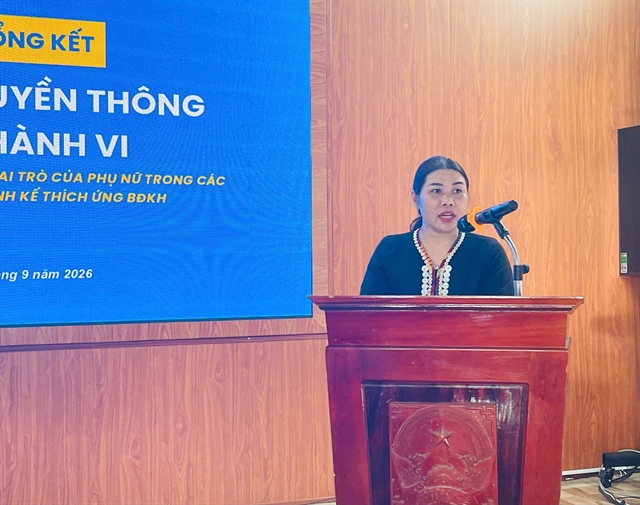
| Hồ Thị Huệ, head of the commune’s Culture and Social Affairs Division and deputy head of the commune Project Management Board, speaks at the event. — VNS Photo Thu Trang |
Hồ Văn Thăng, from Thanh Hoà Village, said: “In my view, within family life, each person has their own tasks and responsibilities. If husband and wife know how to share with one another, the workload becomes less burdensome and the family becomes happier.”
Previously, Thăng believed that household chores were primarily women’s responsibility. Through participating in the campaign and reflecting on his own family life, he realised that tasks such as cooking, cleaning, childcare and other domestic duties are in fact shared responsibilities.
“Therefore, my wife and I share household tasks. When she is busy, I do what I can. We also discuss production work and family-related matters together. I have come to realise that when husbands share responsibilities, wives gain additional time and opportunities to pursue other work, develop economically and care for themselves and their families.
“For me, sharing housework is not about ‘helping’ my wife – it is about sharing responsibility for the family together,” Thăng said.
“The tasks we do each day may be small, but if both husband and wife change together, the family will change. I hope that every family will start with small actions, share responsibilities together and build happier families together,” he added.
Huệ expressed her belief that the campaign’s greatest value lies not only in the activities carried out, but in the fact that we have begun to establish a new approach: residents are no longer merely the target of communication efforts, but are themselves the agents and sharers of change.
She indicated that, in the coming period, behaviours related to climate-adaptive production, men’s sharing of household responsibilities and elders’ support for women will continue to be integrated into regular village and mass organisation activities – including village meetings; Women’s Union branch meetings; Farmers’ Association and Youth Union activities; training classes; livelihood development initiatives; and community communication activities. — VNS
Society
 Society
 Society
 Society
 Society
 Society
 Society
 Society
 Society
 Society
 Society
 Society
 Society
 Society
 Society