 Society

Ambassador pledges every effort to promote Việt Nam–Sweden ties
1.
|
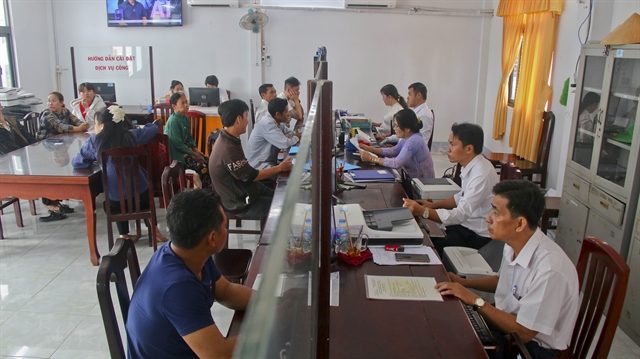
| Residents complete administrative procedures at the Hỏa Lựu Commune Public Administration Service Centre. — VNA/VNS Photo |
CẦN THƠ — Cần Thơ is accelerating digital transformation and artificial intelligence (AI) adoption in public administration to improve services for residents and businesses.
The efforts are being carried out under the implementation of the Politburo’s Resolution No. 57, issued in December 2024, on breakthroughs in science, technology, innovation and national digital transformation.
The Cửu Long (Mekong) Delta city has intensified digital transformation in State governance, administrative reform, digital government and smart city development.
It has applied technologies such as AI, big data and cloud computing, while developing its Intelligent Operations Centre (IOC) to strengthen monitoring, management and data-driven decision-making.
Beyond conventional software and online platforms, AI is being integrated into public administrative services, marking a significant step forward in improving services for residents and businesses.
One notable initiative is the use of AI at the Lai Hòa Commune Public Administrative Service Centre.
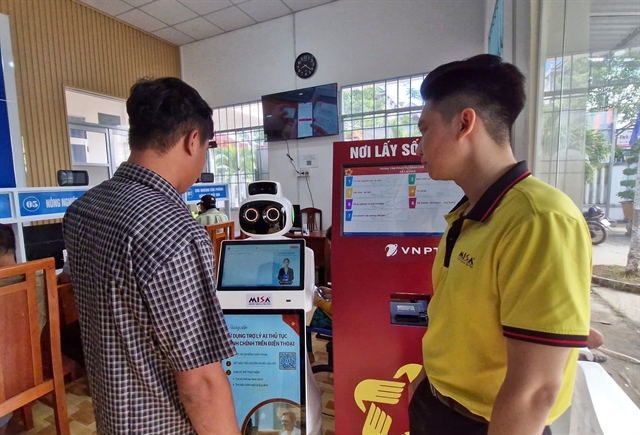
The centre has introduced an AI-powered reception robot integrated with a virtual assistant and an automated question-and-answer system capable of providing detailed guidance on administrative procedures.
|
| Residents use an intelligent reception robot to look up administrative procedures at the Lai Hòa Commune Public Administration Service Centre in Cần Thơ City. — VNA/VNS Photo |
Đào Phước Huyền, a local in Lai Hòa, said people previously relied on officials for assistance when completing administrative procedures, but the robot can now answer many questions accurately and conveniently, making the process easier.
Nguyễn Thị Doan, an official at the centre, said the robot now handles around 60–70 per cent of residents' initial enquiries and guidance requests.
“As a result, one-stop service staff have significantly reduced their advisory workload and can focus on reviewing and processing more complex applications,” she said.
The centre received 3,602 applications in the first six months of the year, with 99.86 per cent submitted online and 99.97 per cent processed on time or early.
Trần Trí Vân, Chairman of the Lai Hòa People's Committee, said the commune focuses on three pillars: the digital economy, digital society and digital government.
It will continue expanding AI applications to support socio-economic development and improve residents' quality of life, he said.
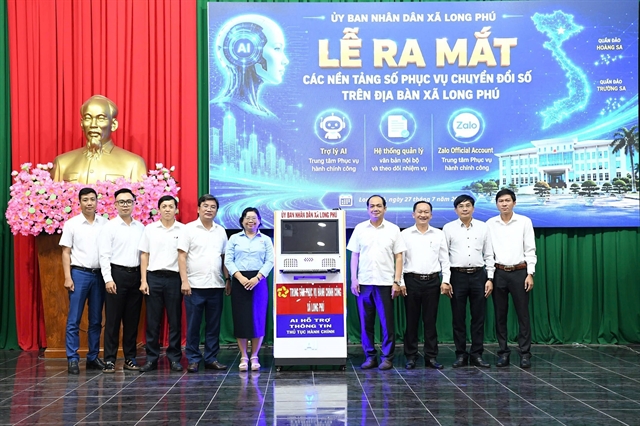
Long Phú Commune has introduced a range of digital platforms, including an AI assistant that helps residents and businesses search administrative procedures, an internal document management system, and a platform for monitoring the implementation of resolutions, programmes and plans.
It has also launched the Public Administrative Service Centre's Zalo official account to strengthen interaction between the local administration and residents.
Lâm Tiến Thạch, Secretary of the Long Phú Party Committee and Chairman of the commune People's Council, said digital transformation is both a key task and a long-term journey.
“This process must always place the satisfaction of residents and businesses at its centre, gradually building a modern, transparent and open public administration,” he said.
|
| The Long Phú Commune People's Committee launches a digital platform ecosystem and an AI assistant to provide information on administrative procedures on July 27. — VNA/VNS Photo |
Nguyễn Văn Khởi, deputy chairman of the Cần Thơ People's Committee, said science and technology form the foundation for building a smart society in the digital era, innovation serves as the driving force, and digital transformation creates breakthrough changes.
“Closely following strategic directions such as the Politburo’s Resolution No 57 and Resolution No. 68 is essential to modernising governance and enhancing the city's competitiveness,” he said.
The city’s digital infrastructure has continued to improve.
All government agencies and units are connected to the dedicated government data transmission network.
Fourth-generation (4G) mobile coverage has reached 100 per cent, while fifth-generation (5G) coverage is approaching 70 per cent.
Digital training
The city has focused on equipping officials and civil servants with AI skills to support the implementation of Resolution No 57.
In July, Liêu Tú Commune, for instance, organised a three-day training programme on AI and digital technologies for optimising commune-level administrative procedures under its plan to implement Resolution No 57.
Lâm Chí Thường, a civil servant at the Liêu Tú People's Committee and the programme’s participant, said participants learned to use digital tools for drafting documents, compiling information, preparing plans, designing presentations, creating images and analysing data.
“These skills have helped improve work efficiency,” he said.
Lâm Thị Thu Hương, an employee of the Liêu Tú Commune General Services Centre and another participant, said AI enables officials, civil servants and public employees to work faster and more effectively.
However, its use also requires careful verification of information, data security and compliance with legal regulations, she said.
Võ Thị Nhì, Deputy Chairwoman of the Liêu Tú Commune People's Committee, said the training programmes help officials, civil servants and public employees gradually master modern AI tools and strengthen their ability to perform digital-based tasks, contributing to the implementation of the digital transformation goals set out in Resolution No 57.
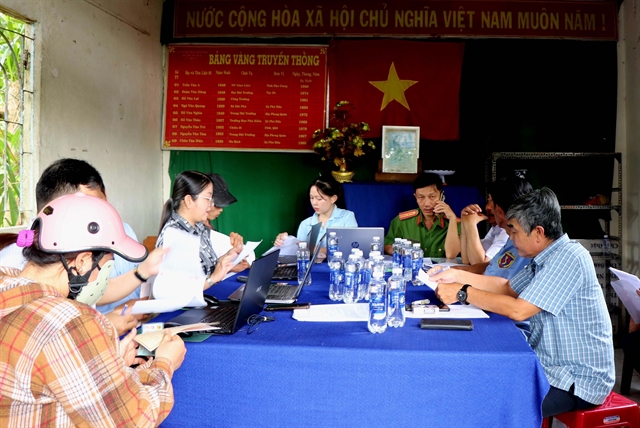
Administrative reform in the city has also been supported through initiatives that help residents access public services more easily.
|
| A mobile team from the Châu Thành Commune Public Administration Service Centre helps vulnerable people complete administrative procedures on Saturdays. — VNA/VNS Photo |
In Long Tuyền Ward, local authorities have established community digital technology teams, provided home-based administrative services for vulnerable people, assigned volunteers to assist residents with online public services and delivered results through the public postal service.
The ward People's Committee has invested in information technology equipment to support the digitalisation of records and work processes, while ensuring connectivity with the city's digital transformation systems.
Despite the coordinated deployment of digital platforms in the city, local authorities said some software systems remain insufficiently integrated, limiting data connectivity, sharing and reuse among agencies.
The integration of sector-specific databases into the city's shared data repository is also limited because several of them remain incomplete.
Although challenges remain, the city continues digitising administrative records, expanding specialised databases and improving digital governance as it works towards building a smart, modern public administration in line with Resolution No 57. — VNS
Society
 Society
 Society
 Society
 Society
 Society
 Society
 Society
 Society
 Society
.jpg) Society
Society
 Society
 Society
 Society
 Society