Top Vietnamese leader hosts welcome ceremony for Swiss President
1.
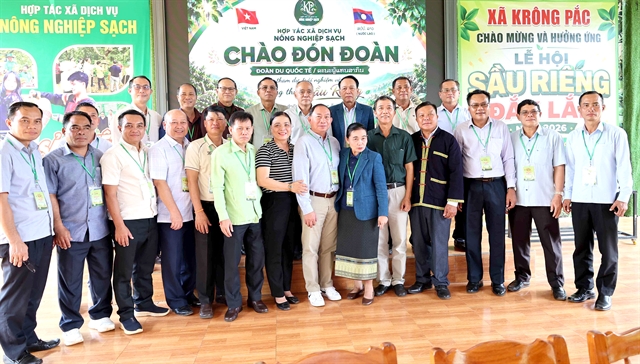 |
| Delegates from the administrations of southern Lao provinces pose for a group photo with the management board of the Clean Agricultural Cooperative in Krông Pắc Commune, Đắk Lắk Province. — VNA/VNS Photo Kha Phạm |
ĐẮK LẮK — Đắk Lắk Province and four southern Lao provinces are stepping up practical cooperation, with agriculture and technical expertise emerging as new areas of collaboration.
A request from Attapeu Province for Vietnamese experts to provide guidance on durian cultivation offers a glimpse of this emerging trend, in which agricultural know-how and local production models are becoming new bridges connecting communities on both sides of the border.
Although Đắk Lắk does not share a direct border with Laos, the province has established cooperation agreements with four southern Lao provinces, including Champasak, Attapeu, Salavan and Sekong.
Built over years of cooperation in areas including training, agriculture, social welfare and people-to-people exchanges, the partnerships are now being expanded towards more specific and results-oriented projects.
From friendship to practical partnerships
During the first Đắk Lắk Durian Festival, which ended on September 2, delegations from Champasak, Attapeu, Salavan and Sekong came to promote agricultural products and explore opportunities for cooperation in farming techniques, processing, production organisation and agricultural value chains.
Among the most concrete proposals came from Attapeu, which expressed interest in drawing on Đắk Lắk’s experience in developing the durian industry.
Attapeu is a southern Lao province bordering Việt Nam and Cambodia, and lies at a strategic crossroads connecting the three countries. Its location provides potential for linking production areas in southern Laos with markets and seaports in Việt Nam.
Soulivong Aphayvong, vice chairman of the Attapeu Province Administration Committee, said that under the memorandum of understanding between the two provinces, Attapeu hoped to invite experts from Đắk Lắk to provide technical advice and organise training for local farmers, particularly on durian cultivation and care.
“We are actively working to turn the key contents of the memorandum into concrete activities, and hope that the Đắk Lắk authorities and leading agricultural cooperatives will support and accompany Attapeu in the coming period,” he said.
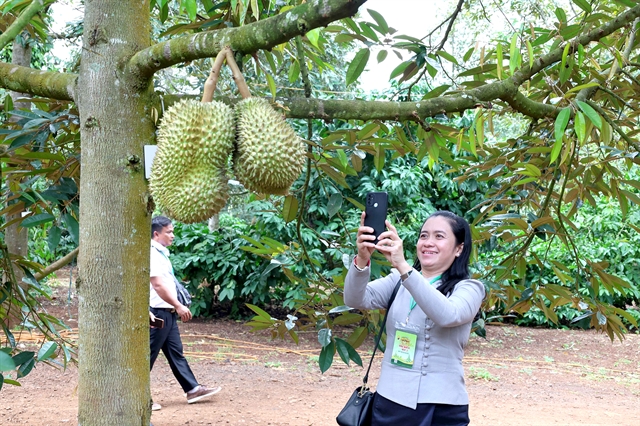 |
| A delegate from a southern Lao provincial administration visits a durian orchard in Đắk Lắk Province. — VNA/VNS Photo Kha Phạm |
The proposal points to a shift in the nature of agricultural cooperation. Instead of focusing mainly on seed varieties or study tours, the two sides are looking at longer-term technical support, farmer training, production models and the role of cooperatives in organising production and connecting farmers with markets.
These are areas in which Đắk Lắk has accumulated considerable experience, as durian has developed into one of the province’s major agricultural commodities.
Mai Đình Thọ, chairman of the Board of Directors of the Clean Agricultural Services Cooperative in Krông Pắc Commune, Đắk Lắk Province, said the cooperative was ready to work with Lao farmers to develop production models and transfer technical know-how.
“We are ready to send staff and members with professional expertise and practical experience to help farmers assess growing conditions, select suitable varieties and learn techniques for cultivating and caring for durian trees,” he said.
“Support should begin with specific models and continue throughout the production process so that farmers can master the techniques themselves.”
Such cooperation could begin on a manageable scale, with experts from both sides assessing soil, water and climatic conditions before selecting suitable varieties and developing cultivation procedures. Farmers could then receive training and monitor the results over successive growing seasons.
For Đắk Lắk cooperatives, collaboration could also extend beyond farming techniques to areas such as cooperative management, growing-area codes, traceability and connections with businesses.
The approach reflects a broader change in Đắk Lắk’s relations with southern Lao provinces: cooperation is increasingly being built around specific needs and local strengths rather than general commitments alone.
Turning agreements into results
The trend is also evident in Đắk Lắk’s collaboration with Champasak.
In mid-August, the Đắk Lắk People’s Committee signed a cooperation agreement with Champasak for the 2026-30 period, covering areas ranging from State management, science and technology to trade, investment, agriculture, tourism, culture, education and workforce development.
The two sides set a target of increasing bilateral trade and service value by 15-20 per cent annually.
More importantly, the agreement includes a mechanism to translate broad areas of cooperation into specific activities.
Vice Chairman of the Đắk Lắk People’s Committee Nguyễn Thiên Văn asked specialised agencies on both sides to identify priority areas that could be carried out immediately and make effective use of a joint working expert group to monitor progress and address difficulties.
This mechanism could provide a model for cooperation with Attapeu, Salavan and Sekong, helping ensure that memorandums of understanding are followed by clearly defined projects, responsibilities and timelines.
Under such an approach, each proposal could identify the needs of the Lao partner, the lead agency on the Đắk Lắk side, participating partners, available resources, deadlines and expected results.
This would allow cooperation to continue between official meetings instead of depending largely on periodic exchanges of delegations.
For Attapeu’s durian proposal, for example, the first step could be a specialised survey mission involving agricultural experts, cooperatives and businesses from Đắk Lắk. The team could assess growing conditions, training needs and market prospects before selecting a pilot model that is small enough to manage risks but large enough to generate measurable results.
Progress could then be assessed through practical indicators such as the number of farmers trained, the number applying recommended techniques, crop health, disease incidence, digitalisation of growing areas, and the number of participating cooperatives and businesses involved in the value chain.
If the collaboration develops into commercial production, issues including quality standards, plant quarantine, traceability, processing, transportation and market access would also need to be addressed from the outset.
The flow of cooperation is not necessarily one way. Southern Lao provinces have land resources, diverse ecological conditions and demand for agricultural development, while Vietnamese businesses may find opportunities to invest and develop value chains there, provided that such activities comply with local laws and bring sustainable benefits to local communities.
For Đắk Lắk, cooperation with the Lao provinces can therefore create opportunities to share agricultural expertise while opening new spaces for businesses and cooperatives to expand their networks.
The wider geography also creates potential for cooperation involving the Việt Nam-Laos-Cambodia border area. Attapeu borders both Việt Nam and Cambodia, while Đắk Lắk and Lâm Đồng have links with Cambodia’s Mondulkiri Province.
If agricultural, logistics and tourism initiatives are developed along regional corridors rather than as separate bilateral programmes, the three border areas could complement one another in production, markets and transport.
Such a vision, however, will still depend on concrete projects.
A training course tailored to farmers’ needs, a durian pilot model monitored throughout a production cycle or a border-gate proposal addressed within a clear timeframe can deliver more practical value than broad commitments without clearly assigned responsibilities.
This is where Đắk Lắk’s cooperation with southern Lao provinces is showing a new direction.
When expertise crosses borders together with mechanisms for monitoring and follow-up, cooperation can take root in everyday life. Lao farmers gain access to appropriate production techniques, Đắk Lắk cooperatives expand their network for sharing experience, businesses gain access to potential new production areas, and authorities have more information to adjust their programmes.
In this way, the longstanding friendship between Đắk Lắk and southern Lao provinces can be strengthened through tangible results from individual farms and cooperatives to broader agricultural value chains and livelihoods. — VNS
 Society
 Society
 Society
 Society
 Society
.jpg) Society
Society
 Society
 Society
 Society
 Society
 Society
 Society
 Society
 Society