 Society
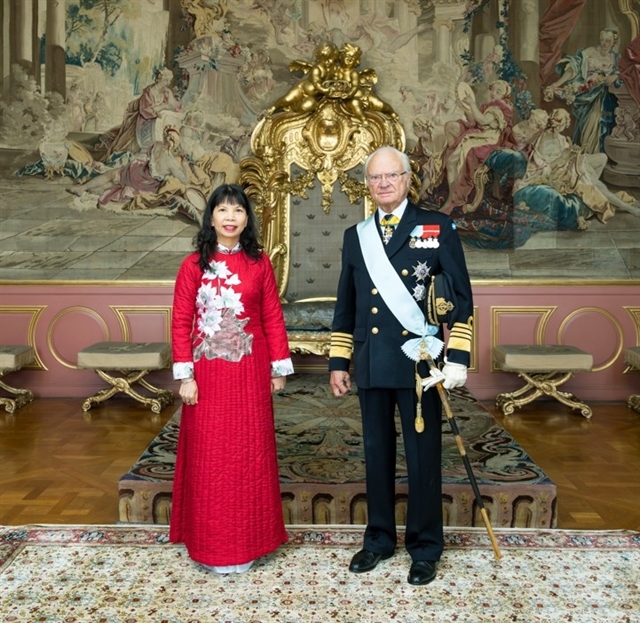
Ambassador pledges every effort to promote Việt Nam–Sweden ties
1.
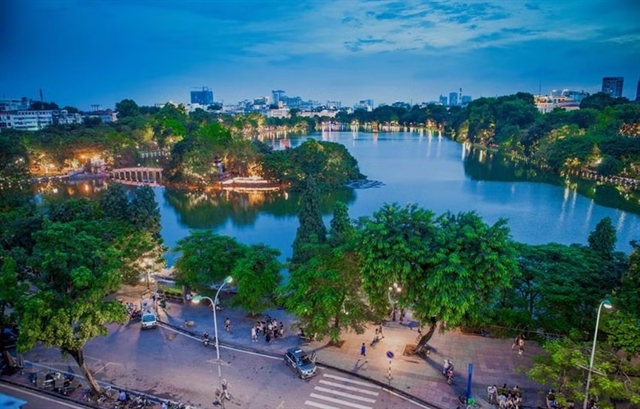 |
| A view of Hoàn Kiếm Lake. VNA/VNS Photo |
HÀ NỘI — The Hoàn Kiếm Ward People's Committee, in co-ordination with the the Cửa Nam Ward People's Committee, will hold a community consultation from September 7 to 26, 2026 on an adjustment of the planning for Hoàn Kiếm Lake area and its surroundings.
The Hà Nội People's Committee said the consultation aims to make information publicly available and to gather the full range of public opinions so that the planning documents can be further researched and refined in accordance with regulations.
The area in question falls within Hoàn Kiếm Ward and Cửa Nam Ward, covering about 65.89 hectares.
In line with the orientation of the Capital's 100-year Master Plan, the historic inner city – including Hoàn Kiếm Lake and its surroundings – is to be studied for conservation and reconstruction with a view to promoting the value of the existing urban architectural space, while controlling the scale of new development and improving the quality of the landscape, infrastructure and environment.
The overarching concept is to study the organisation of Hoàn Kiếm Lake as a great square – a symbol of the capital – in combination with Cách mạng Tháng Tám (August Revolution) Square and the Opera House, forming a "History – Culture – Arts" precinct. The focus is on expanding connectivity around the lake, particularly to the north and east.
For the area to the north of Hoàn Kiếm Lake, the plan envisages expanding Đông Kinh Nghĩa Thục Square to create a large public square, strengthening connections with the lake and the park-square to the east. The scheme includes a study of a symbolic "Triumphal Arch" structure, inspired by the image of a pair of cranes spreading their wings in flight, serving as a focal terminus for the Old Quarter's urban axis and opening a new spatial axis towards the south.
For the area to the east of the lake, the plan studies the creation of a system of squares and parks in the vicinity of the Hà Nội City People's Committee headquarters, Lý Thái Tổ Garden, Hà Nội Central Post Office, and Hòa Phong Tower; the reorganisation of the space around Bà Kiệu Temple; the placement of a Capital Martyrs' Memorial; and the strengthening of connections with the Đinh Lễ–Tràng Tiền area and appropriate commercial and service spaces.
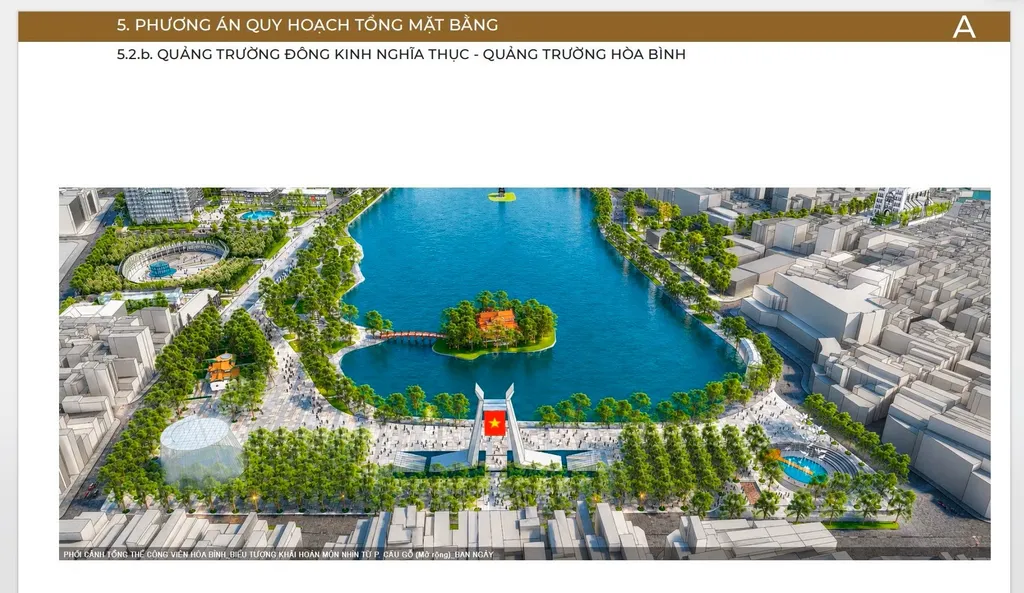 |
| An artistic render of the revamped Hoàn Kiêm Lake area, with a Victory Arc overlooking the lake. |
The eastern park-square area is being studied for underground spatial development to expand public and service areas and to connect with Station C9 on Urban Railway Line No 2, establishing a special transit-oriented development (TOD) zone for culture, services and commerce.
For the the Hà Nội People's Committee headquarters area, the scheme proposes a new nine-storey above-ground, four-basement structure based on the restructuring of the site. It studies the demolition of the headquarters of the municipal People's Council and People's Committee, the Khăn Quàng Đỏ Cinema and the Cung Thiếu nhi (Children's Palace) building block, while proposing the retention of three French architectural structures: the Ấu Trĩ Viện, the Indochina Treasury and the Tòa Đốc Lý. The space is to be organised along north–south and east–west axes, connecting with the parks and squares to the north and east, Lý Thái Tổ Garden, and Hoàn Kiếm Lake.
For the Hà Nội Central Post Office area, the scheme studies the demolition of certain architectural structures deemed unsuitable, while also studying solutions to evoke and recreate the distinctive architectural imagery and character of the former Báo Ân Pagoda within the central space of the Post Office grounds.
For the south-east area of the lake, the plan studies the organisation of small commercial spaces combined with cafés and kiosks; emphasises the Tràng Tiền axis connecting the lake to the Opera House; reorganises the Nguyễn Khắc Cần – Tràng Tiền alley corridor into a pedestrian zone; and supplements and expands access to the Đình – Đền – Chùa Vũ Thạch heritage cluster from Hàng Khay, Bà Triệu, and Hai Bà Trưng streets.
For the west side of the lake, the plan studies extending Nhà Thờ Street to the lake and connecting it with Lê Thái Tổ Street to create an open space and pedestrian zone. It also studies the placement of a luxury hotel through the restructuring of the site currently occupied by the Hà Nội Mới newspaper and printing house headquarters, the City Criminal Investigation Police headquarters at No 2 Tràng Thi and surrounding areas, to serve tourism and socio-economic development.
For the August Revolution Square, Opera House, National History Museum, and surrounding area, the plan studies the integration of the system of squares, gardens, museums and architectural landscape spaces to the east of Hoàn Kiếm Lake; the connection of the Tràng Tiền axis with the Red River Scenic Boulevard axis; and the development of an open cultural and arts space behind the Opera House, creating an outdoor performance venue in combination with existing structures.
The scheme also studies the reorganisation of space through the merging of the National History Museum and the former Revolutionary Museum to form an interconnected cultural complex at ground level and underground, and studies the placement of a new building – an International Finance Tower – on the site of the former Revolutionary Museum following the merger of the two institutions.
The planning documents will be publicly displayed at Hà Nội Book Street on 19/12 Street; the the Hoàn Kiếm Ward People's Committee headquarters at No.126 Hàng Trống; and the Hà Nội Exhibition and Information Centre at 93 Đinh Tiên Hoàng Street, Hoàn Kiếm Ward.
The documents will also be posted on online channels for public comment, including the portals of the the Department of Construction, the the Hoàn Kiếm Ward People's Committee (hoankiem.hanoi.gov.vn), the the Cửa Nam Ward People's Committee (cuanam.hanoi.gov.vn), the the Hà Nội Institute for Urban Planning and Architecture, and the iHanoi application. — VNS
Society
 Society
 Society
 Society
 Society
 Society
 Society
 Society
 Society
.jpg) Society
Society
 Society
 Society
 Society
 Society
 Society