 Society

NA President visits Beijing Economic-Technological Development Area
1.
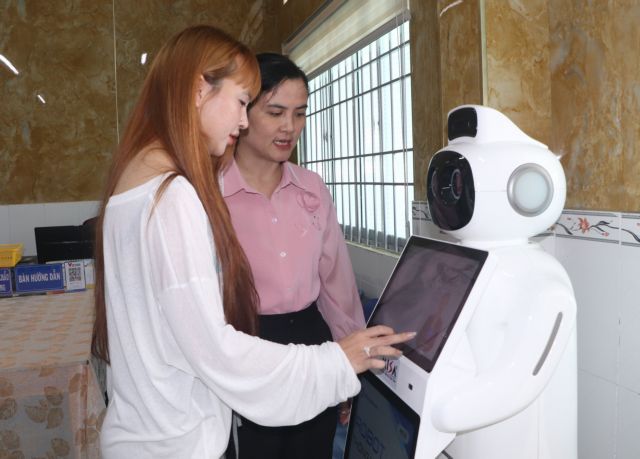 |
| Vĩnh Phước Commune in Cà Mau Province is piloting the use of a reception robot to assist residents with administrative procedures. — VNA/VNS Photo Tuấn Phi |
CÀ MAU — Cà Mau Province has launched a plan to improve digital skills among residents, officials and businesses while promoting online public services and the digital economy.
The efforts are in line with the Politburo’s Resolution No. 57 issued in December 2024, on breakthroughs in science, technology, innovation and national digital transformation.
Under the plan, agencies and units will organise digital knowledge and skills training tailored to different groups.
Officials, civil servants, public employees and workers will receive training to improve their expertise in digital transformation and digital skills.
Agencies will also review, reduce and simplify administrative procedures and develop video clips and handbooks to help residents use online public services at home.
The southernmost locality identifies residents as the main beneficiaries of digital transformation.
It will support businesses, co-operatives and household businesses in developing digital skills, using specialised management software and e-commerce, and putting their products on digital marketplaces.
It will also develop the “Digital Market – Digital Rural Area” model to provide digital skills training for traders and farmers.
For residents, Cà Mau will launch the “Digital Family” movement, aiming for each household to have at least one member proficient in five basic digital skills.
Residents will be encouraged to study through online platforms, use smart devices and digital payments, and access basic artificial intelligence (AI) tools.
Community-based digital technology teams, youth union members and grassroots officials will provide direct guidance through a campaign to visit residential areas and households.
Training will also be integrated into community meetings and commune-level public service centres.
Priority areas include social security, healthcare, education, insurance, land-related financial obligations, and fees and charges in agriculture and the environment.
A key focus of the plan is the “One Citizen – One Digital Identity” model, which will be linked with digital skills training, online public services and cashless payments, helping lay the foundation for the development of the local digital economy and digital society.
The plan also highlights digital transformation in education, with a focus on equipping students with digital and online safety skills and promoting the use of AI and digital technologies in teaching and management. — VNS
Society
 Society
 Society
 Society
 Society
 Society
 Society
 Society
 Society
 Society
 Society
 Society
 Society
 Society
 Society