 Economy


EVNNPT seeks over $224 mln in bank loans for grid expansion
1.
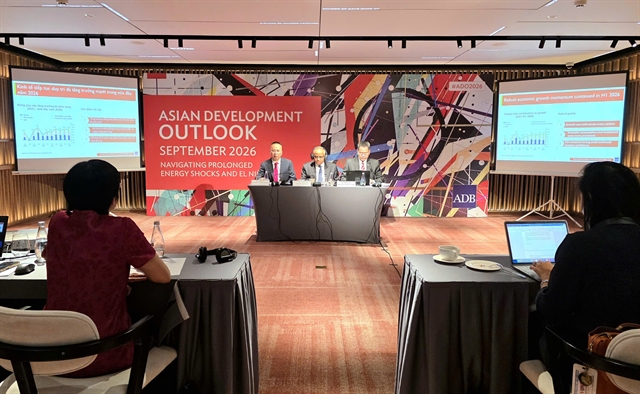 |
| ADB's representatives at the press conference on September 23 morning. — VNS Photo Ly Ly Cao |
HÀ NỘI — The Asian Development Bank (ADB) has raised its 2026 growth forecast for Việt Nam to 7.8 per cent following stronger-than-expected economic performance, while warning that increasing reliance on investment and credit could heighten inflation, exchange-rate and financial-sector pressures.
Speaking at the launch of the Asian Development Outlook September 2026 on September 23, ADB Country Director for Việt Nam Shantanu Chakraborty said the economy entered the year with strong momentum and continued to perform well despite greater uncertainty in the global environment.
GDP expanded 8.2 per cent in the first half, compared with 7.5 per cent in the same period last year, supported by manufacturing, domestic consumption, foreign direct investment (FDI) and supportive policies. ADB consequently lifted its 2026 growth forecast from 7.2 per cent in its July update to 7.8 per cent, while raising its 2027 projection from 7.0 per cent to 7.6 per cent.
Inflation forecasts were also revised upwards to 4.3 per cent this year and 4.0 per cent in 2027 amid sustained demand pressures and higher energy and import costs.
Bùi Minh Giáp, ADB's principal economist in Việt Nam, said first-half growth was broad-based, spanning industry and construction, services and agriculture, while domestic consumption, public and private investment, FDI and trade contributed to the demand side.
However, inflationary pressure has become more widespread rather than being concentrated in individual categories such as fuel or food, reducing the room for further monetary easing.
"If credit grows too quickly while inflation, the exchange rate and credit quality are under pressure, risks to the financial system could increase," Giáp said, adding that monetary policy should remain flexible but become more prudent.
ADB also highlighted the quality of FDI as an increasingly important consideration. Foreign investment remains strong, particularly in manufacturing and processing, reinforcing Việt Nam's position in regional production networks.
The issue, Giáp said, was no longer simply how much FDI Việt Nam could attract, but how much domestic value added it could generate, together with stronger links with Vietnamese companies, technology transfer and improvements in domestic capabilities.
 |
| Customers buying goods at a supermarket in Đà Nẵng City. Domestic consumption is still strongly supporting growth, but sustainable consumption can’t rely only on short-term stimulus. — VNA/VNS Photo |
Manufacturing remains another major growth engine, with the Purchasing Managers' Index (PMI) staying above the 50-point threshold for 14 consecutive months. However, production continues to depend heavily on imported inputs and export orders, prompting ADB to call for greater localisation, stronger supporting industries and deeper participation by domestic companies in supply and value chains.
Trade is also presenting a more complex picture.
Imports have grown faster than exports, driven partly by demand for machinery, raw materials and components, with the trade deficit reaching around US$23 billion by the end of August.
Giáp noted that rising imports were not necessarily negative if machinery and intermediate goods were translated into greater production capacity, productivity and future exports. But a prolonged trade deficit without corresponding increases in domestic value added could create additional macro-economic risks.
ADB also cautioned about Việt Nam's heavy dependence on bank lending to finance investment. Rapid credit expansion, particularly into long-term or higher-risk projects that fail to generate adequate cash flows, could increase liquidity, maturity and asset-quality pressures in the banking system.
Chakraborty similarly warned that greater reliance on bank credit for large-scale investment could increase liquidity, maturity and portfolio-concentration risks if not prudently managed. Public investment should therefore prioritise efficiency, project readiness and implementation quality so that infrastructure spending can ease bottlenecks and crowd in private investment.
Businesses, meanwhile, continue to face pressures from financing costs, orders, competition and new market standards. ADB said business support should extend beyond lower interest rates and credit expansion to include easier access to financing and credit guarantees, administrative reforms, technology, skills and assistance in meeting market standards.
For the medium and long term, Giáp said Việt Nam needed more efficient public investment, deeper capital markets with more diversified instruments, a more resilient banking system, stronger domestic private enterprises and more substantive FDI linkages.
He stressed that sustaining growth would require a stronger shift from expanding inputs towards improving productivity, quality and the resilience of the economy over the medium and long term. — BIZHUB/VNS
Economy
 Economy
 Economy
 Economy
 Economy
 Economy
 Economy
 Economy
 Economy
 Economy
 Economy
 Economy
 Economy
 Economy
 Economy