 Economy


Việt Nam encourages greater US business participation in APEC Year 2027 activities
1.
|
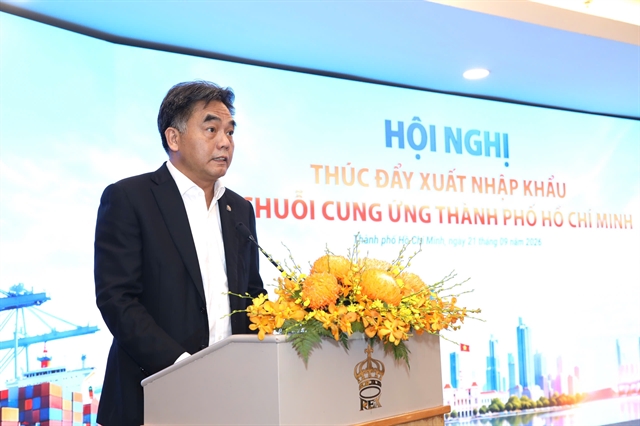
| Vice chairman of the HCM City People's Committee, Nguyễn Lộc Hà, speaks at a conference on promoting trade and supply chains on September 21. — VNS Photo |
HCM CITY — HCM City is striving to promote higher-value exports, integrate logistics and adopt more enterprise-focused policies to sustain growth and make better use of free trade agreements, according to its officials.
Speaking at a conference on promoting trade and supply chains organised by the municipal Department of Industry and Trade on September 21, Lê Văn Danh, deputy director of the department, said the city's exports topped US$65.8 billion in the first eight months of 2026, up 7.82 per cent year on year.
The city accounted for about 18 per cent of the country's total trade, maintaining its lead nationally.
Vice chairman of the city People's Committee, Nguyễn Lộc Hà, said its trade strategy for until 2030 aims for average annual export growth of 10-11 per cent.
Processed and manufactured industrial products are expected to account for more than 90 per cent of exports by 2030, with technology products accounting for around 70 per cent.
Markets covered by FTAs are expected to buy more than 75 per cent of the city’s exports.
Hà said rapid changes in global trade and supply chains, together with opportunities created by FTAs, are placing greater demands on the competitiveness of businesses.
To maintain export momentum through the end of the year and in 2026-30, he called for a focus on several strategic priorities.
“The immediate focus is to promote higher-quality, higher-value exports.”
He said the city needs to provide enterprises with better support in terms of market information, technical standards and market access requirements, and businesses need to upgrade their production capacity, product quality and branding to meet international standards.
He said the city would further develop port and logistics infrastructure and high-tech zones to enable import-export businesses to participate more deeply in global supply chains.
It would also strengthen links between import-export enterprises and logistics providers, while making better use of seaports, logistics infrastructure, industrial parks, export processing zones and production and trade hubs, he said.
He called for a stronger enterprise-centred approach from municipal authorities, with businesses’ problems being addressed with clearly assigned responsibilities, deadlines, and measurable outcomes.
Making better use of trade deals
Ngô Chung Khanh, deputy director general of the foreign market development and multilateral trade policy department at the Ministry of Industry and Trade, said that while tariff preferences under FTAs remain vital, global buyers are increasingly focusing on rules of origin, supply chain traceability, regulatory compliance and corporate resilience.
|
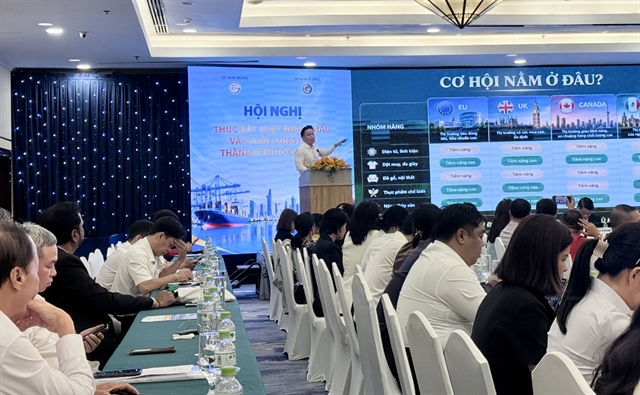
| Ngô Chung Khanh, deputy director general of the foreign market development and multilateral trade policy department, calls on businesses to boost exports to the European Union, Canada, Mexico and the UK, where more than 90 per cent of tariff lines on Vietnamese exports have been scrapped. — VNS Photo |
Making better use of FTAs should therefore go beyond tariff preferences and be linked to selecting suitable markets and products, improving supply chain management, diversifying suppliers and customers and proactively meeting new market requirements, he said.
"There remains considerable room to benefit from FTAs, and the important issue is how businesses make use of it."
He pointed to the European Union, Canada, Mexico, and the UK, where more than 90 per cent of tariff lines on Vietnamese exports have been abolished, saying Vietnamese exports still account for only a small share of total imports in these markets, indicating considerable untapped potential.
"HCM City has five groups of products with export potential that should be promoted, including electronics and components; textiles, garments, leather and footwear; agricultural and aquatic products; processed foods; and wooden furniture."
Dr. Bùi Bá Nghiêm, a senior specialist at the Ministry of Industry and Trade's Import-Export Agency, said support for businesses seeking to use FTAs and participate more deeply in global supply chains should move from general assistance towards programmes tailored to specific markets and buyers.
The city could develop supplier programmes based on the actual procurement needs of lead companies, initially focusing on electronics, mechanical engineering, wood products, textiles, and footwear, he said.
For each product group, lead companies should clearly define technical standards, required volumes, quality requirements and supplier evaluation criteria, he said.
"Support should focus on areas where businesses remain weak, such as productivity, precision, defect control, testing, traceability and on-time delivery."
Support programmes should be assessed not simply by the number of businesses receiving support, but by the number of products approved and contracts successfully fulfilled, he said.
When enterprises improve production capacity, quality control and raw material sourcing, their compliance with rules of origin naturally improves, and only then can FTA tariff preferences translate into practical advantages in securing and retaining orders, he said.
Danh said the city would strengthen links between leading companies, FDI enterprises and domestic businesses, while organising international sourcing fairs, supporting-industry exhibitions and business-matching activities.
“The city will also diversify its export markets, focusing on regions with strong potential such as the Middle East, Southeast Asia and Latin America. Trade promotion activities will shift from general business connections to more targeted engagement by product sector, market and buyer group.”
At the conference, the city Department of Industry and Trade and the HCM City Logistics and Port Association signed a deal to strengthen coordination in developing logistics and supply chains. — VNS
Economy
 Economy
 Economy
 Economy
 Economy
 Economy
 Economy
 Economy
 Economy
 Economy
 Economy
 Economy
Economy
Economy
 Economy