 Economy



French rep highlights importance of data security in AI use in public administration
1.
|
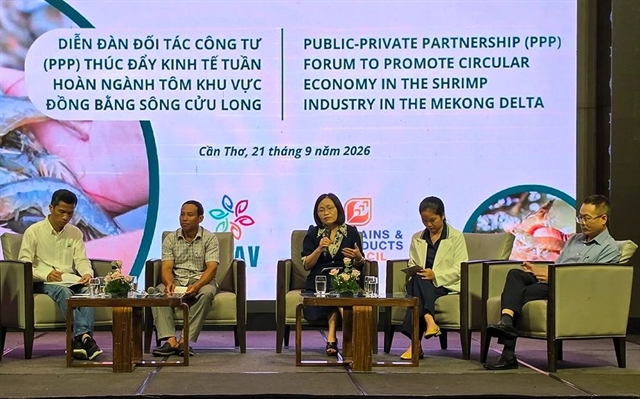
| A dialogue session at a forum on promoting the circular economy in the Mekong Delta shrimp industry held in Cần Thơ on September 21. — Photo baocantho.com.vn |
HÀ NỘI — Việt Nam’s shrimp industry is facing cost pressures, climate change and increasingly stringent export market requirements, highlighting the need to shift towards a circular and sustainable production model, according to experts at a public-private partnership forum on promoting the circular economy in the Mekong Delta shrimp industry held in Cần Thơ on September 21.
At the forum, Vũ Đức Đam Quang, deputy head of the International Cooperation Department under the Ministry of Agriculture and Environment (MAE), said the shrimp industry plays an important role in production, exports and livelihoods, particularly in the Mekong Delta.
In 2025, Việt Nam’s shrimp exports reached about US$4.6 billion, accounting for about 40 per cent of the country’s total seafood export value.
However, the industry is facing new demands in its development. Input costs, particularly feed, energy and environmental treatment, are putting increasing pressure on production efficiency. Climate change, saltwater intrusion, disease outbreaks and changes in environmental conditions continue to directly affect shrimp farming.
Export markets are paying increasing attention to traceability, carbon emissions, environmental responsibility and the sustainability of the entire value chain.
“These requirements make one issue very clear: the shrimp industry needs to continue innovating its production models, improve resource efficiency and reduce emissions, while strengthening its ability to meet increasingly stringent requirements from international markets,” Quang said.
Against this backdrop, Quang said the circular economy offers a suitable approach to the shrimp industry’s transition by improving resource efficiency, reusing water and by-products, saving energy, applying technology and increasing data transparency.
In practice, viable models and initiatives have already emerged. This provides a basis for further connecting technology, finance and markets, promoting public-private partnership models and scaling up suitable solutions.
Ngô Thế Anh, head of the Aquaculture Division under the MAE'S Department of Fisheries and Fisheries Surveillance, said the circular economy in the shrimp industry is not a standalone technology but a way of reorganising production towards greater efficiency, circularity and sustainability.
The development of a circular economy in the shrimp industry still faces gaps that need to be properly identified. The first concerns institutions, policies and governance. Although relevant policies and guidelines are already in place, specific and detailed regulations on the circular economy in the shrimp industry still need to be further developed.
Other gaps concern infrastructure, technology, data, financial markets, production organisation and implementation capacity.
According to Thế Anh, addressing these gaps is a prerequisite for putting the circular economy into practice in the shrimp industry, with the goal of green production, higher value, lower emissions and sustainable development.
At the same time, participation is needed from the State, businesses, farmers, research organisations and other relevant partners to share responsibility, resources and benefits.
The public sector needs to continue improving mechanisms and policies, support research and technology transfer, and strengthen oversight of implementation. Public-private partnerships need to work together, share resources and create value, while clearly defining the roles of the State, businesses and farmers in resource use and ensuring sustainability.
To boost investment, attention should be paid to capital, technology, governance, model development, value-chain links and market expansion.
According to Việt Nam Customs data, shrimp exports in August reached $478.5 million, up 4.2 per cent year on year. Cumulative exports in the first eight months totalled $3.3 billion, an increase of 12 per cent on year. — VNS
Economy
 Economy
 Economy
 Economy
 Economy
.jpeg) Economy
Economy
 Economy
 Economy
 Economy
 Economy
 Economy
 Economy
 Economy
 Economy
 Economy