 Society
PM urges Hưng Yên to become dynamic growth hub by 2030
1.
|
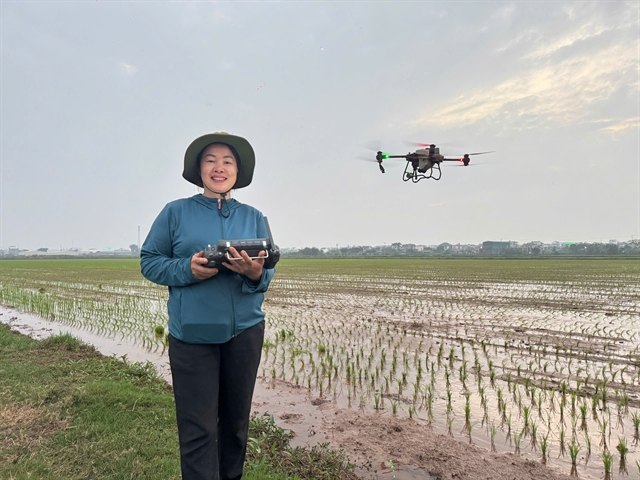
| Nguyễn Thị Hưng operates a spraying drone over the rice fields. — Photo courtesy of Hưng |
Minh Hằng
HƯNG YÊN — For Nguyễn Thị Hưng from Tiền Hải commune in the northern province of Hưng Yên, farming has changed from a labour-intensive livelihood into a technology-driven business.
With a drone, rice transplanter and harvester, she can manage large areas of rice with far fewer workers. She also uses a mobile phone and digital applications to monitor crops, identify diseases and check weather conditions before spraying.
Her journey began with just two sào (720sq.m) of rice.
Hưng, 48, worked for Việt Tiệp company that manufactures glass products from 2004 until 2011, when she left after the birth of her third child.
“Initially, my family had just two sào of farmland, enough to grow food for ourselves,” Hưng said.
“As neighbours began leaving their fields idle, I started renting their land and gradually expanded the area I cultivated,” she said.
She then bought machinery and began providing harvesting services to other farmers. As more land was left uncultivated, she expanded further, taking on land preparation and transplanting work and eventually producing seedlings.
Hưng added: “Consolidating the fields into larger plots makes farming easier and less labour-intensive. It also makes weed control easier and allows machinery to work more efficiently. I now farm 36ha of rice.”
Her investment in machinery has since become a source of income in its own right, as she provides mechanised services to other farmers.
Digital farming
Before buying a spraying drone, Hưng said, applying pesticides was physically demanding, requiring her to carry heavy tanks through the fields.
The drone allowed her to spray faster and more precisely, while weather applications helped her choose suitable conditions.
Her total investment in machinery is now nearly VNĐ3 billion (US$115,150), including land-preparation equipment, a seeder, transplanter, harvester and a spraying drone. Local authority support covered part of the cost of some equipment.
Hưng said the difference in labour productivity has been substantial.
A person transplanting rice manually could plant only around 180-360sq.m a day, while a machine can cover nearly 2.9ha to 4.3ha, depending on field conditions.
“Reducing labour means increasing income,” Hưng said.
Technology has also changed how she monitors crops. She photographs rice plants with her phone and uses applications to help identify diseases and recommend treatment.
She still relies on her own experience and checks the fields daily, but says digital tools and AI can help detect problems earlier, particularly diseases she has not encountered before.
For Hưng, the transformation comes from combining technologies rather than relying on one machine.
“Land preparation, transplanting, harvesting and drone spraying – when they are combined, the effect is much greater,” she said.
Yet technology has not removed all the risks of farming.
Without mechanisation, Hưng believes it would be difficult to maintain production on her current scale, while younger people increasingly leave agriculture for factory and company jobs.
For smaller farmers, however, mechanisation has not necessarily made rice farming profitable.
|
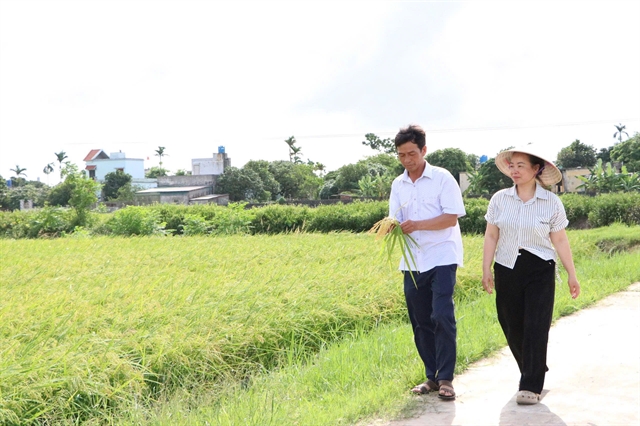
| Hưng and her husband inspect their rice fields. — Photo courtesy of Hưng |
Nguyễn Thị Năm, 63, from Trà Giang commune, used to grow five sào (1,800sq.m) of rice with her husband. Machines reduced the need for hired labour, but other costs remained high and poor harvests could leave the family making little or even losing money.
“Sometimes it is more economical to buy rice than to grow it ourselves,” she said.
The couple stopped growing rice about a year ago because of health problems. Năm said many families had also abandoned their fields, while only a few farmers with sufficient capital were expanding by renting land and investing in machinery.
“Ten years ago, if I had had enough capital, I would have continued farming, especially as technology was making farming much easier for farmers,” Năm said.
Her experience illustrates a problem facing many smallholders as technology can reduce physical labour, but it does not automatically make small-scale rice production profitable.
A model difficult to replicate
Trần Ngọc Kha, chairman of the Tiền Hải Farmers’ Association, said Hưng’s model had proved economically successful but would be difficult for most farmers to replicate.
“Only a few households are farming on a large scale and using machinery,” he said.
Of the association’s 4,215 members, only three to five currently use machinery and advanced technology extensively.
Some farmers have taken over abandoned fields with local approval, while others have left farming for more stable factory or company jobs.
For those lacking capital, Kha said wider access to technology would require loans, training and technology-transfer programmes.
"The association provides basic agricultural training but lacks the resources to support broader technology adoption," Kha said.
He said local farmland would continue to shrink, with many remaining farmers likely to grow rice mainly for household consumption rather than income.
Permanent vice chairman of the Vietnam General Association of Agriculture and Rural Development Nguyễn Trí Ngọc said technology could significantly improve agricultural efficiency, but scale was crucial.
High-tech agriculture aims to increase productivity, reduce production costs and raise farmers’ incomes while producing goods that meet market requirements.
But rice production in northern Việt Nam remains fragmented.
“Technology can solve the labour problem, but it also requires sufficient production scale to reduce costs and improve competitiveness,” Ngọc said.
He said land concentration, leasing and other forms of organising scattered land into larger production areas should be encouraged.
With larger fields, farmers or service providers can use machinery such as combine harvesters, seeders and drones more efficiently.
The main barriers include capital, fragmented land, farmers’ skills, data infrastructure and a lack of coordinated policies, he said.
A broader policy framework is therefore needed, combining land consolidation, financial support, training and technology transfer.
Making technology accessible
Ngọc said the country’s push for science, technology, innovation and digital transformation in agriculture would only have a broad impact if small farmers could also benefit.
“Small farmers cannot be left behind,” he said.
|
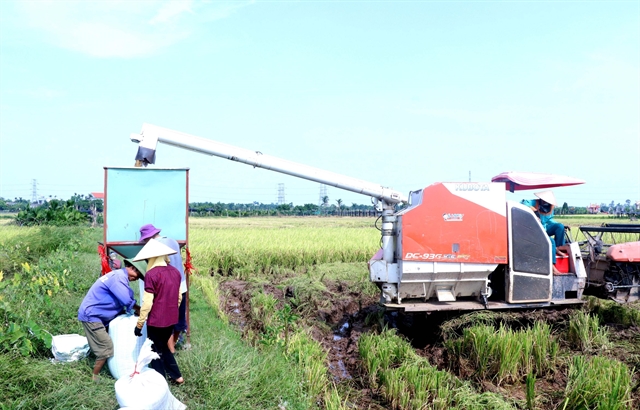
| Combine harvesters help farmers in Hưng Yên Province speed up the rice harvest. — VNA/VNS Photo Đinh Văn Nhiều |
AI could also play a growing role, but Ngọc said its effectiveness depended on reliable data on land, weather, pests, diseases, crop varieties and yields.
“AI needs big data,” he said. “We need to build a digital ecosystem and collect and standardise data as a foundation for accurate and reliable applications.”
Over the next five to 10 years, he expects technology to accelerate a shift from simply producing agricultural commodities towards a broader agricultural economy, with greater mechanisation and more professional production.
But technology alone will not be enough. Land organisation, farmers’ skills and production models will also need to change.
For Hưng, the transformation is already personal.
She now rents additional land, sometimes paying rent in rice, and consolidates scattered plots so they can be managed more efficiently.
Her two older children are studying medicine, while her third may consider studying agriculture. She does not force them to follow her path.
Instead, she hopes farming can become a profession that requires more technical and managerial skills and less physical labour.
“I have become a very different kind of farmer from the way I was in the past, when farming depended largely on hard physical labour and long hours in the fields,” she said.
Her story shows what can happen when machinery, capital and determination come together.
According to Ngọc, advanced technology can bring significant value to agriculture, but making it accessible beyond large farms will require coordinated policies to ensure that farmers and other participants across the value chain can access and benefit from it. — VNS
Society
 Society
 Society
 Society
 Society
 Society
 Society
 Society
 Society
 Society
 Society
 Society
 Society
 Society
.jpg) Society
Society