 Society
NA President meets with Chinese friendship figures in Beijing
1.
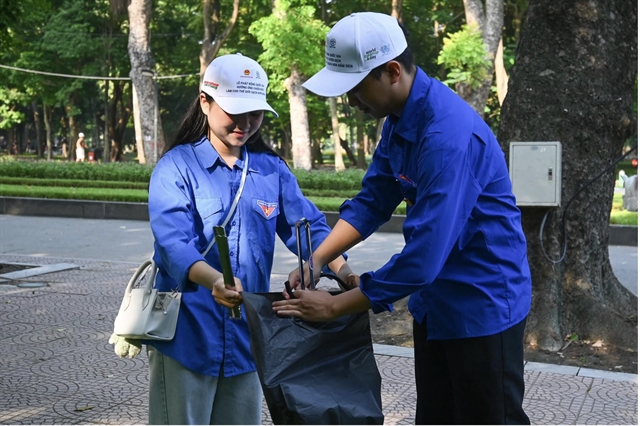 |
| Young people in Hà Nội collect rubbísh in Thống Nhất Park. VNS Photo |
HÀ NỘI — A programme exchanging recyclable waste for gifts, held in earlier this week, as part of the national launch ceremony for the 2026 World Cleanup Day campaign, attracted 461 participants at the entrance to Thống Nhất Park.
According to Hà Nội Urban Environment Company Limited (Urenco), in one day, the programme collected 856kg of recyclable waste, including 659kg of cardboard, 156kg of plastic and 41kg of metal.
The figure remains modest compared with the amount of waste generated every day in a major city.
According to the Hà Nội Department of Agriculture and Environment, the capital generates about 7,500-8,000 tonnes of domestic waste every day.
What matters, however, is how these materials are viewed. If separated at source, paper, plastic, metal and other materials can be recovered, recycled and returned to production, rather than being sent along with mixed waste through the entire process of collection, transportation and treatment.
This is why waste separation at source is increasingly regarded as an important component of urban waste management.
Nguyễn Thanh Sơn, Urenco Deputy General Director, said the company was activating a network of 100 waste separation and recyclable-material recovery points, known as HUBs, while launching the “21 Days of Waste Separation” community action programme across the capital.
According to Assoc. Prof. Dr Nguyễn Thường Lạng, an economist and international trade expert and senior lecturer at the Institute of International Trade and Economics under the National Economics University, the approach to environmental sanitation is changing.
A clean city can no longer be assessed simply by the number of tonnes of waste collected each day or the capacity of its collection and treatment systems. If the volume of waste entering treatment facilities continues to increase, environmental pressures will remain in the long term.
“Separation at source” is therefore not merely an environmental sanitation requirement. It is also the first step in determining which materials are genuinely waste that needs to be treated and which still have the potential to be used, reused or recycled.
At the household level, separating a plastic bottle, a can or a piece of cardboard may seem like a small action.
But in a city of millions of people, the amount of material retained through such actions is far from small.
Assoc. Prof. Dr Nguyễn Thường Lạng said the value of the circular economy did not lie solely in the final recycling stage. Value is determined from the moment reusable and recyclable materials are separated from the mixed waste stream.
In other words, to recycle more, the first step is to prevent recyclable materials from becoming waste.
The network of 100 HUBs being developed by Urenco could become an important link in this process.
Under the plan, the collection points will sort, weigh and record recyclable waste before transferring it to appropriate receiving facilities. A digital map will help residents locate collection points while supporting collection operations and tracking material flows.
If operated effectively, the HUBs will not simply be places to “collect recyclable waste”. More broadly, they could become the first nodes of an urban resource recovery network.
In such a system, the journey of a plastic bottle, a piece of cardboard or a metal can would not necessarily end in a rubbish truck. The material could move from a household to a collection point, then to a recycling facility and eventually return to the market in the form of another product.
However, a network of collection points will struggle to fulfil its potential if residents do not use them regularly.
The “21 Days of Waste Separation” programme will therefore only have lasting significance if waste separation continues after the launch campaign ends.
The key indicators, therefore, should not simply be how many kilogrammes of paper, plastic and metal a programme collects, but also how many households continue to separate waste, how many residential areas and agencies maintain the practice, whether the volume of recovered materials remains stable and where those materials are ultimately sent, Sơn said.
If a stable material flow can be established, supported by data, receiving facilities and a viable market for recycled materials, waste separation at source could become an integral part of the urban economy, he added. VNS
Society
 Society
 Society
 Society
 Society
 Society
 Society
 Society
 Society
 Society
.jpg) Society
Society
 Society
 Society
 Society
 Society