 Society
Hoàn Kiếm Lake abuzz as capital marks 72nd Liberation Day anniversary
1.
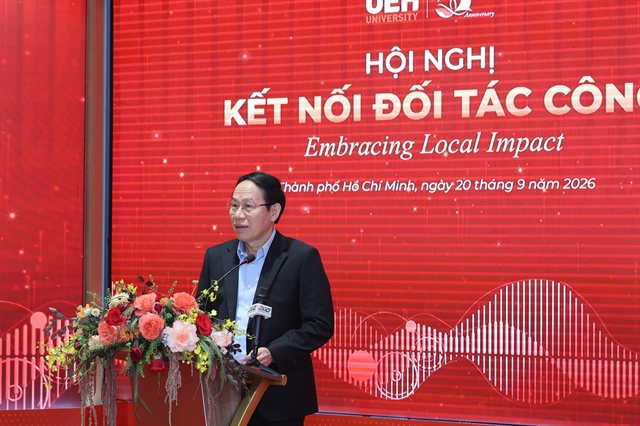 |
| Deputy Prime Minister Lê Tiến Châu made the remarks at 2026 UEH Public Sector Partnership Connection Conference held in HCM City on September 20. Photo courtesy of UEH |
He made the remarks at 2026 UEH Public Sector Partnership Connection Conference held in HCM City on September 20.
Over its 50 years of development, UEH has steadily established itself as a prestigious higher education institution in the fields of education and research regarding economics, management, administration, and policy, he said.
It has progressively evolved into a multidisciplinary institution, strengthened international cooperation, and forged increasingly close ties with the development of the city, the region, and the nation, he said.
Châu highly appreciated the co-creation ecosystem that UEH has embedded in its public sector partnership strategy for 2026-2030 period.
This approach entails co-defining issues, co-designing solutions, co-implementing initiatives, and sharing responsibility for the outcomes.
He underlined that Politburo Resolution No. 71 identifies higher education as the core for developing high-quality human resources and talent, as well as driving scientific, technological, and innovation development.
He ordered the university to select several major issues driven by practical development demands with clear applications, focusing its research efforts on carrying them through to completion.
Collaborative and research activities must aim at removing bottlenecks and addressing specific challenges facing HCM City, other localities, and the country as a whole, he said.
For higher education institutions in general, it is essential to clearly define areas of strength, focus on building strong interdisciplinary research teams, and step up links among universities, research institutes, enterprises, and experts, he said.
Building upon the rich models and practices of UEH and other higher education institutions, the Ministry of Education and Training must urgently finalise the scheme to promote effective Government – University – Enterprise cooperation, he said.
The Deputy Prime Minister requested the Ministry of Science and Technology to coordinate with the Ministry of Education and Training, the Ministry of Finance, and relevant agencies to review existing regulations to ensure a seamless procedure from practical problems and scientific tasks to selection, resource allocation, research execution, handover, application, and evaluation of results.
He also proposed ministries, sectors, and localities to proactively review and select major challenges and practical bottlenecks to mobilise the intellect of universities, research institutes, experts, and scientists to research and propose solutions.
“For its part, the Government is committed to continuing to refine institutional frameworks and remove bottlenecks regarding university autonomy, financial mechanisms for science and technology, and data sharing, thereby creating the most favorable environment for higher education institutions and the community of experts and scientists to unlock their potential and make substantive, effective contributions to the country,” he added.
Assoc. Prof. Bùi Quang Hùng, Secretary of the Party Committee and President of UEH, said that the university’s Public Sector Partnership Strategy for the 2026-2030 period operates based on a five-component collaboration model – Government, University, Business, Community, and Natural Environment – harnessing collective strength to address major regional and national challenges through a breakthrough model and innovative approaches.
At the conference, UEH introduced its Value Co-Creation Ecosystem for Sustainable Impact that outlines five directions: Co-developing learning and practical capability, co-conducting research and transferring knowledge, co-developing talent, co-developing innovative solutions, and co-investing in the future. —VNS
Society
 Society
 Society
 Society
 Society
 Society
 Society
 Society
 Society
 Society
 Society
 Society
 Society
 Society
 Society