 Society
HCM City detains 21 in environmental data falsification probe
1.
|
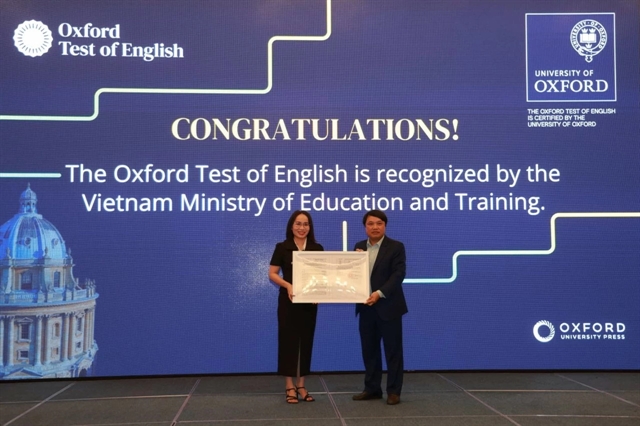
| A representative of the Ministry of Education and Training presents a decision recognising Oxford Test of English certificate levels as equivalent to the six levels of Việt Nam’s Foreign Language Proficiency Framework to a representative of Oxford University Press in Việt Nam. Photos courtesy of Việt Nam Education Publishing House |
HÀ NỘI — As English is increasingly viewed as a tool for learning, communication and global integration as well as a school subject, Việt Nam’s education system faces a new challenge: students need access to quality learning materials and appropriate learning environments, along with reliable assessment tools capable of measuring their actual language proficiency.
As Việt Nam carries out the Government project to make English a second language in schools through 2035, closer links between learning materials, training and assessment are emerging as a key factor.
The announcement in August by the Việt Nam Education Publishing House (VEPH), Oxford University Press (OUP) and UKTA International Education Joint Stock Company of the Oxford Test of English (OTE)'s adoption in Việt Nam provides one example of this trend.
|
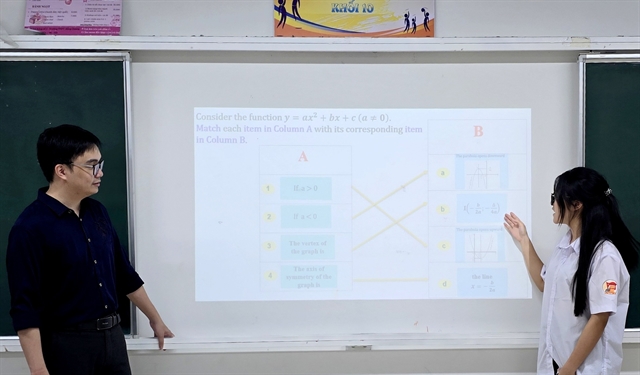
| A student Hồng Quang High School in Hải Phòng studies mathematics in English during the 2025-2026 academic year. VNA/VNS Photo Minh Thu |
More than simply adding another international English certificate, the move reflects a broader approach to building an education ecosystem in which learning, teaching and the measurement of learning outcomes are connected and directed towards a common goal of genuine competency.
From learning English to developing language competency
On October 27, 2025, the Prime Minister issued Decision 2371/QĐ-TTg approving the project on making English a second language in schools for the 2025-2035 period.
The project aims to build an ecosystem for the use of English in educational institutions, improve the quality of English language education and promote teaching and learning through English, helping develop a generation of citizens capable of international integration. English is expected to be used more widely in teaching, communication, management and other educational activities at schools.
This also changes the way foreign-language teaching and learning are viewed. While learning outcomes may previously have been measured mainly through scores or performances on tests, the new approach places greater emphasis on learners’ ability to use the language in real-life situations.
Achieving that goal requires more than a good textbook or an individual training programme. Learners need access to materials aligned with expected outcomes, teachers need professional and methodological support and learning outcomes need to be measured through reliable assessment tools capable of reflecting the skills learners actually use.
In other words, three links — learning materials, training and assessment — need to be part of the same chain.
This is also an approach increasingly emphasised by VEPH as it expands international cooperation.
|
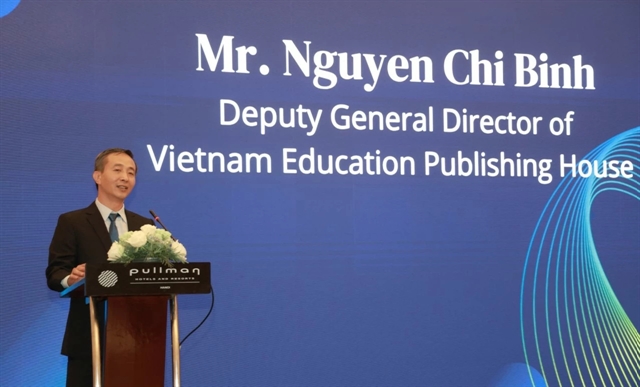
| Nguyễn Chí Bính, Permanent Deputy General Director of VEPH, speaks at the event. |
Permanent Deputy General Director of VEPH Nguyễn Chí Bính said that amid fundamental and comprehensive education reform, providing quality learning materials alone is not enough. More importantly, building a coordinated education ecosystem in which learning materials, training and assessment are closely connected is needed to develop learner competencies, he noted.
“What learners read on the page and what they demonstrate in tests must ultimately lead to the same goal: genuine competency,” he said.
In recent years, the English language assessment market in Việt Nam has become increasingly diverse. Alongside familiar certificates such as IELTS, TOEFL, Cambridge Assessment English and four-skill TOEIC, which are used under various admission and training regulations, Việt Nam also has the VSTEP system, administered domestically under the six-level Foreign Language Proficiency Framework for Việt Nam.
Against this backdrop, the introduction of the OTE is particularly notable.
Under Decision 1429/QĐ-BGDĐT dated May 29, the Ministry of Education and Training (MoET) recognised OTE and OTE Advanced as equivalent to levels of Việt Nam's six-level Foreign Language Proficiency Framework for use in university admissions and training.
OTE scores from 21-50 correspond to Level 1, 51-80 to Level 2, 81-110 to Level 3 and 111-140 to Level 4. For OTE Advanced, scores from 111-140 correspond to Level 4 and 141-170 to Level 5. There is currently no OTE or OTE Advanced score equivalent to Level 6.
Having more choices not only gives learners greater flexibility, but also provides educational institutions with additional assessment tools to match their training objectives and expected learning outcomes.
Tạ Ngọc Trí, deputy director general of the General Education Department under the MoET, said the recognition of additional international foreign language certificates would help diversify English assessment tools, create more opportunities for learners and promote the international integration of Việt Nam’s education system.
OTE measures language use
One notable feature of OTE is its focus on assessing learners’ ability to use English in real-world contexts.
Developed by OUP and certified by the University of Oxford, OTE assesses all four skills — listening, speaking, reading and writing — in line with the Common European Framework of Reference for Languages. The computer-based test uses adaptive assessment technology, with the reading and listening modules adjusting question difficulty according to a test-taker’s performance.
This approach reflects the shift from testing knowledge of language to assessing the ability to use it.
The test focuses on situations learners may encounter during study, work and other situations. OUP says OTE is designed to assess how well learners can use English in everyday academic and professional contexts, covering all four key skills. It is also delivered in a flexible, modular format, allowing candidates to take individual modules or all four skills.
Managing Director at Oxford English Assessment Sara Pierson said: “We are delighted that the Oxford Test of English has been recognised across Việt Nam. This milestone reflects our commitment to providing accessible, flexible and reliable assessment that helps learners demonstrate the real-world English skills they need to succeed in study and work.”
|
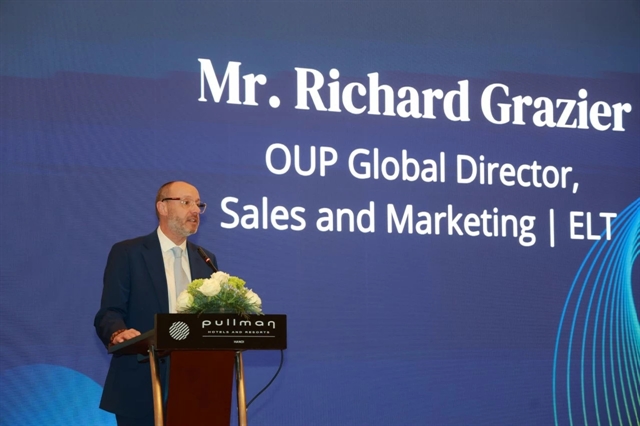
| Richard Grazier, Sales and Marketing Director at Oxford University Press. |
OUP Sales and Marketing Director at OUP, said: “This 30-year milestone is a celebration of collaboration and progress. We are especially proud that the Oxford Test of English is now officially recognised by MoET – a significant achievement that will open new opportunities for teachers and learners across Việt Nam. Together, we look forward to shaping the next chapter in English language education.”
According to VEPH, OTE is currently accepted by more than 1,200 schools, organisations and educational institutions worldwide.
In Việt Nam, UKTA remains the exclusive distributor of OTE under its agreement with VEPH, while VEPH serves as OUP and UKTA’s National Strategic Partner. The partners are working to develop the assessment network nationwide, including connecting educational institutions, expanding test centres and organising workshops and training activities.
The recognition of OTE in Việt Nam can therefore be viewed within a broader picture: the country is gradually expanding and diversifying foreign-language assessment tools while strengthening links with international education standards.
For VEPH, it also represents another step in its role as a bridge between Việt Nam’s education system and international partners. From learning materials and training programmes to teacher development and assessment, the different components are increasingly being brought together within a more coherent chain.
“Our goal is not only to bring an additional internationally standardised test, but also to help English gradually become a tool for daily learning and communication among Vietnamese students,” Permanent Deputy General Director of VEPH Bính said.
That may ultimately be the most meaningful measure of an education ecosystem: not how many lessons learners have completed or how many points they have achieved in a test, but whether the knowledge and skills they acquire have genuinely become competencies that enable them to learn, communicate, work and integrate into the wider world. — VNS
Society
 Society
 Society
 Society
 Society
 Society
 Society
 Society
 Society
 Society
 Society
 Society
 Society
 Society
 Society