 Economy

Đà Nẵng green-lights US$105 million Thai development deal
1.
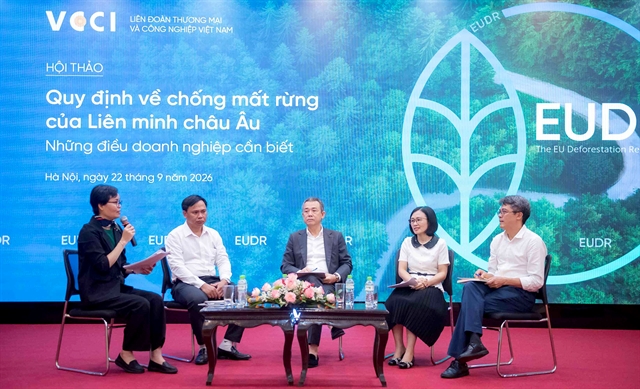 |
| A panel discussion at a seminar on EU Deforestation Regulation (EUDR) held by VCCI on September 22. Photo trungtamwto.vn |
HÀ NỘI — The European Union Deforestation Regulation (EUDR) is setting new requirements for exporters and prompting Việt Nam to strengthen supply chain traceability and management capacity, experts said at a seminar held by the Việt Nam Chamber of Commerce and Industry (VCCI) on September 22.
The seminar on EU Deforestation Regulation (EUDR) brought together businesses and stakeholders to discuss the regulation’s requirements from an exporter’s perspective, as well as preparations, challenges and solutions to support compliance.
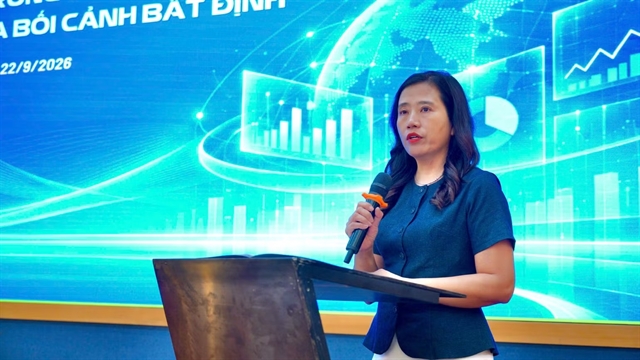
Speaking at the opening, Đậu Anh Tuấn, VCCI Deputy Secretary General and Director of its Legal Department, said the competitiveness of an export-oriented economy had traditionally been measured by price, quality and delivery time.
Markets, however, are increasingly asking how goods are produced, where they come from and what impact production has on the environment and local communities, he said.
The EUDR is a clear reflection of this shift and part of the EU’s broader green policy framework, alongside the Carbon Border Adjustment Mechanism and rules on supply chain due diligence, packaging and forced labour, Tuấn said.
A common feature of these regulations is that they shift the focus of oversight from products to production processes and from national borders deeper into supply chains.
Businesses therefore need to build the capacity to adapt to this broader trend rather than respond to each regulation separately, he added.
The EUDR will apply from December 30, 2026, to large and medium-sized enterprises and from June 30, 2027, to small and micro enterprises, Tuấn said.
The regulation covers more than 80 product lines in seven groups: cattle, cocoa, coffee, oil palm, rubber, soy and wood.
To comply with the EUDR, commodities must meet three main requirements: they must be deforestation-free, comply with the laws of the country of production and be covered by a due diligence statement.
For Việt Nam, the regulation is significant as coffee, rubber, wood and wood products are among the country’s major exports. The EU is also one of Việt Nam’s major markets and plays a role in setting standards for other markets.
“From a legal perspective, the obligations fall on operators in the EU. Vietnamese businesses are not directly subject to the regulation. In practice, however, all the data needed to meet those obligations is on the Vietnamese side – on farmers’ plots, at collection facilities and at processing plants,” Tuấn said.
This makes the EUDR a test of Việt Nam’s supply chain management capacity, he said, as the legal obligations are imposed on one side while the data needed to meet them is held on the other.
EUDR compliance is not simply a matter of preparing additional documents at the final stage, but requires continuous traceability from the plot of land to the container, Tuấn said.
In supply chains involving multiple layers of intermediaries, inadequate information management could make it difficult for businesses to demonstrate that goods are legally produced and not linked to deforestation, he said.
No business, regardless of its size, can digitise hundreds of thousands of producers on its own, Tuấn said. The process requires the involvement of industry associations, government support in providing land and forest data and appropriate cost-sharing among supply chain participants.
The EU has classified Việt Nam as a low-risk country, Tuấn said. This provides an advantage by reducing the burden of proof and the likelihood of post-clearance checks.
However, country-level classification does not replace the obligations applicable to individual shipments, he said.
“A country-level advantage only becomes a real competitive advantage when it is translated into specific records and data for each business. Conversely, if we become complacent, we could lose the advantage we currently have,” Tuấn said.
He hoped the seminar would help businesses clarify four practical questions: whether their products fall within the scope of the EUDR; what data and evidence they need to prepare; how they should coordinate with suppliers and EU customers; and which requirements are mandatory.
“Every time markets raise their standards, Vietnamese businesses face a choice: either retreat to less demanding market segments or move up to remain in the most demanding markets,” Tuấn said.
He said EUDR compliance should not be viewed solely as a regulatory obligation, but also as an opportunity to improve transparency and standardise supply chains that are important to Việt Nam’s agricultural and processing industries.
At the seminar, Dr Nguyễn Thị Thu Trang discussed the responsibilities of different parties in coordinating compliance, as well as key issues including information requirements, geographic coordinates, product origin, the “deforestation-free” requirement and the legality of goods.
During a panel discussion, delegates examined the capacity of Vietnamese export supply chains to meet EUDR requirements. They also addressed businesses’ questions and concerns and shared experience of accessing the European market and complying with its regulations.
The delegates proposed policy and technical solutions to address difficulties and support businesses, producers and exporters in relevant sectors in meeting EUDR requirements when the regulation takes effect. —VNS
Economy
 Economy
 Economy
 Economy
 Economy
 Economy
 Economy
 Economy
 Economy
 Economy
 Economy
 Economy
 Economy
 Economy
 Economy