 Society
HCM City honours fallen soldiers with solemn musical tribute
1.
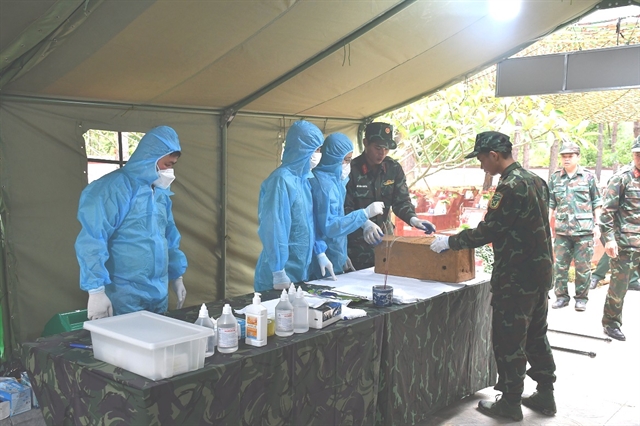 |
| Search and recovery teams collecting remains to verify the identities of fallen soldiers in Lai Châu Province. — Photo baolaichau.vn |
LAI CHÂU — For 76 years, Hà Thị È waited to learn where her father was buried.
She was a teenager when Hà Văn Sinh was killed in 1950 while serving as a political officer with a local militia unit in what is now Lai Châu Province.
She was 93 when she finally stood before his grave.
The moment came after soldiers searching for the remains of fallen fighters discovered a small glass bottle buried alongside a set of remains.
Inside were a few pieces of information that helped investigators identify the dead man as Sinh, originally from Mường Kim Commune, Than Uyên District, Nghĩa Lộ Province, now part of Mường Kim Commune in Lai Châu Province.
“Every piece of information about a martyr is connected to a story, a life and a family that has waited for decades,” said Colonel Trần Thanh Bình, deputy political commissar of the Lai Châu Provincial Military Command.
On July 26, ahead of War Invalids and Martyrs’ Day, authorities formally confirmed Sinh’s identity and handed the decision to his daughter.
È was determined to see her father’s grave. But age and frailty meant she could not make the climb herself. Soldiers took turns carrying her up hundreds of stone steps to the hillside cemetery.
When she reached the grave and saw her father’s name on the headstone, she broke down in tears.
Colonel Bình recalled that È touched the headstone with her hand before embracing the grave.
“For her, at an age when she is nearing the end of her life, this was the fulfilment of a long-held wish,” he said.
For the soldiers involved in the search, the scene was a poignant reminder that behind every unidentified grave is a family that may have been waiting for decades, or even an entire lifetime.
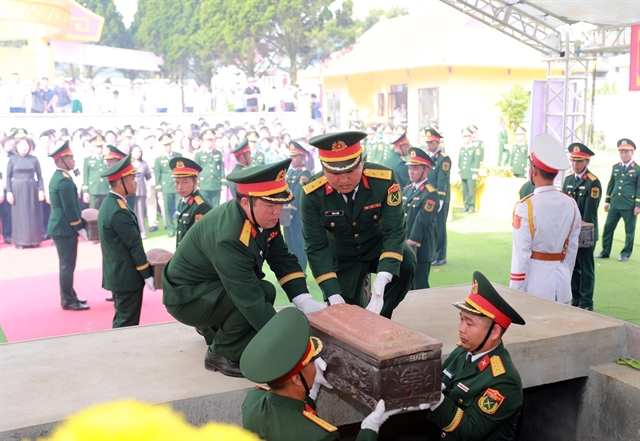 |
| Officers and soldiers carrying out the burial of fallen soldiers’ remains at Bình Lư Commune Cemetery. — VNA/VNS Photo Quý Trung |
A race against time
The discovery came as the country steps up efforts to locate and identify the remains of soldiers killed in past conflicts. A Government initiative, the 500 Day and Night Campaign, is intensifying the search for, recovery and identification of martyrs’ remains ahead of the 80th anniversary of War Invalids and Martyrs’ Day in 2027.
The campaign aims to locate and recover about 7,000 sets of remains, carry out DNA testing on about 18,000 samples and establish a genetic database of relatives of fallen soldiers. It also includes the clearance of unexploded bombs and mines in key areas.
Lai Châu, a mountainous province in the country's northwest, has already completed one of its main targets. By early June, authorities had collected all samples required for DNA testing under the provincial plan.
But DNA is only one part of the process.
“Collecting a DNA sample is an important step, but it is not the final goal,” said Colonel Bình.
The ultimate aim was to combine DNA results with military records, witness accounts and other evidence to establish the identity of each fallen soldier and inform their families, he said.
That task is particularly difficult in Lai Châu. The province's steep and fragmented terrain has changed significantly since the wars. Former battlefields have been transformed by erosion, natural changes and infrastructure projects. In many places, little remains to show that fighting once took place there.
The people who witnessed those events are also disappearing. Many potential witnesses are now elderly, while their memories have faded. Historical documents are scattered among different archives and records do not always agree.
In some cases, investigators have only a name, the military unit to which a soldier belonged or a vague indication of where fighting took place.
From there, search teams must reconstruct what happened.
“These cases require patience and the cross-checking of information from many sources,” Colonel Bình said. “We cannot rush the process.”
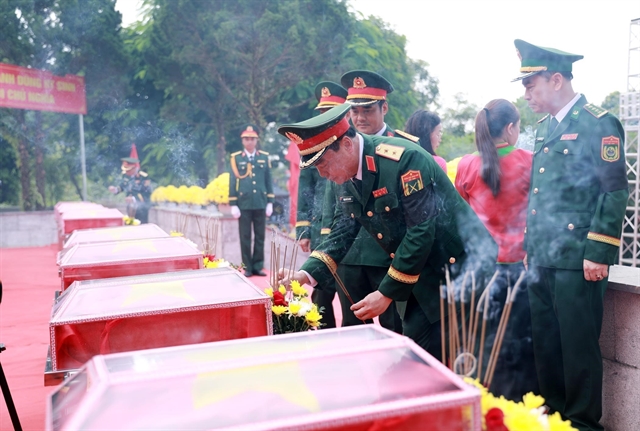 |
| A memorial incense-offering ceremony honouring the martyrs at Binh Lu Commune Cemetery. — VNA/VNS Photo Quý Trung |
Every clue matters
Provincial authorities follow a simple principle of investigating information as it emerges and continuing the search as long as there is evidence or a possibility of finding the remains.
Local residents can play an important role. A seemingly insignificant detail, a remembered location, an old story or information passed down through generations, can become the clue that leads investigators to a grave.
For the search teams, difficult terrain and the passage of time are not reasons to stop.
Every unidentified soldier represents a family that has not yet received an answer.
Lai Châu Province plans to continue reviewing areas where remains may be located, collecting and comparing information, searching for witnesses and examining historical records. Authorities are also encouraging residents to come forward with information.
“Every piece of information, no matter how small, must be received, verified and handled seriously,” Colonel Bình said.
A single clue can mean days of searching and months of checking records, but È's story shows why the effort matters. After 76 years, her father has a name and her family finally knows where he lies.
“We understand that families have been waiting for decades,” Colonel Bình said. “For every family, knowing where their loved one is and whether they have been brought home is an immense wish.”
Many families are still waiting, and soldiers continue to search the mountains for traces of those who died generations ago. Every grave identified brings one more name home. — VNS
Society
 Society
 Society
 Society
 Society
 Society
 Society
 Society
 Society
 Society
 Society
 Society
 Society
 Society
 Society




