 Society
HCM City honours fallen soldiers with solemn musical tribute
1.
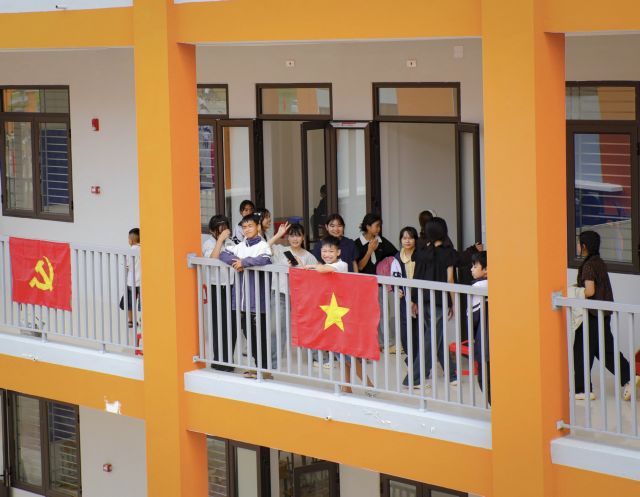 |
| Students at Sam Mứn Primary and Secondary Boarding School in the hallway in the days leading up to the new school year. — VNA/VNS Photo Xuân Tư |
Khánh Dương
HÀ NỘI — In just a few days, more than 2.7 million students and over 1.4 million teachers nationwide will step into a new school year, bringing with them new hopes and expectations.
The Ministry of Education and Training has identified students’ progress, teachers’ working conditions, school performance and the quality of staff as key measures of the outcomes of the 2026-2027 academic year.
Against this backdrop, teachers and parents are placing their hopes in a school year that puts people at the heart of education.
Bùi Hương Thảo has mixed feelings of excitement and worry as her only child is about to enter first grade at a public school in Hà Nội.
She and her family spent the National Day holiday shopping for school supplies.
“I feel excited, but also a little worried about whether my daughter will be able to keep up with the new pace. She will be moving from kindergarten, where she had plenty of free time, into a new stage of learning that will require greater effort from both her and us as parents,” she told Việt Nam News.
“While the child is entering first grade, perhaps parents are also entering a new classroom of their own – learning how to stand behind their child and let them grow up on their own,” she said.
“Of course, what matters most to me is that my child will read and write well and have a solid foundation in mathematics. But I don’t want grades to become the only measure of success.”
“I only hope that every day she goes to school, there will be something that makes her happy and eager to come home and tell Mom about it,” Thảo added.
Phan Ngọc Doanh, whose second child is also about to enter first grade at a private school in Hà Nội, said: “What I hope for most is not that my child studies as much as possible, but that he feels happy going to school, becomes confident, develops a love of learning and gradually builds the habit of being independent and self-disciplined in his studies.”
She also hopes teachers will have enough time and resources to pay attention to each student, because “every child has a different pace of adjustment and different strengths”.
Students in the final grade at each educational level are also facing a transition, as are their parents.
With Doanh’s first child entering fifth grade, the final year of primary school, she hopes the new school year will be higher quality, but less stressful for both children.
“For my fifth grader, I hope my child will build a solid knowledge base to enter secondary school without being placed under too much pressure from examinations,” she said.
Vũ Thu Trang, whose twin children are preparing to take the high school graduation and university entrance examinations next year, also hopes for greater stability and transparency in examinations.
“I hope authorities will create the most favourable conditions possible for students in terms of the high school graduation examination format. I also hope schools and teachers will closely support students, drawing up study plans, providing career guidance and introducing effective exam preparation methods from the beginning of the school year.”
Equitable access
Minister of Education and Training Hoàng Minh Sơn said that during the 2026-2027 school year, the ministry would continue to focus on expanding access to equitable and quality education for all, one of the three core goals set out in Resolution 71 on breakthroughs in education and training development.
“We need to ensure that everyone who wants to learn has access to education, regardless of whether they live in cities, rural areas or remote, disadvantaged regions,” he said.
He also highlighted the principle of putting people at the centre of development and making human development a key driver of progress. This means that educational success should not be measured solely by students’ grades, but also by the quality of education and how much students are able to grow in their learning environment.
According to Sơn, one of the key challenges in ensuring equitable and quality education is making sure there are enough schools and classrooms to meet demand.
This is also an aspiration shared by many parents.
“From a parent’s perspective, I also hope more high-quality secondary schools will be available in residential areas, giving parents more choices and allowing children to study in a good learning environment close to home, rather than having to travel too far every day,” Doanh said.
Sơn said that when there are not enough schools and classrooms, students are forced to compete for places and seek out schools they believe offer better educational opportunities.
“The goal should be to ensure an adequate number of schools, classrooms and qualified teachers, with educational quality distributed more evenly across the system,” he said.
“Once supply is sufficient, students should be able to enroll in a school near their home and attend the school that is most convenient for them. This would reduce competition and pressure, as well as reliance on extra classes and tutoring, and even help curb practices like cheating driven by the pressure to secure a place at a desired school,” the minister added.
School restructuring
Another major change in the new school year is the restructuring of the school system, with many schools being merged into larger school clusters. The number of vice principals will also be reduced following the mergers, with many former vice principals moving into teaching positions.
The changes have raised concerns not only among students and parents, but also among teachers and school administrators.
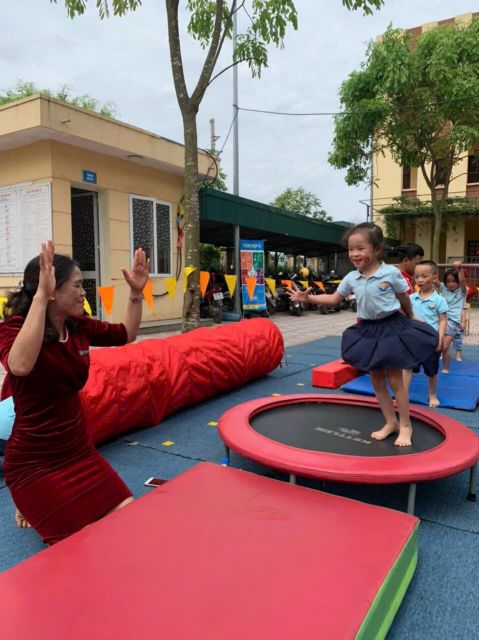 |
| Đào Thị Phương Nghi encourages her students at an outdoor physical exercise session. — Photo courtesy of Nghi |
Đào Thị Phương Nghi, principal of Thanh Oai Kindergarten on the outskirts of Hà Nội, is entering the new school year with the added responsibility of managing a larger school formed through the merger of three smaller ones.
She said it is a valuable opportunity to work and exchange ideas with more experienced and professional colleagues through practical experience.
“Our teaching staff has been strengthened with the addition of several vice principals, most of whom have strong professional expertise. I believe their experience and knowledge will help make our school’s teaching team stronger,” she said.
Lê Thị Thu Thủy, a teacher at Tân Khai Primary School in Hà Nội, said teachers’ working conditions should be considered an important measure of the new school year.
“If teachers’ working conditions are to be one of the measures of a successful new school year, I hope that measure will go beyond facilities and income to include whether teachers have enough time, support and professional space to do their jobs well.
“For students to have a good school year, teachers first need a good working environment,” she said.
From attention to action
Sơn said education and training has never before received such sustained, continuous and direct attention from leaders at both the local and national levels.
“This attention is substantive rather than merely symbolic,” he said.
Citing the emphasis by Party General Secretary and State President Tô Lâm and Prime Minister Lê Minh Hưng on the need to reform education governance, Sơn said the ministry is developing and will soon issue a set of indicators for education and training development, covering national and local education as well as higher education.
“The reform of education governance will move away from focusing heavily on procedures and instead be driven by clearly defined outcomes. Localities will be assigned targets, similar to socio-economic development targets, but these must be substantive indicators that truly reflect educational quality,” he said.
All these indicators will be integrated into a digital education development platform, with corresponding digital platforms for individual schools and localities.
The ministry, departments of education and authorities at the provincial, commune and ward levels will be able to access and monitor the indicators, enabling localities to develop innovative solutions based on their specific circumstances, he added. — VNS
Society
 Society
 Society
 Society
 Society
 Society
 Society
 Society
 Society
 Society
 Society
 Society
 Society
 Society
 Society




