 Society

AIMCONNECT 2026 Held in Singapore, Bringing Global Automotive Leaders Together to Explore the Future of AI, Trust and Connected Mobility
1.
|
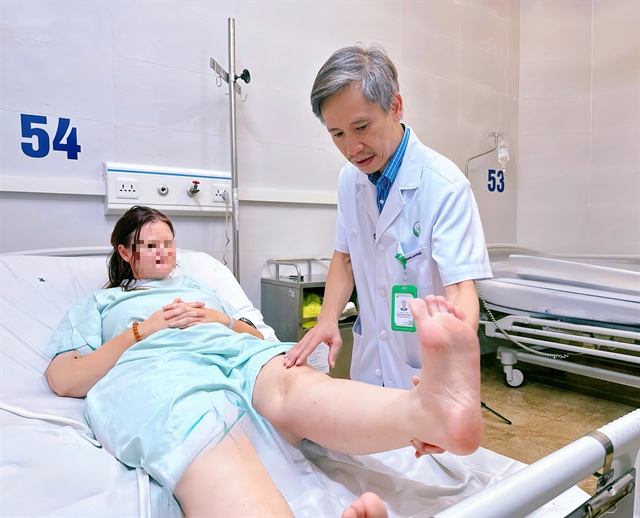
| Associate Professor Dr. Nguyễn Mạnh Khánh checks the patient's mobility after surgery, marking the first steps on the recovery journey. Photo courtesy of Việt Đức Hospital |
HÀ NỘI — A New Zealand patient who had travelled more than 9,000km to Việt Nam for a hip replacement was standing and walking on her own within days of surgery, Hà Nội-based Việt Đức University Hospital said on July 26.
Associate Professor Dr Nguyễn Mạnh Khánh, Deputy Director of Việt Đức Hospital and Head of Orthopaedic and Trauma Department 1, said the patient had been experiencing left hip pain for about 10 years. Initially the pain occurred only during physical activity, but it gradually increased in intensity and frequency, seriously affecting her daily life.
Although the patient had been recommended for a hip replacement in New Zealand several years earlier, she was required to wait under the public health system.
The waiting time for surgery had stretched to about four years. Meanwhile, the cost of surgery as a self-paying patient would amount to nearly NZ$40,000 (about US$23,000, current exchange rate).
After researching the expertise of Vietnamese doctors and the quality of treatment available in several countries in the region, the patient decided to travel to Việt Nam for treatment at Việt Đức Hospital.
On admission, her left hip joint had been completely ruined. She was in severe pain, almost entirely unable to walk independently, and dependent on a wheelchair. Her weight of nearly 100kg made movement, anaesthesia, and surgery more complex, doctors said.
Following physical examination and imaging assessment, doctors diagnosed the patient with avascular necrosis of the femoral head, leading to end-stage hip osteoarthritis. This condition can arise from a range of causes including blockage of the blood vessels supplying the femoral head, trauma, autoimmune disease, prolonged use of corticosteroids, or being overweight or obese.
Despite the difficulties posed by the patient's physical condition, the surgical team performed a total hip replacement using a minimally invasive technique. The thick layer of soft tissue around the hip meant the approach to the joint was considerably deeper than in typical cases.
Nevertheless, the operation proceeded smoothly, with a skin incision of only about 5–6cm, helping to reduce soft tissue damage and support post-operative recovery.
From the second day after surgery, the patient was guided by rehabilitation technicians to stand up and begin walking. After nearly one week of treatment, the surgical wound had healed cleanly, both lower limbs were balanced, the patient was free of pain, and she was able to walk independently.
In the doctors' assessment, upon returning to New Zealand the patient will quickly resume a normal life – she would be able to drive, take part in suitable sporting activities, and live independently after many years constrained by her hip condition.
The patient said that before surgery her life had been almost entirely upended by chronic pain. Every step required a walking stick or crutches, making her feel she was ageing before her time. Even everyday tasks had become extremely difficult.
After the operation, joy and hope had returned.
The patient is confident that in about three months' time she will be able to run again, something she never thought that could become a reality.
She also expressed her gratitude for having been treated in Việt Nam. "I feel incredibly fortunate that this beautiful country has helped me. The doctors here are truly professional and possess outstanding expertise. They understood my situation, made the decision to help me, and gave me a new life. There are no words to fully express my gratitude to the doctors and the hospital. Thank you so much!"
Nguyễn Mạnh Khánh said the case was testament to the development of Vietnamese surgery in the field of joint replacement. Not only have domestic medical facilities mastered a range of specialised techniques on a par with those of developed countries, they also deliver high-quality treatment at reasonable cost. — VNS
Society
 Society
 Society
 Society
 Society
 Society
 Society
 Society
 Society
 Society
 Society
 Society
 Society
 Society
 Society