 Society
HCM City honours fallen soldiers with solemn musical tribute
1.
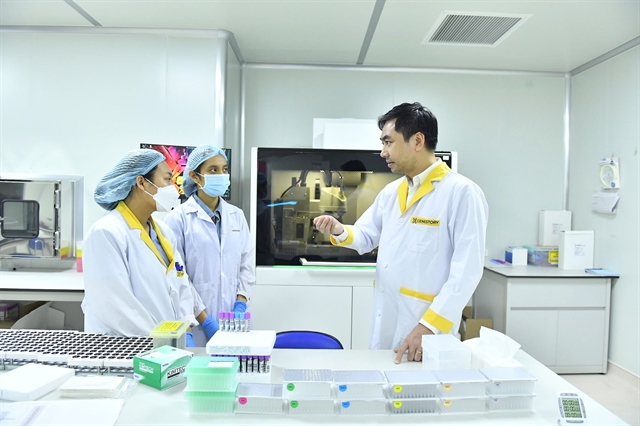 |
| Dr Võ Sỹ Nam (right) discusses genome sequencing technology with his colleagues. — VGP/VNA Photo |
HÀ NỘI — For the first time, Vietnamese scientists have successfully built a large-scale human genome dataset together with a population-specific reference genome for people.
The work has just been published in Nature Communications – one of the world’s leading prestigious scientific journals – opening up an important foundation for genetics research, precision medicine and preventive medicine in Việt Nam.
A group of Vietnamese scientists led by Dr Võ Sỹ Nam, executive director of the Big Data Research Institute under VinUni University, and Prof Vũ Hà Văn, the institute’s scientific director, has just published the study 'VN1K is a pangenome-informed multi-omics and phenomics resource for the Vietnamese population' in Nature Communications.
The work introduces the first large-scale, comprehensive source of genome, multi-omics and phenotypic data of Vietnamese people, and at the same time successfully builds the Vietnamese PanGenome Reference (VPR) – the first population reference genome specifically for Vietnamese people.
This is considered an important scientific foundation for genetics research and many applications in precision medicine, preventive medicine, as well as genome decoding services for citizens.
The project was initiated in 2018, with the participation of more than 40 Vietnamese scientists. The research team analysed data from 1,011 people from 53 out of 63 provinces and cities, recording more than 42 million genetic variants, of which about 8.5 million variants had never appeared in commonly used international databases.
From this source of data, the scientists developed the Vietnamese PanGenome Reference (VPR) – Việt Nam’s first large-scale population reference genome, helping to improve the accuracy in analysing and interpreting genetic variants of Vietnamese people compared with current reference genomes, which are mainly built from European data.
Previously, genetic data of Vietnamese people in international studies remained very limited. This gap meant that many studies on disease pathology, drug response and precision medicine applications did not fully reflect the genetic characteristics of Vietnamese people.
According to the research team, the successful building of VN1K not only supplements the missing data of Việt Nam on the world genome map but also contributes an important source of data for South-East Asia, where large-scale genetic data remains lacking.
From VN1K data, the scientists identified many gene variants related to adverse reactions to some common drugs, while also developing drug-response prediction models for about 150 groups of drug substances, contributing to supporting personalised treatment.
One application already implemented is the project “The right medicine for me”, helping thousands of disadvantaged children with epilepsy undergo genetic testing before treatment, thereby reducing the risk of serious drug reactions and improving treatment effectiveness.
One outstanding application of the project is VinGenChip – the first biochip designed based on Vietnamese human genome data. This technology is capable of simultaneously analysing tens of thousands of genetic variants, serving individual identification, drug-response prediction, disease-risk screening and population genetics research.
Currently, VinGenChip is one of the technologies being used in the Martyrs’ Gene Bank Project and related projects, as well as the 500-day-and-night campaign to search for, collect and identify the identities of martyrs’ remains, which is being implemented on a scale of up to millions of DNA samples.
With the ability to simultaneously read a large number of identification-value genetic variants, this technology contributes to improving the accuracy of matching data between relatives’ DNA samples and remains, while significantly reducing costs compared with many imported solutions.
The application of VinGenChip on the platform of Vietnamese genome data is expected to contribute to improving the effectiveness of identifying the remains of martyrs whose information is still missing, serving a task of special historical, political and humanitarian significance. This is also proof of the ability to transform scientific research results into technologies serving the country’s practical needs.
Sharing the significance of the work, Văn said this was a study entirely carried out by Vietnamese scientists in Việt Nam, for Vietnamese people, pioneering in nature and laying the foundation for comprehensive studies on the Vietnamese genome in the future.
Meanwhile, Nam affirmed that the group’s goal was not only to build databases and AI tools for genetic data, but also to transform research results into applications serving the community, contributing to promoting preventive medicine and precision medicine in Việt Nam. — VNS
Society
 Society
 Society
 Society
 Society
 Society
 Society
 Society
 Society
 Society
 Society
 Society
 Society
 Society
 Society




