 Economy


Japan–Việt Nam ties: Moving from investment to co-creation
1.
|
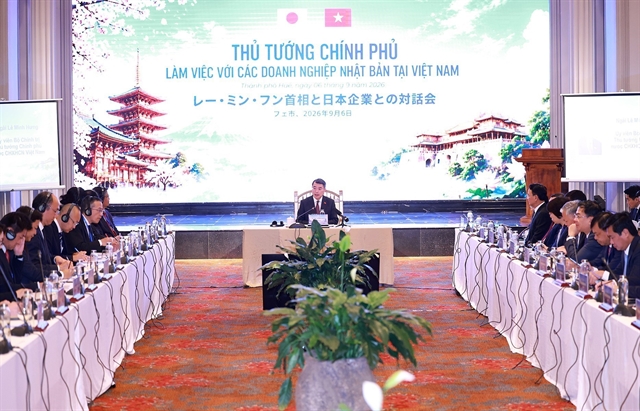
| Prime Minister Lê Minh Hưng speaks at a meeting with Japanese businesses in Việt Nam on September 6, 2026. — VNA/VNS Photo Dương Giang |
Khánh Linh
TOKYO — General Secretary of the Communist Party of Việt Nam and State President Tô Lâm will pay an official visit to Japan from November 8 to 11, providing an opportunity to give fresh impetus to bilateral cooperation under the two countries’ Comprehensive Strategic Partnership.
As the two countries seek to deepen their ties, a key priority is to translate their strong political relationship into more substantive economic cooperation. This will require going beyond investment and technology transfer to build partnerships that enable Vietnamese businesses to strengthen their technological capabilities, participate more deeply in global supply chains and create greater value locally.
|
|
| Professor Seiya Sukegawa at the Faculty of Political Science and Economics, Kokushikan University, in Japan. — Photo courtesy of Professor Seiya Sukegawa |
Professor Seiya Sukegawa at the Faculty of Political Science and Economics, Kokushikan University in Japan, who has studied Japan–ASEAN economic relations, believes the next stage of cooperation should be marked by a shift ‘from investment to co-creation’.
“‘From investment to co-creation’ means moving beyond Japanese companies simply setting up factories in Việt Nam and transferring technology. It means Japanese and Vietnamese companies are identifying the challenges facing Việt Nam’s industries and society, then working together to develop solutions,” he told Việt Nam News.
“Cooperation could extend across the entire process, from planning and design to research and development, prototyping, quality assessment, sales and maintenance.”
Such a shift would give Vietnamese partners a more active role in the development of products and services, rather than limiting their participation to manufacturing based on technologies and specifications provided by foreign investors.
Strengthening the role of Vietnamese businesses
A major challenge for Việt Nam is ensuring that foreign investment generates stronger domestic industrial capabilities and closer links between foreign-invested enterprises and local companies.
According to the World Bank report Việt Nam 2045: Trading Up in a Changing World, the share of Vietnamese firms participating in global value chains fell from 35 per cent in 2009 to 18 per cent in 2023, while foreign firms accounted for 73 per cent of the country's exports.
These figures highlight the gap between Việt Nam's growing role in international trade and the participation of domestic businesses in global production networks.
“Strengthening local firms’ capabilities and building closer links between domestic and foreign companies will be essential to advancing co-creation,” Sukegawa said.
He outlined practical steps that Japanese companies and Vietnamese partners could take to address this challenge.
“Japanese companies should share their procurement standards and medium- to long-term needs with local firms at an early stage. They should also work with them to improve quality control and production processes, train technical staff and obtain relevant certifications,” he said.
“Vietnamese companies, in turn, should aim to move beyond contract manufacturing and take on roles in areas such as component development, design support and process improvement.”
|
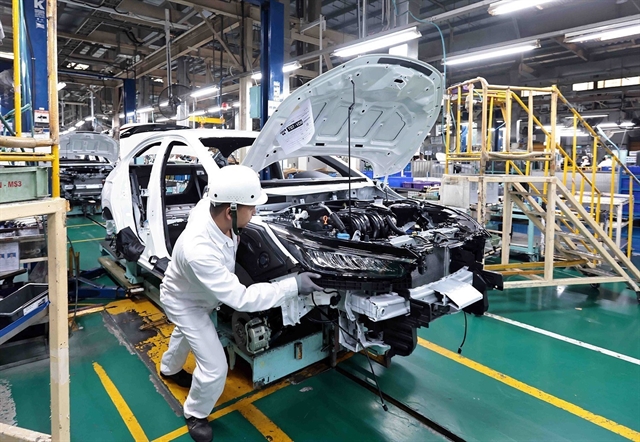
| Car assembly workshop at Honda’s Phúc Yên plant in Phúc Yên Ward, Phú Thọ Province. — VNA/VNS Photo Trần Việt |
This requires a change in the way partnerships are built. Rather than treating local suppliers mainly as subcontractors, Japanese companies could involve them earlier in product development and production planning, giving Vietnamese firms opportunities to learn, improve their capabilities and take on more sophisticated tasks.
The goal, therefore, is not simply to increase the number of Vietnamese suppliers in Japanese companies’ supply chains but to expand the range of activities they can undertake and the value they can retain.
Semiconductors and green manufacturing offer practical opportunities
While co-creation can cover a wide range of industries, Sukegawa identified two areas where Việt Nam and Japan could make tangible progress in the coming years: strengthening Việt Nam’s semiconductor ecosystem and promoting energy efficiency and decarbonisation in manufacturing and industrial parks.
In the semiconductor sector, cooperation could focus on areas where Japanese companies have established strengths, including manufacturing equipment, materials, precision manufacturing and quality control.
“This does not mean assuming that Japan has a broad advantage in designing or manufacturing the world’s most advanced chips,” he said. “Rather, cooperation in these supporting areas – combined with workforce development and the participation of Vietnamese suppliers – could help build Việt Nam’s industrial capabilities.”
This approach would allow Việt Nam to move up to a higher position in the semiconductor value chain while making use of Japan's technological expertise and industrial experience.
The second priority is improving energy efficiency in factories and industrial parks, expanding the use of renewable energy and strengthening energy management.
“These efforts can support Việt Nam’s industrial competitiveness while addressing its need for a stable electricity supply,” Sukegawa said.
Japan and Việt Nam have already identified industrial park decarbonisation, offshore wind power and power grid development as areas for cooperation, he noted.
AI and digital technologies could support both priorities. However, their greatest value would come from addressing practical industrial needs.
“Their value will be greatest when applied to practical needs such as inspection, equipment maintenance, process improvement and energy management, rather than treated as priorities in isolation,” he said.
These areas illustrate how co-creation could work in practice: Japanese and Vietnamese partners identifying shared challenges, combining their respective strengths and developing solutions that can be applied in factories and across industrial sectors.
|
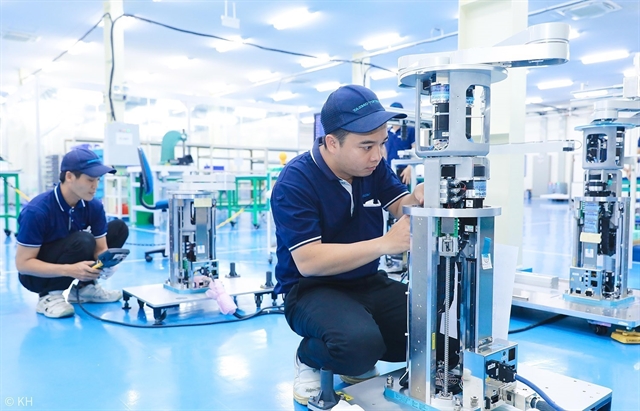
| TAZMO Vietnam, a wholly Japanese-invested company in Long Hậu Industrial Park, Tây Ninh Province, is among the pioneers in manufacturing robots and high-tech equipment for the semiconductor industry. — VNA/VNS Photo Thành Phương |
Moving up the value chain while strengthening supply-chain resilience
A further priority is helping Vietnamese companies take on higher-value activities while demonstrating the substance of production carried out in the country.
Sukegawa said simply participating in supply chains was not enough to address concerns that Việt Nam could be used as a transshipment point to reroute goods and avoid trade remedies in third countries.
Sukegawa noted that the use of Chinese-made intermediate goods does not, by itself, mean that a product is being transshipped to evade trade measures. For certain US trade measures, origin determinations are made case by case, taking into account factors such as the origin of components and the extent of processing carried out in Việt Nam.
"What matters is that companies can demonstrate what production and processing take place in the country and what value is added locally," he stressed.
“Reviewing excessive reliance on intermediate goods from China and expanding local sourcing would also help diversify supply chains and strengthen Vietnamese firms,” he added.
“Transparency about sourcing must therefore go hand in hand with substantive production, processing and value creation in Việt Nam,” he said.
Japanese companies can support this process by sharing quality, delivery and cost requirements, as well as future procurement needs, at an early stage. They can also provide technical guidance, help suppliers obtain certifications and offer the prospect of stable, long-term business relationships.
Digital technology can also help companies document and verify the sources of key components, manufacturing and processing steps, inspections and certifications, as well as the technology and value added in Việt Nam.
This is closely linked to a broader transformation in regional manufacturing. In his analysis of Japan–ASEAN economic relations, Sukegawa has argued that Southeast Asia needs to move beyond its traditional role as an assembly base towards becoming a region that creates more value through research and development, design, components, services and other higher-value activities.
For Việt Nam, this means attracting investment while also ensuring that domestic firms, engineers and workers become more deeply involved in production and innovation.
Building a partnership between equals
The shift towards co-creation also has a wider strategic significance for both countries. Stronger industrial capabilities in Việt Nam could contribute to more diversified and resilient supply chains for Japan, while closer cooperation with Japanese companies could support Việt Nam's industrial upgrading, workforce development and creation of higher-value products and services.
Sukegawa hopes Party General Secretary and President Tô Lâm's visit will help turn broad areas of cooperation agreed at the leaders' level into concrete joint projects.
“It can also be an occasion to connect the long history of exchanges between Japan and Việt Nam with a new era of co-creation,” he said.
The year 2026 marks the 40th anniversary of Việt Nam's adoption of the Đổi Mới (Renewal) policy. More than 120 years ago, Vietnamese patriot Phan Bội Châu travelled to Japan, helping launch the Đông Du movement, which encouraged young Vietnamese to study in the country.
Sukegawa said the Đông Du movement reflected Vietnamese aspirations to learn from Japan and develop the human resources needed to modernise their own country.
“I believe the significance of the visit lies in building on that history to advance cooperation in which Japan and Việt Nam jointly develop human resources, strengthen the capabilities of local firms and upgrade industry.”
At the same time, he cautioned against idealising the past.
“Acknowledging its historical context can help ensure that today’s partnership is based on mutual respect and cooperation between equals,” he said.
That principle, he suggested, should be reflected in the way new projects are designed and implemented. The two sides could establish working groups involving companies, universities and government agencies to advance projects in areas such as upgrading local suppliers, training engineers, and improving energy efficiency and decarbonisation in factories and industrial parks.
“Each project should have clear responsibilities, timelines and objectives,” he said.
He also called for a broader approach to assessing the results of bilateral cooperation.
“Its success should be measured not only by the amount invested, but also by the production processes undertaken by Vietnamese firms, the skills developed, the technologies and products created jointly, and the value generated locally.” — VNS
Economy
 Economy
 Economy
.jpg) Economy
 Economy
 Economy
 Economy
 Economy
 Economy
 Economy
 Economy
 Economy
 Economy
 Economy
 Economy