.jpg) Economy

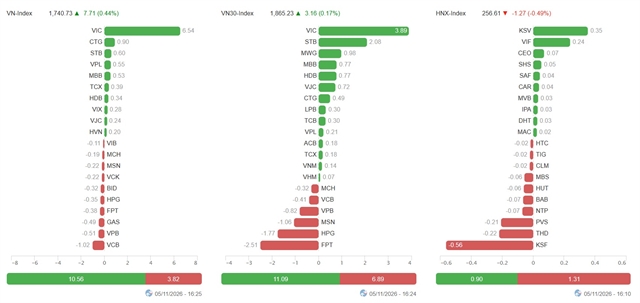
Earnings growth fails to lift Vietnamese stocks as investors remain cautious
1.
|
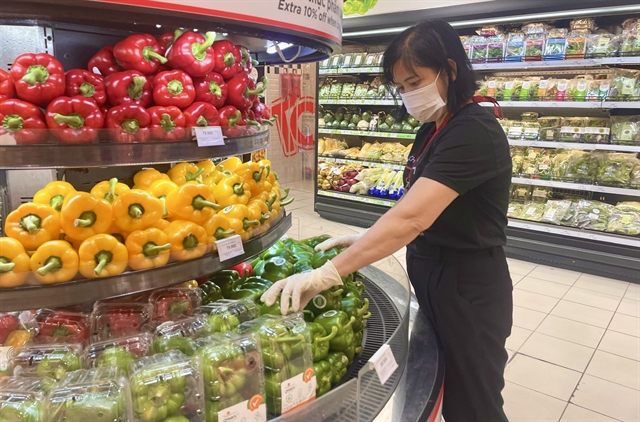
| Local fruits and vegetables on shelves of a supermarket in HCM City. Việt Nam has launched a programme to develop a competitive ecosystem of quality Vietnamese products, boost local consumption and strengthen the position of local brands. — VNA/VNS Photo Hương Giang |
HÀ NỘI — Việt Nam aims to ensure Vietnamese products account for more than 80 per cent of goods displayed in domestic supermarkets and shopping centres and 60 per cent in traditional markets by 2030, under a new government programme to boost local consumption and strengthen the position of local brands.
The target is part of the “Vietnamese goods for Vietnamese” programme for the 2026–30 period, approved under Decision No. 2069/QĐ-TTg signed by Deputy Prime Minister Phạm Gia Túc late last month.
Under the programme, the domestic retail market is expected to reach VNĐ13.5-14 quadrillion (US$513-532 billion) by 2030 with average annual growth of 14-15 per cent in total retail sales of goods and consumer services during the period.
The programme aims to develop a competitive ecosystem of quality Vietnamese products, build strong domestic brands trusted by consumers and encourage greater use of locally made goods to contribute to the country's ambition of achieving double-digit economic growth.
Digital transformation and modern distribution channels will play a key role in expanding the domestic market.
More than 70 per cent of small- and medium-sized enterprises (SMEs) producing consumer goods are expected to adopt e-commerce, while 45 per cent of SMEs operating in trading are targeted to join major domestic and international e-commerce platforms.
E-commerce sales are projected to grow by 23-25 per cent annually, reaching $93-97 billion by 2030, equivalent to 18-19 per cent of total retail sales of goods and consumer services.
The Government plans to establish at least five specialised online stores for Vietnamese products on major e-commerce platforms.
A unified national identification system will be introduced for Vietnamese products meeting the programme's criteria, alongside a product traceability system to help consumers verify origins and product information.
The identification system will be applied consistently across product packaging, retail outlets, e-commerce stores, promotional materials and communication campaigns to help consumers easily recognise eligible Vietnamese products.
The programme also calls for stronger links between domestic manufacturers, suppliers and distribution networks, while encouraging foreign-invested enterprises to prioritise Vietnamese suppliers that meet quality requirements.
To promote local consumption, the Government will launch a national communications campaign highlighting Vietnamese products, brands, quality and origins through traditional media, social networks and major shopping events.
Measures will also be taken to expand Vietnamese goods distribution through tourism, including display and retail outlets at airports, seaports, border gates and tourist destinations.
Inspections will be enhanced against counterfeit, substandard and smuggled goods, as well as origin fraud, across both traditional and online markets. Digital technologies and artificial intelligence will be used to help detect violations.
The programme also seeks to improve the legal framework for domestic trade, product quality standards, distribution, e-commerce and consumer protection, while supporting the development of commercial infrastructure, particularly in rural and disadvantaged areas. — VNS
Economy
 Economy
 Economy
 Economy
 Economy
 Economy
 Economy
 Economy
 Economy
 Economy
 Economy
 Economy
 Economy
 Economy
 Economy