 Economy

HCM City works to clear the way for RoK investors
1.
|
|
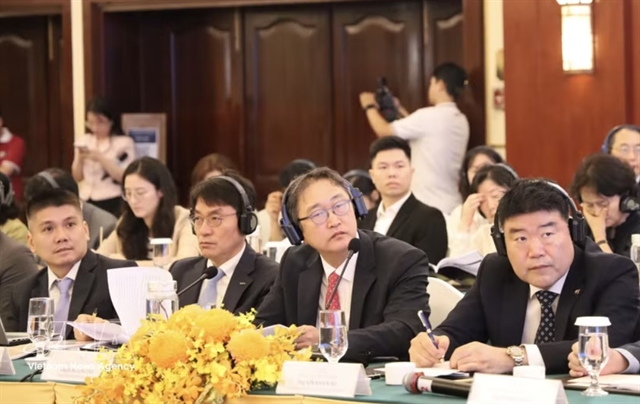
| Korean business executives at the dialogue. — VNA/VNS Photo |
HCM CITY — HCM City is courting capital from the Republic of Korea (RoK) for high tech, supporting industries, semiconductors, infrastructure and green energy, pledging to improve the investment climate and fix corporate bottlenecks fast, heard a 2026 dialogue between HCM City leaders and Korean enterprises on Thursday.
The event was co-hosted by the Ho Chi Minh City Investment and Trade Promotion Centre (ITPC) and the RoK Consulate General in the city.
ITPC Director Phạm Quang Nhật said the dialogue has run annually since 2021 as a direct channel for a transparent, stable and open investment climate. More than 4,500 Korean companies operate in the city, alongside the Korean community, the largest in the country.
HCM City, aiming to become a modern megacity and hit double-digit growth, has made foreign investment, especially high-tech, high added-value and green projects, a key driver. It is pushing new mechanisms to widen opportunities in semiconductors, artificial intelligence (AI), digital economy, green transition, clean energy and international financial centre, he said.
According to him, the Republic of Korea leads in project count in the city, with more than 3,400, and ranks second by registered capital with more than US$15.8 billion as of late September. The city is soliciting 200 projects across nine sectors, many matching Korean strengths, including electronics, semiconductors, high tech, supporting industries, next-generation industrial parks, urban transport, ports, logistics and urban development.
The municipal departments of industry and trade and finance and Ho Chi Minh City Export Processing and Industrial Zones Authority (HEPZA) said the city is drafting a plan to convert industrial and export-processing zones toward hi-tech, ecological and next-generation industry. For plants moving out of residential areas, the city aims to pair relocation with replacement industrial land and is studying interest rate support for infrastructure investors and companies involved in conversion.
Officials from the departments of science and technology, and industry and trade cited support under the revised High Technology Law: up to 100 per cent R&D funding for strategic technology, import tax exemption for specialised research machinery and materials, intellectual property protection cost support and loan interest support of up to 10 per cent a year for as long as five years.
Beyond investment, Korean firms cited snags in imported consumer goods licensing, temporary residence declarations for foreigners, electronic administrative procedures and tax finalisation on dissolution or relocation.
On tax, firms said some finalisation files for dissolution or relocation have dragged on for years, with requests for documents of unclear necessity. They want published processing deadlines and a defined scope for explanatory documents. They also flagged inconsistent dossier and notarisation requirements among officials handling investment registration certificates (IRC) and enterprise registration certificates (ERC) and called for a clean-up.
Vice Chairman of the municipal People’s Committee Nguyễn Công Vinh told departments and agencies to pair listening with action, work directly with firms to clear issues within their authority, and issue specific guidance or promptly advise higher authorities on matters beyond their remit.
“Within 15 working days after the dialogue, agencies must update progress and results on each petition. In case full settlement is not possible, they must state the reason, the path forward and an expected completion date. For cross-sector issues, the lead agency and coordination duties must be clear so that firms should not have to contact multiple offices for the same matter”, he said. — VNA/VNS
Economy
 Economy
 Economy
 Economy
 Economy
 Economy
 Economy
 Economy
 Economy
 Economy
 Economy
 Economy
 Economy
 Economy
 Economy