 Society
Vietnamese scientist wins ASEAN-US Science Prize for Women
1.
By Khánh Linh
HÀ NỘI — A police officer scanned 79-year-old Thế Thị Yến's fingerprints before a medical worker drew a small tube of blood from a vein in her arm.
The procedures took only a few minutes. For Yến, however, they represented nearly six decades of waiting.
Her older brother, Nguyễn Thế Toàn, left for the battlefield in Central Việt Nam in 1966 and was killed in action two years later at the age of 28. Their father died in 1968 and their mother a year later, both believing their eldest son was still fighting on the front. It was not until 1978 that the family finally received official confirmation of his death.
For decades, they searched for his grave. They travelled, sought help from his comrades and local authorities, and followed every lead they could find. None brought him home.
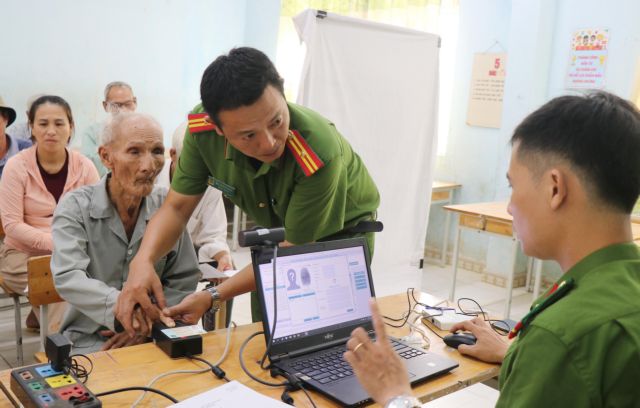 |
| Police officers collect the fingerprints of a fallen soldier's relative during a DNA sampling campaign in Bình Sơn Commune, Quảng Ngãi Province. VNA/VNS Photo Phạm Cường |
As technicians labelled Yến's blood sample, she quietly watched every step. This time, her family's hope rested not on fading memories or fragmented wartime records, but on a scientific process that would carry her DNA into Việt Nam's National War Martyrs' Gene Bank.
"We've searched everywhere we could. Now all we can do is place our hope in this DNA sample," she told reporters. "There were four siblings in my family. Now only I remain. I only hope I will still be here when my eldest brother comes home."
Yến was among nearly 15,000 relatives who provided blood samples in Hà Nội earlier this month. Led by the Ministry of Public Security under Government direction, the initiative is building a nationwide genetic reference database to help identify thousands of fallen soldiers whose remains have never been identified.
The project has become a key scientific pillar of Việt Nam's 500-day campaign to accelerate the search, recovery and identification of war martyrs' remains, launched ahead of the 80th anniversary of War Invalids and Martyrs Day on July 27, 2027.
Unlike previous efforts, which depended largely on wartime documents, eyewitness accounts and personal belongings, the gene bank offers something those methods cannot: a permanent genetic reference that can be matched with unidentified remains whenever new evidence becomes available.
The initiative works by collecting DNA from surviving relatives and comparing it with DNA recovered from unidentified martyrs' remains over time. GeneStory, a Vietnamese biotechnology company partnering in the campaign, is responsible for collecting blood samples, decoding and analysing DNA through the national database.
By early July, around 95,000 relatives had provided DNA samples, with more than 53,000 already analysed and added to the national database. The system has already contributed to identifying 23 previously unknown soldiers, while all sampling and testing costs are fully funded.
Officials describe the gene bank as the foundation of Việt Nam's long-term effort to identify unknown war dead. Earlier this month, Prime Minister Lê Minh Hưng directed ministries and localities to accelerate DNA collection and integrate the data nationally.
Journey of a blood sample
For most families, the journey ends the moment a blood sample is taken. In reality, it is only beginning.
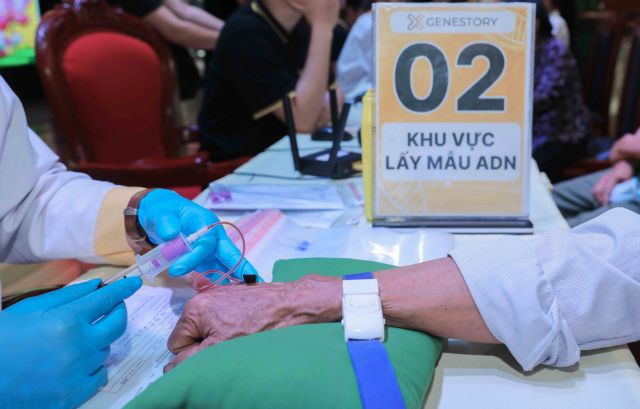 |
| DNA samples are collected under strict procedures to ensure accuracy, traceability and secure handling. VNA/VNS Photo Phan Phương |
A tube of blood collected at a commune hall does not travel directly to a laboratory. Instead, it enters a tightly controlled chain of custody overseen by the Ministry of Public Security.
After collection, samples are transported under strict preservation conditions through a tightly controlled chain of custody before undergoing DNA extraction, sequencing and two independent rounds of verification. Only then are the results uploaded to the National Population Database and the gene bank for future matching.
According to Dương Ngọc Cường, CEO and co-founder of GeneStory, every stage has been designed to guarantee scientific accuracy while protecting personal data.
"To become a secure digital record in the gene bank, every blood sample must go through a highly rigorous technological journey," he said.
From the moment a sample enters the laboratory, names disappear from the process. Technicians see only a barcode attached to a tube no larger than a finger. Every step is digitally recorded and fully traceable, ensuring both data security and scientific accuracy.
"Identity information is only accessible during the initial collection stage. Everyone involved afterwards works only with barcodes, ensuring complete anonymity and protecting personal data," Cường said.
"A single error such as a sample mix-up or contamination could mean missing the opportunity to reunite a soldier missing in action with his right family, or even worse, returning an incorrect result," he added.
Science trumps memory
For decades, Việt Nam's search for fallen soldiers relied on wartime records, veterans' memories and information provided by local residents. However, memories fade, witnesses grow old, documents disappear and former battlefields have changed beyond recognition after half a century.
DNA has changed that equation. Unlike eyewitness testimony, genetic information does not deteriorate with time. Once entered into the gene bank, every DNA profile can continue to be compared with newly recovered remains for years or even decades to come.
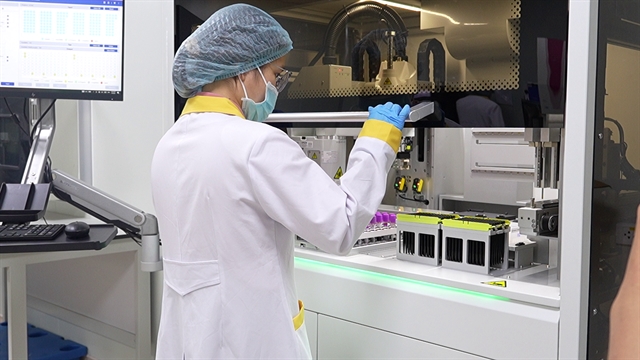 |
| A technician prepares DNA samples collected from relatives of fallen soldiers for analysis. Photo courtesy of GeneStory |
According to Cường, such a nationwide project would have been almost impossible 10 or 15 years ago.
The breakthrough was not simply the result of advances in DNA sequencing technology. It also depended on three foundations that did not yet exist: a unified mechanism for inter-agency coordination, the National Population Database integrated with biometric identification, and the completion of the Vietnamese Genome Project in 2021.
Together, these developments have enabled Việt Nam to carry out a project at a scale that would once have been beyond reach.
Cường described the National War Martyrs' Gene Bank not as a static repository, but as a living, interconnected data ecosystem. Its greatest strength lies in what he called its "network effect".
Because relatives share inherited genetic markers across family lines, every new DNA profile strengthens the broader relationship map.
"Every new DNA sample enriches the genetic relationship map and increases the possibility of matching other unidentified remains already waiting in the system," he said.
The larger the database becomes, the more powerful its matching capability grows.
A family whose DNA produces no match today may receive answers years later as more relatives contribute samples and additional war martyrs' remains are recovered.
Rather than solving one individual case, every new DNA profile expands the possibility of solving thousands more.
Once the 500-day campaign concludes, the gene bank will remain a piece of long-term national scientific infrastructure, enabling every newly recovered set of remains to be automatically compared against an ever-growing database of relatives' DNA.
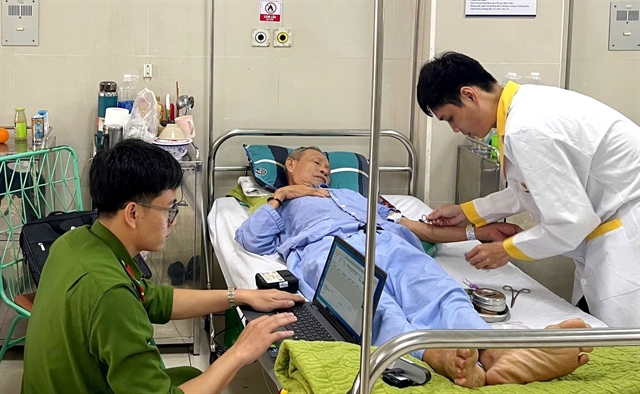 |
| A technician and a police officer collect a blood sample from an elderly relative of a fallen soldier at a hospital bedside in Quảng Trị Province. — VNA/VNS Photo Võ Dung |
Hope beyond the laboratory
For Cường, however, the project is ultimately about people rather than technology. He recalled one collection trip during which his team travelled to the home of a frail 95-year-old mother of a fallen soldier who was too weak to travel.
"After we finished collecting her blood sample, she looked at us with a profound sense of relief, as though she had finally laid down a burden she had carried for more than half a century," he recalled.
"What none of us expected was that only a few hours after we left, her family called to tell us she had passed away peacefully."
The phone call has stayed with him ever since. "If we had arrived just a day later, or even a few hours later, the only remaining maternal genetic link to that fallen soldier would have been lost forever," he explained.
Inside a laboratory, Thế Thị Yến's blood sample will become another digital genetic record. At the gene bank, it will become another thread in a growing network connecting families still searching for answers.
Every new DNA profile added to the Gene Bank creates another possibility that science may one day succeed where memory could not.
For Yến, after nearly six decades of waiting, that possibility is reason enough to keep hoping. — VNS
Society
 Society
 Society
 Society
 Society
 Society
 Society
 Society
 Society
 Society
 Society
 Society
 Society
 Society
 Society