 Society
Preserving heritage and harnessing cultural strength in a new era
1.
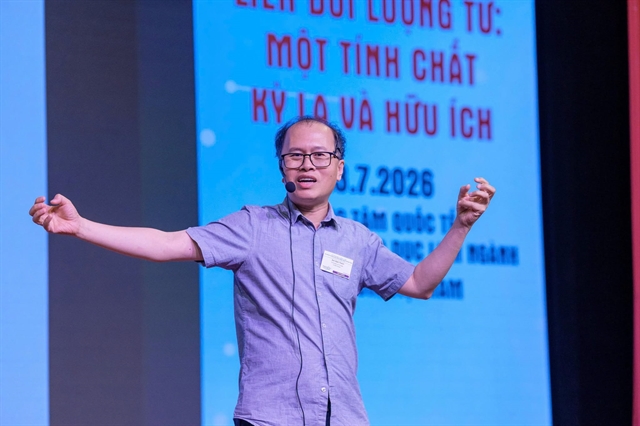 |
| Prof. Đàm Thanh Sơn (University of Chicago, US), recipient of the 2018 Dirac Medal, hosts a public lecture on July 23 at Gia Lai-based ICISE. |
GIA LAI – To develop quantum technology, Việt Nam needs to invest in fundamental science and build a research workforce specialising in quantum physics, materials science, photonics, and atomic physics.
Prof. Đàm Thanh Sơn from the University of Chicago, US, emphasised that at a public lecture hosted by the International Centre for Interdisciplinary Science and Education (ICISE) on July 23.
The lecture entitled "Quantum Entanglement: A Strange and Useful Property" was held as part of the Gia Lai Quantum Year 2026 programme.
Opening his talk, Professor Sơn, recipient of the 2018 Dirac Medal, summarised over a century of the history and development of quantum theory. By weaving in various anecdotes and vivid examples, he made modern physics concepts more accessible to students and young researchers.
Professor Sơn recalled the moment often likened to the "new sun" of modern physics, when German theoretical physicist Werner Heisenberg (1901–1976), winner of the 1932 Nobel Prize in Physics, laid the foundation for quantum mechanics.
“From those foundations, after more than a century of development, quantum mechanics has birthed numerous breakthrough technologies, such as smartphones, solar cells, lasers, and nuclear power,” said Prof. Sơn.
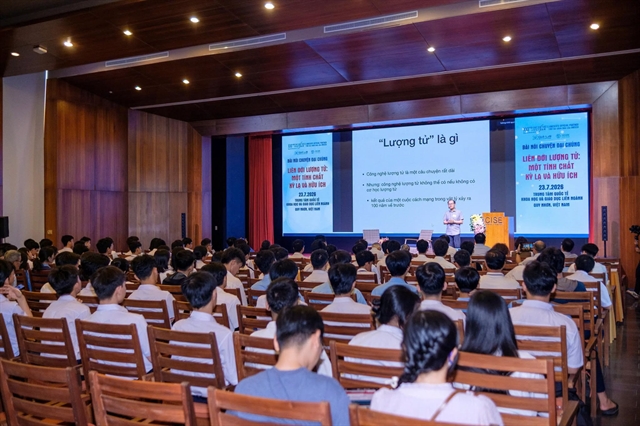 |
| The lecture entitled "Quantum Entanglement: A Strange and Useful Property" was held as part of the Gia Lai Quantum Year 2026 programme. |
During the talks, the professor devoted significant time to analysing quantum entanglement—a unique property of matter regarded as the cornerstone of the "second quantum revolution".
He explained how this phenomenon could unlock new insights into the natural world, ranging from black hole physics to solid-state physics. In conclusion, Prof. Son emphasised that quantum entanglement is a vital property of matter that bridges diverse scientific fields and has the potential to underpin numerous breakthrough technologies in the future.
How can we master quantum technology?
During the talk, Prof. Sơn answered numerous questions and advised students who wish to study quantum physics to first master the foundations of classical physics, mechanics, and electromagnetism, along with core concepts such as the Schrödinger equation and the hydrogen atom.
He also encouraged young people to connect their studies and research with issues of community and social concern, noting that this makes their work more meaningful.
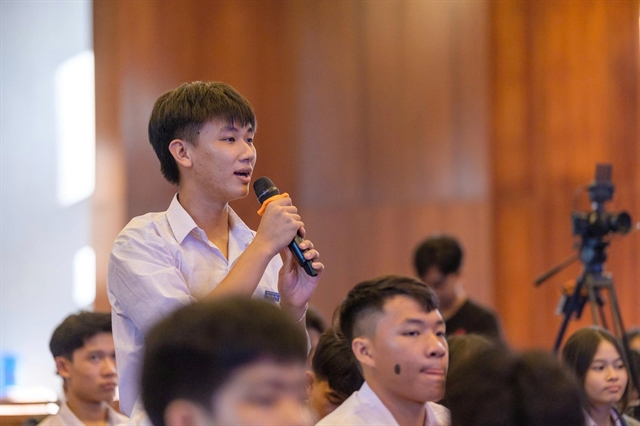 |
| A student raises questions for Professor Đàm Thanh Sơn. |
Responding to a question regarding the future of quantum computing and Việt Nam's potential direction, Prof. Sơn noted that while many countries are pursuing various qubit architectures, he highly regards the development of topological qubits.
He argued that to develop quantum technology, Việt Nam must invest in basic science and build research teams specialising in quantum physics, materials science, photonics, and atomic physics. He emphasised that fundamental research is essential for delving deeper into the mysteries of nature.
The lecture was organised on the occasion of Prof. Sơn's participation as a lecturer in the Second Advanced School on Topological Quantum Matters, held at the ICISE from July 20 to 24.
The lecture attracted more than 300 participants, both in person and online, including students from Lê Quý Đôn High School for the Gifted, Chu Văn An High School for the Gifted, and Hùng Vương High School for the Gifted in Gia Lai, and Lương Văn Chánh High School for the Gifted in Đắk Lắk Province, as well as undergraduate and graduate students, early-career researchers in physics and quantum physics, and members of the public with a strong interest in science. VNS
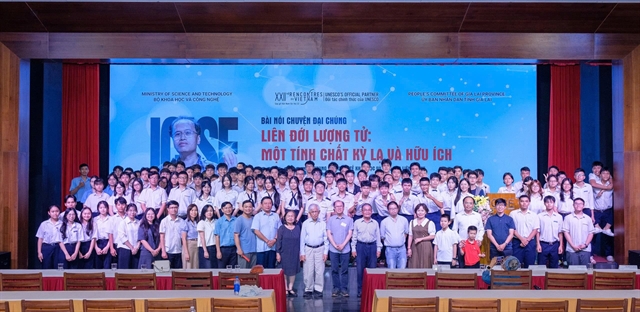 |
| The lecture attracts more than 300 participants, both in person and online. Photos courtesy of ICISE |
Society
 Society
 Society
 Society
 Society
 Society
 Society
 Society
 Society
 Society
 Society
 Society
 Society
 Society
 Society