 Society

Preserving heritage and harnessing cultural strength in a new era
1.
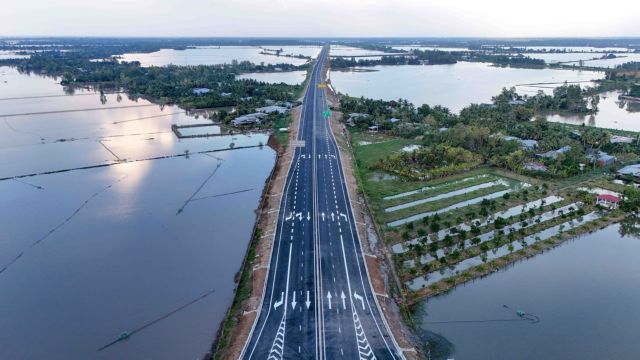 |
| A section of the Cần Thơ - Cà Mau Expressway runs through Vị Thủy Commune in the Mekong Delta city of Cần Thơ. — VNA/VNS Photo Thanh Liêm |
HÀ NỘI — Việt Nam’s revised national road network plan envisages a total of 46 expressways stretching more than 10,000km by 2050.
The adjustment to the plan for the 2021-2030 period was unveiled at a conference organised by the Việt Nam Road Administration on Thursday. Under the revised plan, five additional expressway routes have been added to the national network.
The first route is the Northern Mountain Ring Road, approximately 327km in length, running from Tà Lùng Border Gate in Cao Bằng Province through Lạng Sơn, Thái Nguyên, Tuyên Quang and Lào Cai to Sơn La Province.
This route is divided into seven sections: Tà Lùng-Đông Khê, Đông Khê-Thất Khê, Lạng Sơn-Thái Nguyên, Thái Nguyên-Tuyên Quang, Tuyên Quang-Lào Cai, Lào Cai-Lai Châu and Lai Châu-Sơn La. The expressway is planned as a four-lane route, with investment scheduled after 2030.
Another route is the Northern Midland Ring Road, with a total length of about 378km. It is divided into three sections linking Tân Thanh Border Gate in Lạng Sơn Province with Sơn La Province. The sections comprise Lạng Sơn-Thái Nguyên, Thái Nguyên-Lào Cai and Lào Cai-Sơn La. The Lạng Sơn-Thái Nguyên section will be prioritised for investment before and after 2030, while the remaining sections are planned for implementation after 2030.
The third route is the Hà Tĩnh-Cầu Treo Expressway, approximately 85km long. It consists of two sections: Hà Tĩnh-Hồ Chí Minh Road and Hồ Chí Minh Road-Cầu Treo. The route will have four to six lanes, with investment to be carried out both before and after 2030.
Next is the Huế-A Lưới Expressway, around 45km in length. It is intended to connect the western area of Huế City with the eastern North–South Expressway. The route is planned as a four-lane expressway, with investment scheduled after 2030.
Finally, the fifth route is the Phan Thiết-Bảo Lộc-Gia Nghĩa-Bu Prăng Expressway, approximately 141km long. This route is divided into two sections: Phan Thiết-Bảo Lộc-Gia Nghĩa and Gia Nghĩa-Bu Prăng.
The entire route is planned as a four-lane expressway. The Phan Thiết-Bảo Lộc-Gia Nghĩa section is earmarked for investment before and after 2030, while the Gia Nghĩa-Bu Prăng section is planned for implementation after 2030.
The revised plan also adjusts the scope, investment schedule and scale of several existing expressways, revises the alignment of 12 national highways and transfers 36 national highways to local road management.
Deputy director of the Việt Nam Road Administration Nguyễn Thanh Hoài said at the conference that the national road network plan serves as a strategic framework for the development of the country’s road system.
He said the plan provides the basis for managing and mobilising investment resources, strengthening regional connectivity and linking economic centres, urban areas, border gates, seaports, airports and other major transport hubs.
The revised road network plan also updates land-use requirements and investment capital demand, while allowing localities to take the initiative in investing in routes scheduled for post-2030 implementation if they are able to balance and allocate resources and assume responsibility for investment efficiency.
“This is an important basis for localities to become more proactive in infrastructure development and regional connectivity,” Hoài said.
He stressed that the plan would only realise its full value if implemented in a serious, synchronised manner in line with available resources.
The administration therefore requires ministries, agencies and local authorities to review and update relevant provincial master plans and other planning documents, while strictly managing land reserves, road safety corridors and development space reserved for planned routes.
Local authorities were asked to strengthen coordination in determining investment priorities, mobilising and efficiently using lawful funding sources and carrying out key projects that enhance regional connectivity and integration between different modes of transport.
For national highways transferred to local management, relevant agencies are required to coordinate the updating of planning documents, handover and reception procedures, and management arrangements in accordance with regulations, while ensuring uninterrupted and safe operation, maintenance and upkeep without affecting projects already being carried out.
The administration will continue working closely with relevant agencies and local authorities to organise implementation of the revised road network plan, while regularly monitoring progress, identifying difficulties and reporting them promptly to authorities for consideration and resolution. — VNS
Society
 Society
 Society
 Society
 Society
 Society
 Society
 Society
 Society
 Society
 Society
 Society
 Society
 Society
 Society