 Society
Việt Nam highlights UNESCO’s role in promoting peace, inclusive development
1.
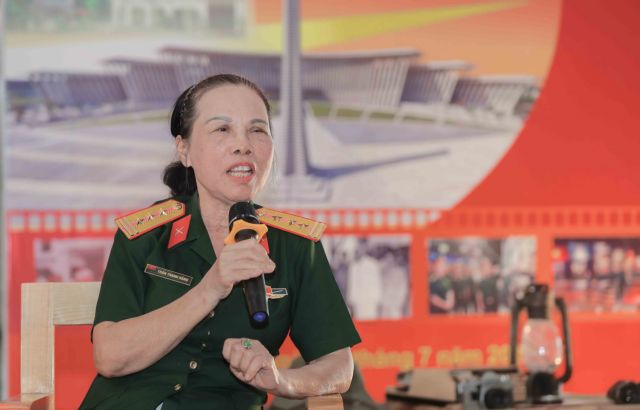 |
| Colonel Trần Thanh Hằng participates in a dialogue with youths in a ceremony to mark the 79th Anniversary of War Invalids and Martyrs’ Day (July 27, 1947 – July 27, 2026). — VNA/VNS Photo Tiến Long |
HÀ NỘI — Colonel Trần Thanh Hằng has been retired for many years, yet her stories and memories of her illustrious career remain as vivid as if it were yesterday.
Hằng, 73, a former staff member at the Việt Nam Military History Museum, speaks with enthusiasm about trips she made to collect historical artefacts, unforgettable encounters and – above all – the love and dedication she devoted over 30 years to gathering wartime objects.
The greatest difficulty in collecting items was not the long journeys or lack of resources, but persuading families to donate their sacred keepsakes, Hằng said.
“For them, each object is tied to memory and to deceased loved ones. Especially for families of martyrs, the possessions of their child who sacrificed their life are sacred. On many trips we returned with nothing,” she said.
Memories
Hằng recalled one visit to a naval rear admiral’s house to request an artefact. She had walked under a scorching sun to meet the rear admiral, who was immediately suspicious.
“When I showed the museum’s introduction letter, he insisted it was a forgery,” she said.
Not only did he refuse the request, but he also alerted the Naval Veterans’ Association that someone was impersonating soldiers to solicit keepsakes. Within a single morning, the rumour spread, and the museum’s naval artefact collection efforts there were nearly halted.
Undeterred, Hằng sought help from the HCM City Veterans’ Association and was introduced to Rear Admiral Nguyễn Dưỡng.
“I called him and said: ‘We’ve come from Hà Nội to collect naval artefacts but have met many obstacles; we hope you can help.’ He asked where we were and invited us to his home at 7pm,” she said.
By then she and Lieutenant Vũ Văn An had been in HCM City for over two weeks and were nearly out of funds. To save money, they had to share a single motorbike taxi.
“When we were a few houses away from Rear Admiral Nguyễn Dưỡng’s home, we got off the motorbike taxi. To our surprise, he was waiting at the gate. He awkwardly asked: ‘Why are you only using one vehicle?’ We frankly said we were on a long mission and had run out of money, and we had to save so we could return to Hà Nội,” Hằng recalled.
Moved by their situation, Dưỡng agreed to donate items to the museum. Before they left, he kindly gave Hằng a parcel of cakes and said: “Take these home for your children, as a gift from me.”
For Hằng, the simple gift was a great encouragement that renewed her and her colleagues’ resolve to continue seeking and preserving wartime memories.
“On subsequent visits to HCM City, he personally accompanied us to meet former senior commanders to encourage donations,” she said about Dưỡng with a smile.
Thanks to Dưỡng’s introductions, Hằng visited Rear Admiral Nguyễn Bá Phát, former Commander of the Navy.
His son, Nguyễn Bá Tài, donated the watch that President Hồ Chí Minh had given his father in 1957. The back of the watch case is engraved with three Chinese characters: ‘Hồ Chí Minh’. This artefact is now on display at the Việt Nam Military History Museum.
Another memory Hằng cherishes is a visit to meet Major General Phi Long, former deputy director of the Operations Department of the General Staff.
Even with an introduction, the general at first refused to receive them.
“The three of us sat on the veranda from morning until noon. The heat was like molten iron. The driver said: ‘This collecting work is too hard. If they won’t let us in, we should go back.’ Our young colleague complained that his back was burning,” she said.
At that moment the general’s daughter-in-law returned home. Taking advantage of the opportunity to pay respects at the altar to her recently deceased son, the team resumed the conversation.
“Seeing our persistence, the general said: 'You are patient, well done',” she recounted.
In the end, he donated a reel-to-reel recorder used to document meetings of the Hồ Chí Minh Campaign Command, including the historical campaign debriefing held in Đà Lạt.
Great joy
Despite many hardships, Hằng’s greatest joy was bringing artefacts back to the museum.
She said that on days they secured an item, she would happily go out to eat; but on days they returned empty-handed, she felt so down she did not want to eat.
In 2002 the museum assigned her to lead a project to collect artefacts related to generals of the Việt Nam People’s Army. Recognising its special significance, she and colleagues travelled nationwide, reaching Hà Nội, HCM City, Đà Nẵng, Cần Thơ and Lạng Sơn, to meet generals and Heroes of the People’s Armed Forces.
This collecting trip yielded many valuable items. General Hoàng Cầm donated a vase crafted from parts of a B-52 bomber shot down by Hà Nội residents in 1972, along with the uniform he wore during major campaigns, notably the Hồ Chí Minh Campaign. Both items are preserved and exhibited at the Việt Nam Military History Museum.
After more than three decades devoted to collecting artefacts, Colonel Hằng has endured countless arduous missions. For her, every hardship was worthwhile because she said the greatest happiness is seeing private memories entrusted to the nation to become part of the people's shared memory, preserving history through tangible evidence. — VNS
Society
 Society
 Society
 Society
 Society
 Society
 Society
 Society
 Society
 Society
 Society
 Society
 Society
 Society
 Society