 Society
Việt Nam gives top priority to relations with Laos: PM
1.
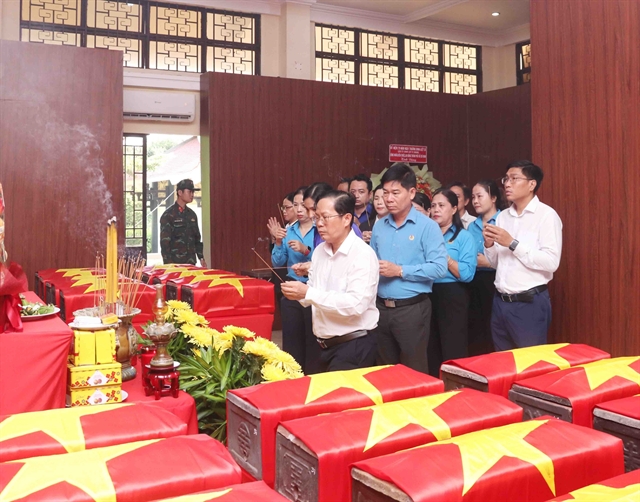 |
| Representatives of all walks of life in HCM City offer incense at the memorial house in Lê Thị Riêng Cultural Park, where the recently recovered war martyrs' remains are kept, on July 13. — VNA/VNS Photo |
HCM CITY —Nearly six decades ago, the 1968 Tết Offensive and General Uprising left countless liberation fighters missing in action on the northern outskirts of Sài Gòn. Today, the search for their remains is bringing a new and long-awaited hope to families who have spent generations waiting for news of their loved ones.
As of July 18, a total of 100 sets of war martyrs' remains and two collective sets of martyrs' remains, each containing the remains of several people, along with a number of associated personal belongings, had been discovered at a park in Hoà Hưng Ward, according to the HCM City Steering Committee for the Search, Recovery and Identification of War Martyrs' Remains.
The search is part of the nationwide "500-Day Campaign" to accelerate the search, recovery and identification of fallen soldiers' remains, which runs until July 27, 2027, the 80th anniversary of War Invalids and Martyrs' Day.
According to the city's search and recovery authorities the search at Lê Thị Riêng Cultural Park, formerly City Cemetery, is based on years of research led by Nguyễn Xuân Thắng, a member of the Việt Nam Association for Supporting War Martyrs' Families.
By analysing photographs, satellite images, military maps and historical records from domestic and overseas sources, his team concluded that the former Sài Gòn administration used the cemetery before 1975 to bury liberation soldiers and patriotic civilians killed during the 1968 Tết Offensive.
The cemetery, once one of Sài Gòn's largest burial grounds, was cleared between 1978 and 1983 to make way for the park, with land-filling obscuring many graves.
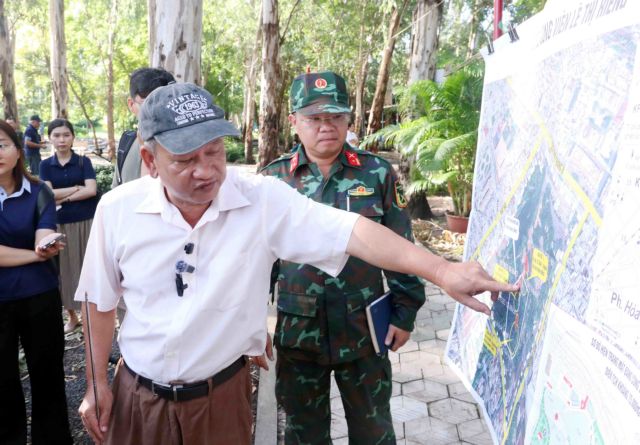 |
| Architect Nguyễn Văn Thắng, a member of the Việt Nam Association for Supporting War Martyrs' Families, points out areas for survey to locate suspected mass gravesites of fallen soldiers at Lê Thị Riêng Cultural Park on June 15. — VNA/VNS Photo |
Tracing the missing
In late May and early June, authorities appealed for witnesses and held a workshop to verify information on suspected burial sites.
Experts believe the park may still contain three mass grave trenches holding the remains of about 900 liberation soldiers who died during the 1968 Tết Offensive.
Major General Trần Chí Tâm, deputy political commissar of Military Region 7, said the suspected burial sites were identified by combining historical documents, field surveys and information provided by witnesses.
Before excavation began, authorities examined three suspected sites using ground-penetrating radar, electrical resistivity equipment, positioning devices and other geophysical methods.
Senior Lieutenant General Nguyễn Văn Gấu, deputy minister of National Defence, said that while ground-penetrating radar was used to scan the entire search area, relevant agencies were also reviewing and standardising lists of martyrs, military unit designations and operational areas during the 1968 campaign to support future identification work.
The city began exploratory excavation in late June, using a combination of manual and mechanical methods.
After two days of digging, the search team discovered a burial trench measuring about 25 metres long and three metres wide.
The search team found the first five sets of human remains with numerous personal belongings, including military ponchos and hammocks that had remained buried for nearly six decades.
For those directly involved in the operation, discovering the first remains was unforgettable.
Recalling the discovery, Lieutenant Colonel Lê Ngọc Hà, an officer from Team K74 under the HCM City High Command, said everyone involved was deeply moved.
"It was an overwhelming moment. The emotions were impossible to describe," he said.
Recovering war martyrs' remains was both an official duty and "a mission from the heart" for every officer and soldier in his team, he said.
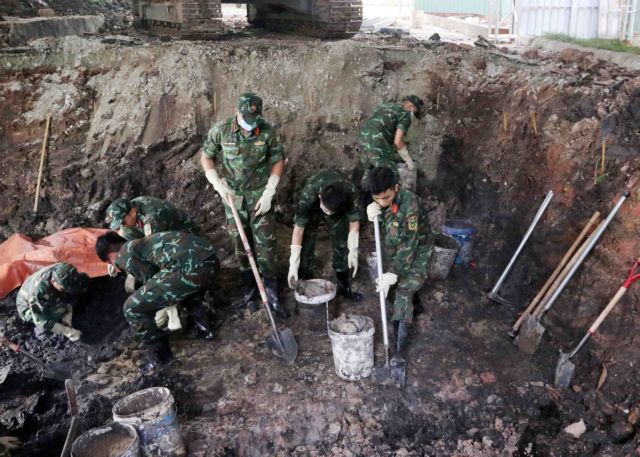 |
| Search and recovery personnel work carefully and urgently to locate the remains of soldiers reported missing in action. — VNA/VNS Photo |
On July 6, HCM City held a ceremony to launch the search and recovery operation at Lê Thị Riêng Cultural Park, marking the transition from information verification to full-scale field excavation.
Speaking at the ceremony, Prime Minister Lê Minh Hưng said searching for, recovering and identifying the remains of fallen soldiers remained a major political task that embodies Việt Nam's traditions of gratitude and remembrance, as well as the responsibility of today's generations towards those who gave their lives for the country.
"For many martyrs' families, the war has never truly ended because they are still waiting for information about their loved ones, who were reported missing in action. We must make every possible effort to bring our fallen heroes back to their families and hometowns," he said.
Families still waiting
For many veterans and war martyrs' relatives, the search at Lê Thị Riêng Cultural Park is more than a political operation. It represents a hope that has endured for decades.
At 82, Trần Văn Bản, a former military doctor, still works as a volunteer daily at the park, helping classify recovered remains, collect DNA samples and identify fallen soldiers.
After nearly six decades, most remains had decomposed and become mixed with soil and sand, making identification a painstaking task that requires experience and great care, he said.
To him, every fragment of remains represents a fallen soldier who deserves the chance to return to their family.
Bản has spent nearly half a century searching for the remains of fallen soldiers to fulfil a promise he and his comrades made before they went into battle – to bring them home to their families.
He hopes the remaining soldiers buried at the park will soon be found and identified.
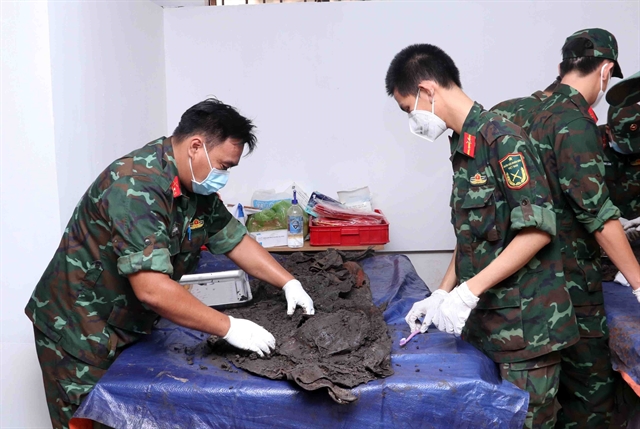 |
| Layers of decayed fabric are carefully removed in the search for reported fallen soldiers' remains and personal belongings. — VNA/VNS Photo |
Hope of identifying one of the first martyrs recovered at the park has grown after a military transfer document was found inside a wallet with the remains.
Authorities have provisionally identified a set of remains as Huỳnh Văn Quên, a soldier with Long An Battalion 1 of the South Việt Nam Liberation Army.
On July 6, after learning of the discovery through media reports, Huỳnh Văn Nhỏ, from Tây Ninh Province’s Vàm Cỏ Commune, contacted the authorities, believing the remains could be those of his eldest brother.
The following day, Nhỏ and his elder brother Huỳnh Văn Mười provided DNA samples for comparison with those taken from the remains. The analysis is still under way.
On July 13, Nhỏ’s family travelled to the park to offer incense to the martyr they believe to be their eldest brother and his comrades.
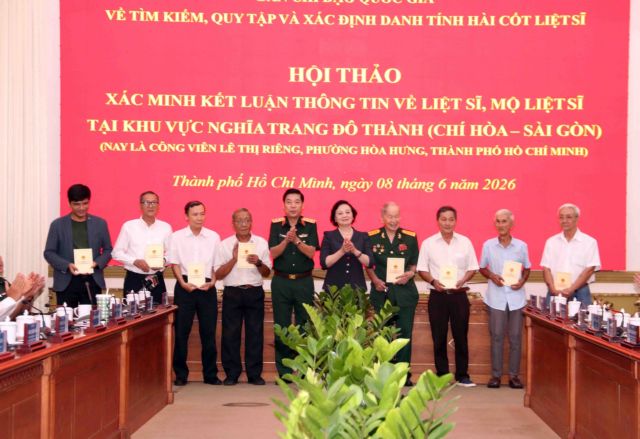 |
| Deputy Prime Minister Phạm Thị Thanh Trà, head of the National Steering Committee for the Search, Recovery and Identification of War Martyrs' Remains, honours witnesses and technicians who provided information on reported fallen soldiers at Lê Thị Riêng Cultural Park on June 8. — VNA/VNS Photo |
To mark the 79th anniversary of War Invalids and Martyrs' Day (July 27, 1947–2026), Communist Party General Secretary and State President Tô Lâm offered flowers and incense at Lê Thị Riêng Cultural Park on July 17, before visiting personnel involved in the search for and recovery of war martyrs' remains.
Speaking with the search team, he said: "Every set of war martyrs' remains recovered today is not only the result of professional efforts, but also the return of a son or daughter to the nation and their family."
He called for greater co-ordination and the mobilisation of all available resources, including advanced technologies and international cooperation, to accelerate the search for, recovery and identification of those reportedly missing in action.
The search at the park is continuing, despite the challenges posed by decades of changes to the landscape and the disappearance of many traces over time.
However, confidence is growing that more fallen soldiers will finally be identified and brought home. — VNS
Society
 Society
 Society
 Society
 Society
 Society
 Society
 Society
 Society
 Society
 Society
 Society
 Society
 Society
 Society