 Society
HCM City honours fallen soldiers with solemn musical tribute
1.
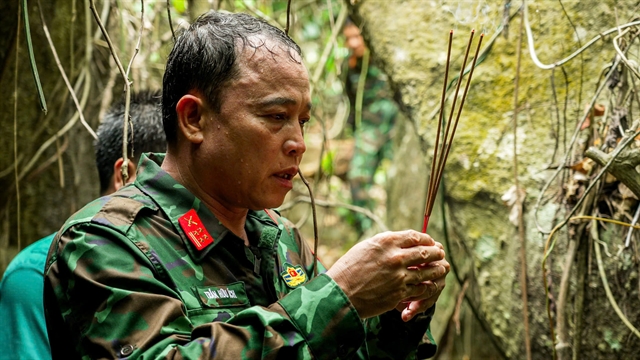 |
| Colonel Trần Hữu Ích, who oversees the excavation at Đá Sập Cave in Hà Nha Commune, Đà Nẵng, offers incense in honour of fallen soldiers. — Photo courtesy of Nguyễn Thanh Phong |
By Công Thành, Thanh Thủy, Thanh Phong
ĐÀ NẴNG — For nearly six decades, the remains of fallen soldiers have lain beneath cemeteries and former battlefields across Việt Nam, their names lost to time.
Now, as a 500-day nationwide DNA identification campaign gathers pace, search teams are racing against time to recover the remains and return them to the families who have waited for them for generations.
Search Team 584 under Quảng Trị Military Command has been working hard at National Road 9 War Martyrs’ Cemetery to collect biological samples from the remains of fallen soldiers for DNA identification.
They spend time digging up bone fragments buried in the tombs of unknown soldiers to send to the Ministry of Health for DNA identification.
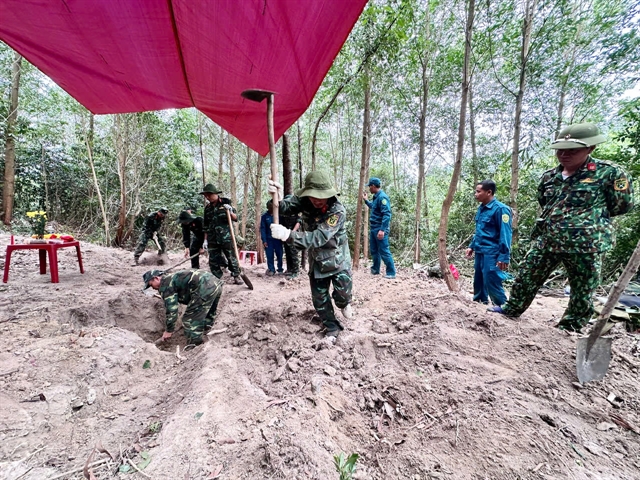 |
| Soldiers from a war martyr-searching team in the Central Highlands province of Đắk Lắk begin an excavation at a former battlefield. — Photo courtesy of Hoài Thu |
“It’s so urgent, but we must carefully select every bone fragment from the remains of war martyrs buried for decades. The search requires only bones that can be used for examinations at labs before the final results of the DNA identification process,” said Captain Nguyễn Văn Hùng, a political officer of the team.
“All members of the team acknowledge the importance of the mission with honour and respect for the war martyrs. We make every effort to work quickly while handling the remains with care to achieve the best possible identification results,” he added.
Lieutenant Colonel Nguyễn Thanh Liêm, head of the team, explained that the collection would require manual work to handle bone fragments from thousands of nameless graves.
“We must identify teeth and dense bone fragments suitable for maternal-line genetic identification. It’s not easy, as almost all the remains have been buried for at least 40 years,” Liêm explained.
Liêm said the team had collected 2,771 samples for maternal DNA testing since the beginning of the campaign in Quảng Trị, but more efforts were needed in identifying the names of the fallen soldiers.
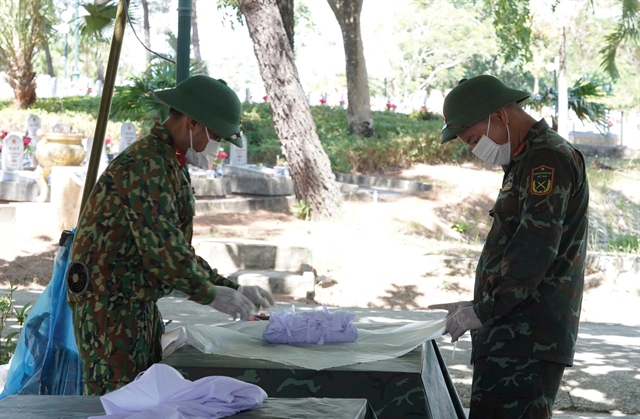 |
| Two soldiers collect bone fragments from the tomb of an unknown soldier for gene testing. — Photo courtesy of Thạch Hãn |
Expanding the search
In Đà Nẵng City, a 54-member team was formed to search more than 26,000 tombs of unknown soldiers at 144 cemeteries for the 500-day DNA testing drive.
So far, the team has taken 753 samples from 1,776 tombs at 19 cemeteries, according to a report from the city’s Military Command.
The team has also begun searching for war martyrs who were buried in Đá Sập Cave in the rural mountainous Hà Nha Commune after being killed in bombardments in 1969, as part of the 500-day campaign.
Colonel Trần Hữu Ích, commander of the city’s Military Command, said eight sets of remains of fallen soldiers had been found, but more tests were needed to identify the names of each one.
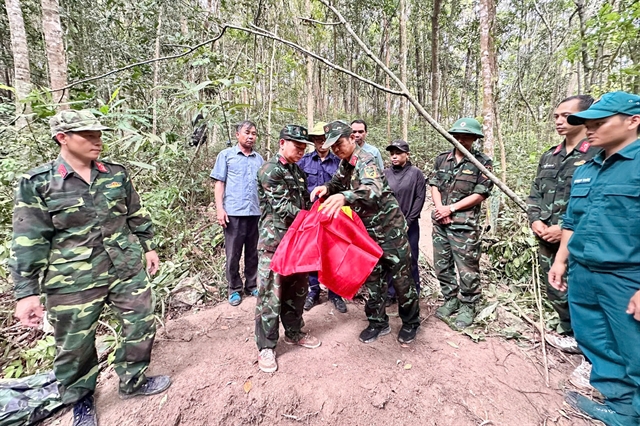 |
| A memorial service is organised in honour of a war martyr whose remains have been found in the jungle. — Photo courtesy of Hoài Thu |
The cave, situated in Sơn Gà Mountain, was a key logistics centre for multiple military divisions of the South Vietnam Liberation forces. But the cave collapsed after fierce bombings by the US-Saigon forces on April 25, 1969, burying many people.
“It’s a tough job as landmines and unexploded ordnance have yet to be cleared, while the structure of the cave has weakened over the years," Ích said.
The team initially discovered various belongings of the fallen soldiers, including sandals, raincoats, pieces of parachute cloth, unfused shells and cartridges scattered in the cave.
“We’ll do what we can to restore the names of all the war martyrs in the cave. They died for the country’s peace, and the young generations are duty-bound to take them home in honour,” he said.
Searching against time
In the Central Highlands region of Đắk Lắk, Team K51 was responsible for locating the remains of 270 fallen soldiers in the region as part of the nationwide campaign.
Colonel Đỗ Văn Thiệu said information about people missing in action had gradually become limited, as most of them died long before 1975, while witnesses had often also passed away.
He also said makeshift graves in the battlefields were either cleared or displaced for construction works in the following years.
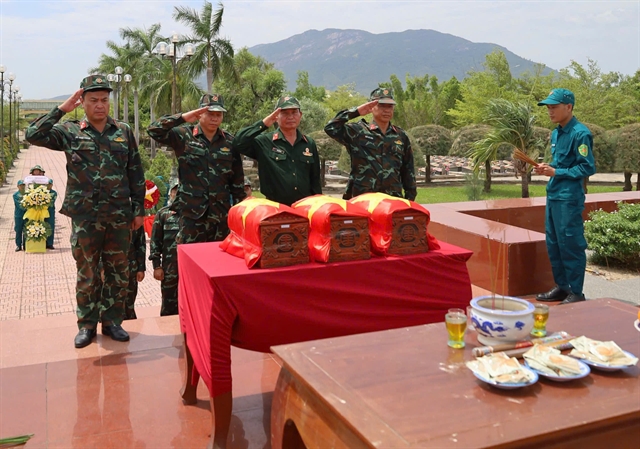 |
| A memorial ceremony for three war martyrs is held in central Việt Nam. — Photo courtesy of Phan Sáu |
“The team luckily found two sets of remains of war martyrs based on information provided by wartime liaison agent Sô Hỗn, 96, in Phước Tân Village,” he said.
He emphasised that the team would keep searching for vestiges of those missing in action despite the limited information during the campaign.
Colonel Đinh Văn Hưng, political commander of Đắk Lắk Military Command, said the 500-day campaign was a key task for young soldiers to honour the noble sacrifice of war martyrs during the wars.
Young soldiers would overcome difficulties posed by time and terrain to find remains of fallen soldiers and repatriate them to their families, Hưng said.
Team K51, in joint action with other teams, had helped repatriate remains of 769 fallen soldiers from Mondulkiri, Cambodia to local cemeteries since 2000, he added. In the past year alone, it found and took samples from 27 sets of remains of martyrs for DNA testing.
A report by the provincial Department of Home Affairs notes that 10,300 sets of remains of war martyrs had been repatriated to their home cemeteries.
The campaign is being rapidly carried out at former battlefields in Ba Gia, Ialy, Đắk Tô, Ia Chim and Sa Bình.
Bringing back the names of unknown soldiers and those whose personal information remains unclear would be the top priority, Lieutenant Colonel Nguyễn Thanh Liêm of Team 584 said.
“We are racing against time to search and recover the remains of war martyrs and take them home after nearly half a century of lying elsewhere. We’ll do all we can for their soul to rest in peace.” — VNS
Society
 Society
 Society
 Society
 Society
 Society
 Society
 Society
 Society
 Society
 Society
 Society
 Society
 Society
 Society




