 Economy

Việt Nam to develop a national programme to boost maritime industry
1.
|
|
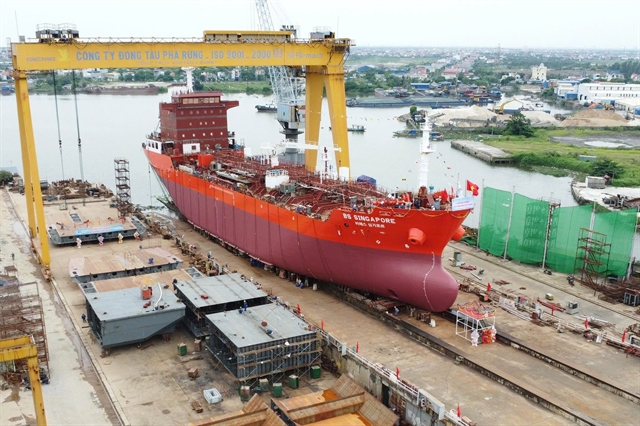
| A vessel being launched at Phà Rừng Shipbuilding Company Limited. — VNA/VNS Photo Hoàng Ngọc |
HÀ NỘI — Việt Nam will develop a national programme for the maritime and marine engineering industries through 2035 as part of the effort to strengthen domestic industrial capacity and build a modern, competitive and self-reliant maritime industry.
Under Decision 2089/QĐ-TTg, signed by Permanent Deputy Prime Minister Phạm Gia Túc, the Government seeks to address existing difficulties and bottlenecks, mobilise resources and make more effective use of the industry's existing capabilities.
Key challenges to be tackled include those relating to institutions, mechanisms, policies, markets, science and technology, personnel and finance to lay the groundwork for modern, coordinated and self-reliant industrial development.
Priorities will be placed on reviewing and classifying national industrial capabilities, improving the institutional and policy framework and strengthening financial, credit, guarantee and insurance mechanisms.
The plan is also aimed at restructuring the maritime industrial market, developing a modern, green and digital industrial ecosystem, promoting international cooperation and investment, supporting businesses in joining global value chains, developing dual-use defence and security industries and establishing key maritime industrial centres and clusters.
Specifically, it calls for improvement of financial, credit, guarantee and insurance mechanisms suited to the particular characteristics of the shipbuilding industry, especially large shipbuilding, repair and conversion contracts that involve lengthy implementation periods, substantial capital requirements and considerable risks.
The Government will also improve mechanisms for mobilising resources from the State budget, corporate capital, credit, capital markets, public-private partnerships and other lawful sources.
Under the plan, several key maritime and marine engineering industrial centres and clusters will be established based on advantages in geographical location, natural conditions, infrastructure, workers and business capabilities, which will be closely linked with seaports, inland waterway ports, logistics networks, supporting industries and related manufacturing sectors.
It also encourages the development of centres specialising in the repair, conversion, dismantling and recycling of watercraft under a circular economy model.
The plan also calls for stronger regional connectivity and the mobilisation of resources to develop an integrated national maritime industrial ecosystem. — VNS
Economy
 Economy
 Economy
 Economy
 Economy
.jpg) Economy
 Economy
 Economy
 Economy
 Economy
 Economy
 Economy
 Economy
 Economy
 Economy