 Society
Việt Nam, Singapore promote cooperation through Party-to-Party channel
1.
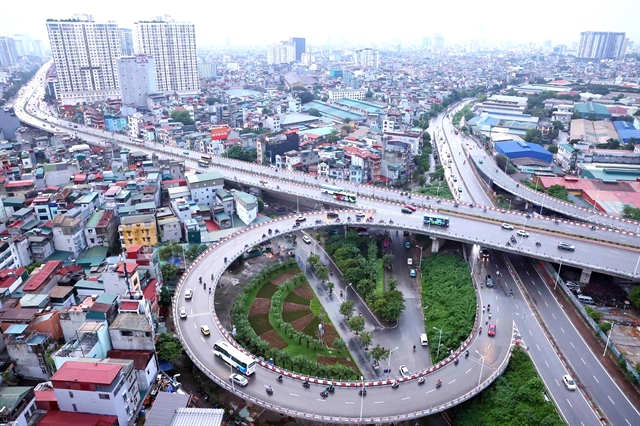 |
| Vehicles on Ring Road 2 in Hà Nội. — VNA/VNS Photo |
HÀ NỘI — Hà Nội must make a greater effort in the second half of this year to fully achieve its 2026 development goals.
Secretary of the Hà Nội Party Committee Trần Đức Thắng said the city must act with a spirit of innovation and ambition to meet all 26 socio-economic targets for this year.
These include achieving gross regional domestic product (GRDP) growth of 11 per cent, increasing exports by 12 per cent, keeping inflation below 4.5 per cent and urban unemployment below 3 per cent, raising the proportion of trained workers to 75.8 per cent and ensuring that every resident receives at least one free routine health check-up or disease screening each year.
Thắng also told Party committees at all levels to uphold the principle of comprehensive leadership in carrying out political tasks.
Responsibilities should not simply be delegated to local authorities; Party organisations and Government agencies must share accountability for all matters under their jurisdiction, he said, adding that Party secretaries at every municipal level will be held accountable for the performance of their localities and agencies.
The Party secretary called on the municipal People's Committee and relevant departments to review growth scenarios and accelerate ongoing projects to achieve the city's 11 per cent growth target for this year.
At the same time, the city must identify major flagship projects capable of laying the foundations for double-digit economic growth in 2027 and beyond, Thắng said.
The city also aims to accelerate industrial development, the digital and green economies, innovation and science and technology; ensure the effective implementation of investment commitments; press ahead with sweeping administrative reforms; improve the investment and business environment; and eliminate bureaucratic red tape that could undermine investor confidence.
He told Party organisations and their leaders to implement the directives of Party General Secretary and State President Tô Lâm on building a high-quality cadre corps, stressing that officials who avoid responsibility, fear making mistakes, shy away from challenges or pass responsibility to others must be replaced without delay.
"The city cannot allow individuals who lack competence, courage or the willingness to act to remain in leadership and management positions within the system," he said.
Along with stricter accountability, the city will encourage and protect officials who demonstrate initiative, embrace innovation and take responsibility for the common good.
“Performance evaluations will be based on concrete results, practical effectiveness, public satisfaction and professional credibility among colleagues and the public,” Thắng said.
Chairman of the Hà Nội People's Committee Vũ Đại Thắng said that with its pivotal role in the national economy, the city remains firmly committed to achieving GRDP growth of at least 11 per cent this year and will not lower its target.
He added that the second half of the year must witness acceleration and breakthrough, with all available resources mobilised to fulfil the goals that have been set.
GRDP expands 8.22% in H1
The city’s GRDP rose by 8.22 per cent, while the State budget revenue reached around VNĐ410 trillion (US$15.6 billion), exceeding 62 per cent of the annual target, during the first six months of this year.
Public investment disbursement totalled approximately VNĐ64 trillion ($2.5 billion), equivalent to more than 53 per cent of the plan assigned by the Prime Minister.
Industry, trade, services and tourism all continued to recover, while the investment climate improved further.
Progress was also maintained in culture, education, healthcare and social welfare, with national defence, security and public order remaining stable.
The city also completed the restructuring of its political system following elections for the 16th National Assembly and People's Councils at all levels for the 2026-2031 term.
Administrative restructuring reduced the number of villages and residential groups from 5,473 to 2,729.
At the same time, the city moved swiftly to implement the 2026 Capital Law through a comprehensive package of resolutions and decisions that took effect on July 1.
The city also unveiled its 100-year Master Plan, establishing a new institutional framework and long-term spatial vision for future development.
Despite these achievements, city leaders acknowledged that progress has yet to match the city’s full potential and competitive advantages, and remains insufficient to support sustained double-digit growth.
While progress has been made in addressing longstanding bottlenecks, implementation remains uneven.
In some areas, responses to concerns raised by businesses and residents have been slow, leaving considerable pressure to meet the city's ambitious targets for the remainder of the year. — VNS
Society
 Society
 Society
 Society
 Society
 Society
 Society
 Society
 Society
 Society
 Society
 Society
 Society
 Society
 Society